
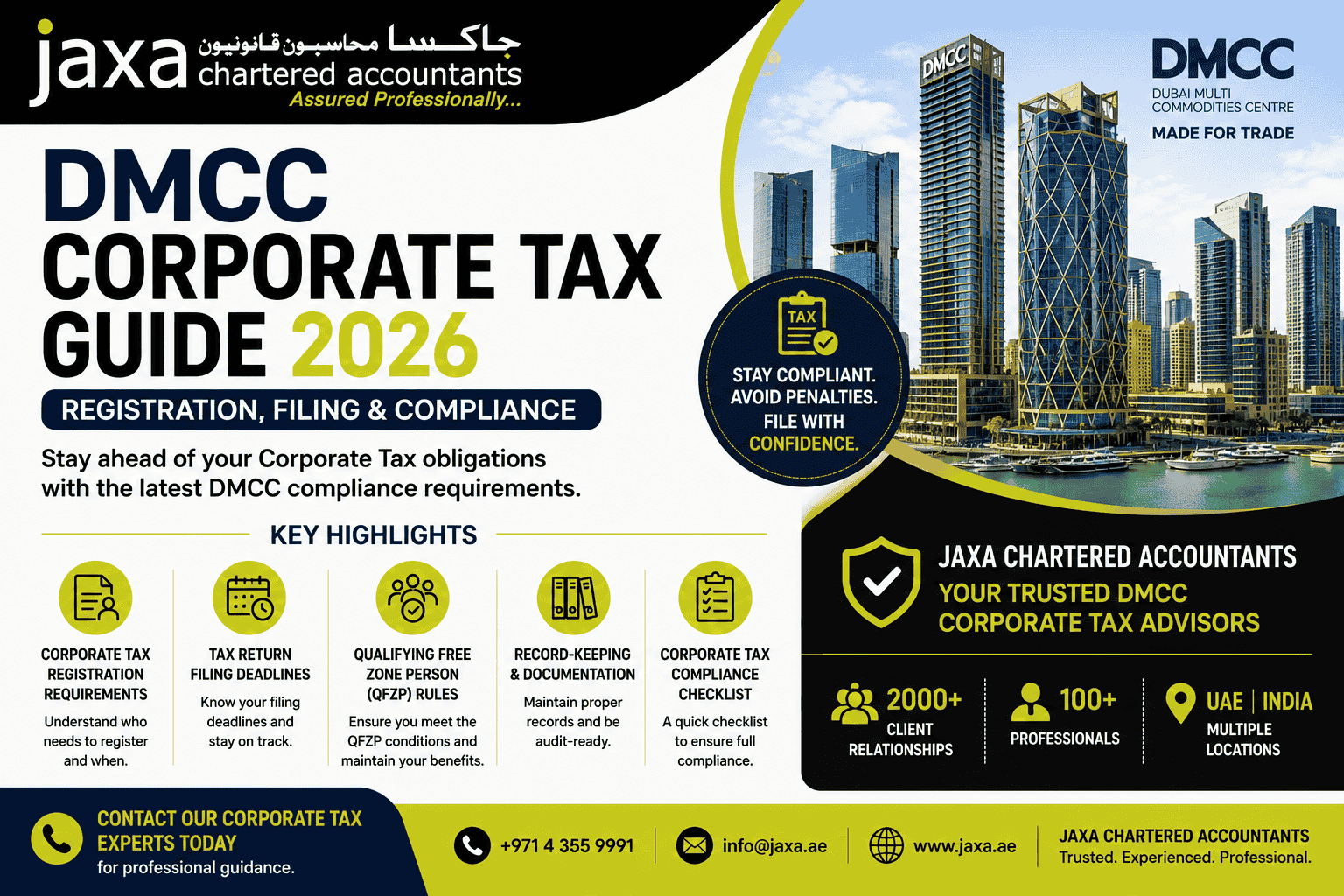

The introduction of the UAE corporate tax regime has changed the tax landscape for businesses operating across the country, including those established in the Dubai Multi Commodities Centre (DMCC). As one of the UAE’s leading Free Zones, DMCC continues to attract investors with its strategic location and business-friendly environment. Understanding the applicable corporate tax rules, registration requirements, filing obligations, and compliance responsibilities in the UAE is essential for maintaining regulatory compliance.
To maintain eligibility for the Free Zone corporate tax incentive, DMCC companies should understand corporate tax obligations, register corporate tax with the UAE FTA, maintain proper financial records, assess their eligibility for QFZP status, and comply with all filing and reporting requirements under UAE corporate tax law. Non-compliance with corporate tax registration, filing and record-keeping requirements may expose DMCC companies to penalties and increased regulatory scrutiny.
Whether you are setting up a new company or an existing business in DMCC, this guide outlines the key corporate tax registration, filing, QFZP eligibility and compliance requirements to help you remain compliant in 2026.
What is DMCC?
The Dubai Multi Commodities Centre (DMCC) is a government-established free zone in Dubai that supports business across a wide range of industries. The DMCC is one of the UAE’s largest and most prestigious free zones, strategically located in Jumeirah Lakes Towers (JLT), Dubai. Today, DMCC provides a world-class business environment for companies operating in commodities, technology, finance, energy, professional services, and other industries. With over 26,000 registered businesses, DMCC continues to strengthen Dubai’s position as a leading global business destination.
While DMCC offers significant business advantages, 100% foreign ownership, modern commercial infrastructure, flexible licensing options, and access to global markets, companies established in the free zone remain subject to the UAE corporate tax regime. To benefit from a 0% corporate tax rate on qualifying income, businesses must meet the conditions to qualify as a Qualifying Free Zone Person (QFZP) and comply with the ongoing requirement under the UAE corporate tax law.
Does UAE corporate tax apply to DMCC companies?
Yes, DMCC companies are generally within the scope of the UAE corporate tax regime and are subject to the provisions of the UAE corporate tax law.
However, the applicable tax treatment depends on whether the company qualifies as a Qualifying Free Zone person (QFZP) and continues to meet the prescribed conditions.
A QFZP may benefit from:
- 0% corporate tax on qualifying income
- 9% corporate tax on taxable income that does not qualify for the 0% rate, in accordance with the UAE corporate tax law.
For DMCC businesses that do not qualify as a QFZP, the standard UAE corporate tax rates generally apply, with 0% on taxable income up to AED 375,000 and 9% on taxable income exceeding AED 375,000 as per UAE corporate tax law.
Regardless of whether a DMCC company qualifies as a Qualifying Free Zone Person (QFZP), it must comply with the applicable UAE corporate tax requirements, including registration with the UAE FTA, maintaining proper accounting records, fulfilling corporate tax filing obligations, within the stipulated deadlines.
UAE Corporate tax registration for DMCC companies
DMCC companies that are required to comply with the UAE corporate tax rate must register for corporate tax through FTA’s Emaratax portal. Businesses are required to complete their registration electronically through the Emara Tax portal by submitting accurate license information and supporting documents to the UAE FTA. Completing the UAE corporate tax registration accurately within the applicable deadline is an essential compliance requirement.
To ensure a smooth registration and ongoing compliance process, businesses:
- Complete UAE corporate tax registration through the Emiratax portal
- Verify that their trade license and business activities are accurate and up-to-date.
- Maintain proper books of accounts and supporting documentation.
- Prepare audited financial statements where required under the UAE corporate tax law and DMCC regulations.
- Engage a DMCC-approved auditor such as Jaxa Auditors, to conduct the statutory audit, where applicable
- Maintain accurate company records with both DMCC and FTA regulations, while fulfilling corporate tax filing and reporting obligations.
Proper bookkeeping and audited financial statements not only support corporate tax compliance but are also necessary for companies seeking to benefit from the Qualifying Free Zone Person(QFZP) regime.
As a DMCC-approved auditor and UAE FTA registered tax agency, Jaxa Auditors assists DMCC businesses with corporate tax registration, statutory audits, bookkeeping, financial reporting and ongoing corporate tax compliance, helping businesses meet both DMCC and FTA requirements.
Who must register for UAE corporate tax in DMCC?
Companies established in the Dubai Multi Commodities Centre (DMCC) that are within the scope of the UAE corporate tax law are required to register for corporate tax as per the UAE FTA through the Emaratax portal.
Registration is a mandatory compliance requirement and applies irrespective of whether a company pays corporate tax or qualifies for the 0% corporate tax rate as a Qualifying Free Zone Person (QFZP).
- Judicial persons established in DMCC that are taxable under the UAE corporate tax law are required to register for corporate tax with the UAE FTA.
- Qualifying Free Zone Person (QFZPs) even if they are eligible for 0% corporate tax rate on qualifying income.
- Free zone companies that do not qualify as a QFZP and are subject to the standard corporate tax regime.
- Branches of foreign companies established in DMCC, where they are considered taxable persons under the UAE corporate tax law.
To remain compliant with the UAE corporate tax regime, DMCC businesses should complete corporate tax registration, determine their eligibility for the QFZP regime, maintain proper records, and comply with the FTA’s filing and reporting requirements.
Qualifying Free Zone Person (QFZP)
One of the key DMCC corporate tax benefits is the opportunity for eligible businesses to qualify as a Qualifying Free Zone Person (QFZP) under the UAE corporate tax law.
A Qualifying free zone Person (QFZP) may benefit from a 0% corporate tax on qualifying income, provided it continues to meet all prescribed conditions throughout the relevant tax period.
To qualify as a QFZP, a DMCC company should generally:
- Maintain adequate economic substance in the UAE.
- Derive qualifying income as defined under the UAE corporate tax legislation.
- Comply with the de minimis requirement to maintain eligibility for the 0% corporate rate on qualifying income.
- Comply with the applicable transfer pricing rules and documentation.
- Prepare audited financial statements in accordance with the UAE Corporate Tax requirement.
- Continue to satisfy all other conditions prescribed under the UAE corporate tax law.
Failure to meet any of the applicable QFZP conditions may result in the loss of the 0% corporate tax rate on qualifying income, and the company may become subject to the standard UAE corporate tax provisions.
UAE Corporate tax filing and payment for DMCC companies
DMCC companies that are within the scope of the UAE corporate tax law must comply with the applicable corporate tax return filing and payment obligations as per the UAE FTA. Failure to meet these obligations may result in administrative penalties.
DMCC companies within the scope of the UAE corporate tax law must file corporate tax returns with the UAE FTA through the Emaratax portal within nine months from the end of the relevant tax period, irrespective of whether they have a corporate tax liability.
To ensure timely corporate tax payment, DMCC companies should:
- Determine their taxable income in accordance with the UAE corporate tax law.
- Assess whether they qualify as a qualifying Free Zone Person (QFZP) and identify their Qualifying income, where applicable.
- Calculate any corporate tax liability based on the applicable provisions of the UAE corporate tax law.
- Submit the corporate tax return electronically through the Emaratax portal within the prescribed deadline.
- Pay any corporate tax due to the FTA within the applicable due date.
- Keep adequate accounting records and supporting documentation to substantiate the corporate tax calculation, return filing, and ongoing compliance with the UAE
Meeting corporate tax payment deadlines is an important part of compliance for DMCC companies, together with compliance with filing and reporting obligations, helping DMCC companies remain in compliance with the UAE corporate tax law and avoid administrative penalties.
Note: A Qualifying Free Zone Person that benefits from the 0% corporate tax rate on qualifying income is still required to register for corporate tax and file an annual corporate tax return in the UAE, even if no corporate tax is payable.
Example:-
| Financial year-end | Corporate tax return & payment due date |
| 31st December 2025 | 30 September 2026 |
| 31 March 2026 | 31 December 2026 |
| 30 June 2026 | 31 March 2027 |
Filing through the Emaratax portal
Corporate tax return must be submitted electronically through the Emaratax portal, business should ensure that:
- Corporate tax registration is active
- Financial statements are complete and accurate
- The taxable income calculation is supported by appropriate documentation
- Supporting schedules and disclosure are prepared, where applicable
- Transfer pricing documentation is available, if required, under the UAE corporate tax law
Ongoing compliance
To remain compliant with the UAE corporate tax, DMCC companies should:
- File corporate tax returns within the prescribed deadline
- Pay any corporate tax due on time
- Maintain accounting records and supporting documents for at least seven years
- Keep corporate tax registration details updated with the UAE FTA.
- Monitor any changes to the UAE corporate tax regime and the UAE FTA guidance.
Accounting, Audit, and Record-Keeping Requirements for DMCC companies
To ensure corporate tax compliance, DMCC companies should establish robust accounting and financial reporting practices. Business should:
- Maintain proper books of accounts and proper documents
- Prepare audited financial statements, where required under the DMCC regulations and UAE corporate tax law.
- Prepare financial statements in accordance with IFRS, where applicable
- Retain accounting records and supporting documents for at least 7 years from the end of the financial year.
- Ensure financial records accurately support the information reported in the corporate tax return.
DMCC Audit Submission Deadline
According to the official DMCC compliance services-Submission of Audited Financial Statements Guidelines, DMCC Member companies must submit audited financial statements within 180 days after the end of their financial year through the DMCC Member Portal.
The submission must include the auditor’s signed and stamped Audited Financial Statements Summary Sheet and Audited Financial Statements report.
Key requirements include:
- Submit audited financial statements through the DMCC Member Portal.
- Complete the submission within 180 days from the end of the company’s financial year.
- Ensure the audit is conducted by a DMCC-approved Auditor, such as Jaxa Auditor.
- Retain the original audited financial statements and supporting documents for inspection, if requested by DMCC.
Example:-
| Financial year-end | DMCC Audit submission deadline |
| 31st December 2025 | 30 June 2026 |
| 31 March 2026 | 31 September 2026 |
| 30 June 2026 | 31 December 2027 |
It is important to note that the DMCC audit submission deadline is separate from the UAE corporate tax filing deadline. While audited financial statements must be submitted to DMCC within 180 days from the end of the financial year, the corporate tax return must be filed with the FTA within nine months from the end of the relevant tax period.
Key Corporate Tax Mistakes DMCC Businesses Should Avoid
- Delaying corporate tax registration with the UAE FTA.
- Incorrectly assuming that all DMCC companies are exempt from the UAE corporate tax.
- Incorrectly assuming that all DMCC companies are automatically eligible for 0% UAE corporate tax.
- Failing to assess eligibility for QFZP status
- Maintaining incomplete or inaccurate accounting records
- Missing deadlines for filing UAE corporate tax returns
- Overlooking transfer pricing documentation
- Failure to prepare or submit audited financial statements as per the DMCC regulations and UAE corporate tax regulations.
- Failure to monitor updates to the UAE corporate tax regulation and FTA guidance
- Missing the DMCC submission deadline for submitting audited financial statements.
UAE Corporate tax compliance checklist for DMCC companies
To remain compliant with the UAE corporate law and DMCC regulations, businesses should ensure they complete the following:
- Register for corporate tax through the Emara Tax portal within the stipulated deadline
- Assess eligibility for QFZP status.
- Prepare audited financial statements, where required, and submit them to DMCC within 180 days from the end of the financial year.
- Comply with transfer pricing documentation rules
- File the corporate tax return with the UAE FTA within nine months from the end of the relevant tax period.
- Pay any corporate tax due within the prescribed deadline
- Retain accounting records and supporting documents for at least seven years
- Keep corporate tax registration details up-to-date with the UAE FTA.
- Regularly review changes to the UAE corporate tax law and DMCC compliance requirements.
How Jaxa Auditors assists DMCC companies with UAE corporate tax compliance
Navigating the UAE corporate tax in DMCC requires more than meeting registration deadlines. From the UAE corporate tax registration and corporate tax filing to QFZP eligibility reviews, auditing, accounting, and tax advisory, businesses in DMCC need professional support to ensure compliance and minimize tax risks.
Recognized as a trusted accounting and auditing firm in the UAE, Jaxa Chartered Accountants brings 19 years of experience in helping businesses manage complex tax and regulatory requirements. As a UAE FTA-registered tax agent, we provide end-to-end support for DMCC companies by registering with the UAE corporate tax, filing corporate tax returns, conducting compliance reviews, and meeting their regulatory obligations while focusing on business growth.
Our team helps businesses confidently mandate corporate tax obligations while remaining fully compliant with the latest UAE FTA regulations.
Our team delivers corporate tax services in the UAE:
- Smooth registration with the UAE corporate tax
- FTA’s Emaratax portal support
- Corporate tax assessment
- Timely Corporate tax return preparation and filing with FTA
- Accounting and bookkeeping services in the UAE
- Corporate tax planning & advisory
- Support as a DMCC-approved auditor and FTA tax agent in Dubai
- Transfer pricing documentation support
- DMCC Member portal support
Looking for professional DMCC corporate tax services?
Managing DMCC corporate tax requirements can be complex, but you don’t have to do it all alone. Our team of experienced tax professionals helps businesses manage registration, filing, compliance, audits, and ongoing tax advisory with peace of mind.
Book a Free consultation with Jaxa Auditors and stay ahead of every corporate tax obligation with confidence.


 Reach us on WhatsApp