
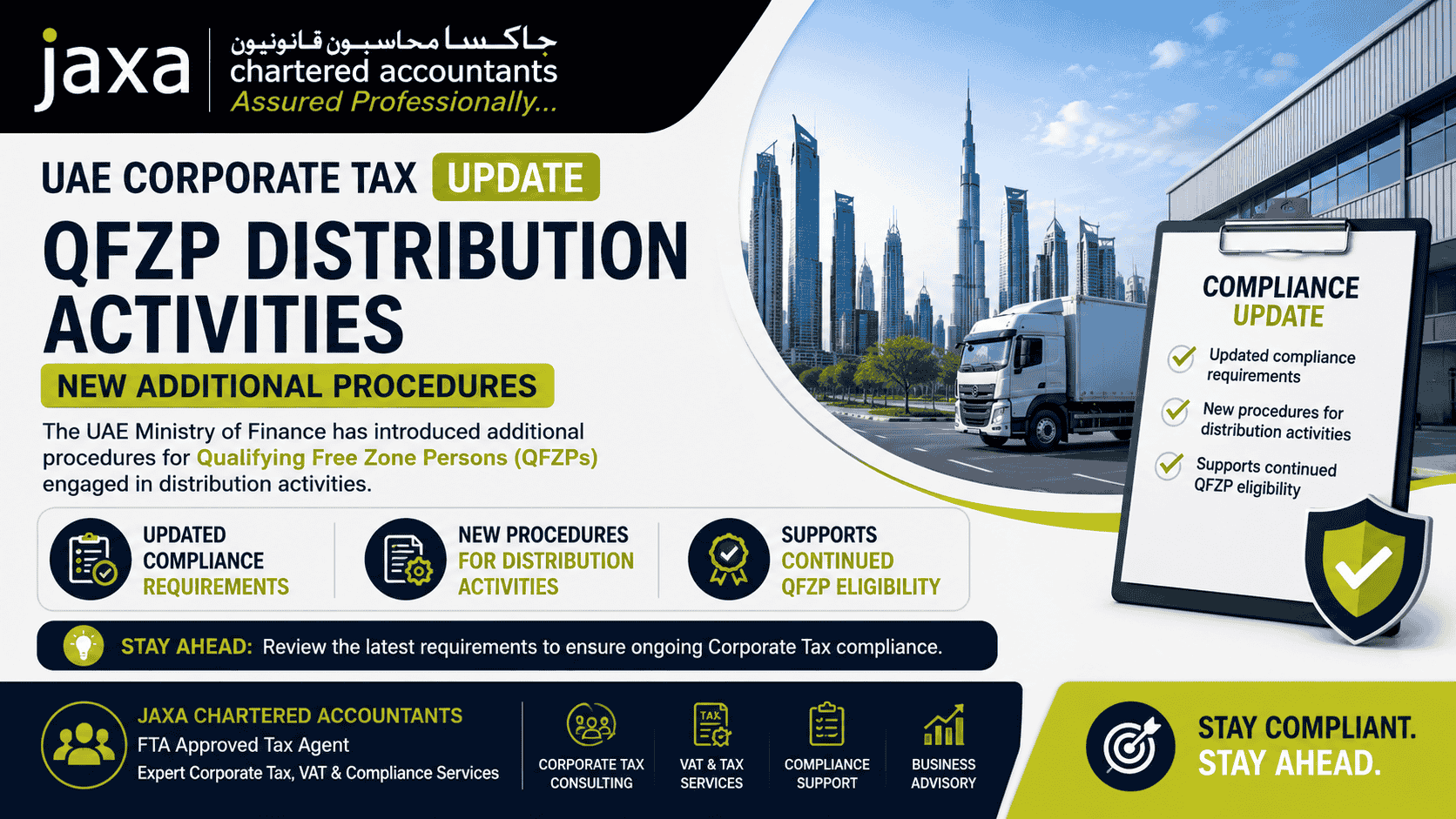

The UAE Federal Tax Authority has issued Decision No. 6 of 2026, setting out additional compliance requirements for a Qualifying Free Zone Person undertaking the qualifying activity of distributing goods or materials in or from a Designated Zone under the UAE corporate tax regime, effective for the tax period starting on or after 1st January 2026. Building on the existing UAE corporate tax framework, Ministerial Decision no. 84 of 2025 requires Qualifying Free Zone Persons to prepare and maintain audited financial statements.
To execute these mandates, the UAE Federal Tax Authority (FTA) has introduced FTA Decision No. 6 of 2026, which outlines supplementary verification and compliance protocols for Qualifying Free Zone Persons who carry out the qualifying distribution of goods or materials in or from a Designated Zone.
In this article, we explain the key provisions of UAE FTA Decision No.6 of 2026, to whom the new requirement applies, the additional procedures that QFZP must follow, and practical steps businesses can take to remain compliant under the UAE Corporate tax regime. Jaxa Chartered Accountants, a UAE FTA Tax agent, provides comprehensive corporate tax advisory, compliance review, and regulatory support to help free zone businesses confidently navigate the latest UAE FTA requirements.
Who Qualifies as a Qualifying Free Zone Person (QFZP) in the UAE?
Under Article 18 of the UAE Corporate Tax Law, a Qualifying Free Zone Person (QFZP) is a Free Zone entity or branch that satisfies the conditions prescribed under the UAE Corporate Tax regime. A business that qualifies as a Qualifying Free Zone Person (QFZP) can benefit from the 0% UAE corporate tax rate on qualifying income, while non-qualifying income is generally subject to the standard 9% Corporate tax rate.
To benefit from the UAE’s 0% Corporate tax regime for the Qualifying Free Zone, businesses must meet the following eligibility conditions.
- Be Established in a UAE Free Zone
The business must be legally incorporated or registered in a recognized UAE Free Zone, including eligible branches of UAE or foreign entities.
- Maintain adequate economic substance: The business must carry out its Core Income-Generating Activities (CIGAs) within the Free Zone and maintain sufficient:
- Qualified employees
- Physical assets
- Operating expenditure
- Where activities are outsourced, they must be performed by related parties or third parties located within a Free Zone and remain under the entity’s effective supervision
- Generate Qualifying Income: The entity must derive qualifying income, which may include:
- Income from the Transaction with other Free Zone Persons where the customer is a beneficial recipient (excluding specified excluded activities)
- Income from qualifying activities carried out with non-Free Zone businesses
- Certain income from intellectual property and other eligible income, provided the de minimis conditions are met.
- Do not elect to be taxed under the standard UAE corporate tax regime: To retain QFZP status, the business must not elect to be taxed under the standard UAE corporate tax regime applicable to a taxable person in the UAE.
- Comply with Transfer Pricing Requirements: All transactions with related parties must adhere to the arm’s length principle, with appropriate documentation maintained as per the UAE corporate tax.
- Prepare audited financial statements: The entity must prepare annual audited financial statements in accordance with International Financial Reporting Standards (IFRS).
- Meet the De Minimis Threshold: Non-Qualifying income must not exceed the lower of
- AED 5 million
- or 5% of the entity’s total revenue
Exceeding the De Minimis Threshold may result in the loss of QFZP status and trigger the applicable cooling-off period under the UAE corporate tax regulations.
Key Additional Procedures under FTA Decision No. 6 of 2026
To strengthen compliance with the UAE corporate tax regulations, UAE FTA decision No 6, 2026 specifies additional procedures for Qualifying Free Zone persons (QFZPs) claiming the qualifying activity of distributing goods or materials in or from a Designated Zone. These requirements apply to tax periods beginning or after 1 January 2026.
- Obtain an Agreed-Upon-Procedures (AUP) report: A QFZP claiming this qualifying activity must obtain an Agreed-Upon-Procedures (AUP) Report from an independent external auditor licensed to practice in the UAE. The entity’s statutory auditor or another licensed independent auditor may carry out the engagement.
- Prepare the report in accordance with ISRS 4400: The AUP Report must be prepared in adherence to the International Standard on Related Services (ISRS) 4400 (Revised)- Agreed-Upon Procedures Engagements, issued by the International Auditing and Assurance Standards Board (IAASB), together with the applicable auditing legislation in the UAE.
- Verifying Qualifying Distribution Activity: The agreed-upon procedures must include verification of whether:
- The QFZP supplies goods or materials to customers for resale, and
- Where applicable, goods imported into the UAE are imported through a Designated Zone.
- Maintain supporting documentation: The businesses should maintain adequate records to support qualifying distribution activity, including purchase and sales documentation, import records, customs documents, and any information required to follow the conditions under the UAE corporate tax regulations.
These are the fundamental conditions for the qualifying distribution activity. Accordingly, the UAE FTA requires the entity to engage an independent external auditor to perform the prescribed procedures subject to agreed-upon procedures, and report the factual findings specified under UAE FTA Decision No. 6 of 2026.
Scope of the Agreed-Upon-Procedure Report
The agreed-upon procedures (AUP) engagement should address the following key conditions prescribed under UAE FTA Decision No. 2026:
- Customers must acquire goods for resale: The agreed-upon procedures should verify that QFZP supplies goods or materials to customers who acquire them for:
- Reselling the goods
- reselling parts of the goods or
- Processing or altering the goods before their subsequent sale or resale.
- Imports through a designated zone: Where the QFZP imports goods into the UAE, the agreed-upon procedures should verify whether those goods are imported through a Designated Zone, as required under the relevant corporate tax provisions.
Documentation to support the Agreed-Upon Procedures (AUP) Engagement
To facilitate the Agreed-Upon Procedures (AUP) engagement under UAE FTA Decision No. 6 of 2026, a QFZP should maintain adequate documentation to support compliance with prescribed conditions:
Evidence of customer reseller status:
The QFZP should maintain documentation demonstrating that its customers acquire the goods or materials for resale, processing, or alteration before resale. Such documentation includes:
- Trade license
- Signed customer declaration
- Sales agreements or contracts
- Sales invoices
- Other commercial records evidencing the customer’s resale activities.
Evidence of import through a designated zone:
Where goods are imported into the UAE, the QFZP should maintain documentation indicating that the goods entered through a Designated Zone. Key supporting documents include:
- Custom declaration
- Custom clearance documents
- Bill of Lading
- Air waybills
- Other shipping documents showing entry through a Designated Zone.
These documents form part of the evidence that may be reviewed by the independent external auditor during the Agreed-Upon Procedures (AUP) engagement.
AUP Report Submission Deadline
The Agreed-Upon Procedures (AUP) report must be submitted to the UAE FTA within 30 days from the UAE corporate tax return filing deadline. Failure to submit the AUP Report within the prescribed timeframe means QFZP will not be regarded as having satisfied the additional procedures prescribed under UAE FTA Decision No. 6,2026 for the relevant qualifying distribution activity.
What happens if the AUP Report is not submitted?
Failure to follow the additional procedures prescribed under FTA Decision no. 6 of 2026 may affect a QFZP’s eligibility to claim the qualifying activity of distributing goods or material in or from a Designated zone.
If the required AUP report is not submitted within the prescribed timeframe:
- The QFZP will be treated as not having complied with the additional procedures prescribed under UAE FTA Decision No. 6 of 2026.
- The entity will not be regarded as meeting the conditions applicable to the qualifying distribution activity of distributing goods or materials in or from a Designated Zone.
- The income derived from that activity may not qualify for the 0% corporate tax rate available under the QFZP regime.
- Additional scrutiny during UAE FTA reviews or tax audits
- Increased compliance or documentation requirements.
As a UAE FTA-approved tax agent in the UAE, Jaxa Auditors helps QFZP assess their corporate tax position, meet the latest UAE FTA compliance needs, and maintain robust documentation to support their QFZP claims.
Auditor procedures under UAE FTA Decision No. 6. of 2026
The UAE FTA Decision no 6. Of 2026 mentions specific agreed-upon procedures that an independent external auditor must perform for QFZPs claiming the qualifying activity of distributing goods or materials in or from the Designated Zone. These procedures must be carried out and reported in accordance with ISRS 4400 (revised).
- Review customer business activities: The auditor must examine a sample of the customer’s trade license or equivalent business documents to verify whether the customer undertakes activities such as trading, wholesale, distribution, or other commercial activities consistent with the resale of goods supplied by the QFZP.
- Verify customer declaration: The auditor must review a sample of signed customer declarations indicating that the goods or materials are intended for resale.
- Inspect sales agreements and commercial records: The auditor must inspect a sample of sales agreements, invoices, purchase orders, and other commercial records supporting the qualifying distribution activity.
- Review import documentation: The auditor must inspect a sample of the customs declarations and import documentation to verify that goods entered the UAE through a Designated Zone.
- Verify designated zone status: The auditor must verify that the Free Zone, port, or area identified in the import records is designated as a Designated Zone under the UAE Free Zone authority regulations.
- Review internal business records: The auditor must inspect a sample of inventory records, warehousing reports, logistics documents, and goods movement records to verify that goods are received, handled, or stored within a designated zone before distribution.
Sampling requirement for the AUP Report under the UAE FTA Decision No. 6 of 2026
As part of the AUP report required under UAE FTA Decision No 6 of 2026, an independent external auditor is not required to examine every transaction. Instead, the auditor must perform the prescribed procedures using a representative sample selected as per the sampling methodology specified in the Decision.
Sample Size Formula
The sample size is calculated using the following formulas:
Sample Size = Sample Population ÷ [1 + (Sample Population × Margin of Error²)]
In which:
- Sample Population = total number of customers, sales agreements, or import transactions selected for testing during the relevant Corporate Tax period.
- Margin of Error =10%
- Sample Size: The number of documents selected for review from the sample population, including the highest-value transactions.
Example: XYZ Trading, a Qualifying Free Zone Person(QFZP) distributing electronic products from a Designated Zone, supplied goods to 75 customers during the relevant UAE corporate tax period.
Sample Size = 75 ÷ [1 + (75 × 10%²)] = 75 ÷ 1.75 ≈ 43
The external auditor would review 43 customer records, including the highest value transactions.
Practical Compliance Steps for Qualifying Free Zone Person(QFZP)
Businesses operating as QFZPs engaged in the distribution of goods or materials in or from a Designated Zone should take proactive steps to follow UAE FTA Decision No 6. In 2026.
- Maintain and retain customer declarations, evidence, and supporting resale activities.
- Keep valid customer documentation, such as trade license, sales agreements, purchase orders, and invoices, to support qualifying distribution activity.
- Retain customs and logistics documents evidencing imports entered the UAE through a Designated Zone.
- Maintain complete inventory, warehousing, and goods movement records to support the auditor’s agreed-upon procedures.
- Review transfer pricing documentation annually
- Monitor qualifying and non-qualifying income separately
- Seek professional corporate tax advisory in the UAE, such as Jaxa.
- Coordinate with your independent external auditor early to facilitate the Agreed-Upon Procedures (AUP) engagement and sampling requirements.
- Submit the AUP Report within 30 days after the UAE corporate tax return filing deadline.
Backed by a seasoned tax professional and UAE- FTA-approved tax agent status, Jaxa Chartered Accountants provides trusted corporate tax advisory and compliance support for Qualifying Free Zone Person.
How can Jaxa Auditors, the best corporate tax services in the UAE, help?
Navigating the UAE corporate tax and maintaining Qualifying Free Zone Person (QFZP) status requires expertise and a proactive compliance approach. With 19+ years of industrial experience in accounting, bookkeeping, auditing, taxation, and business advisory, Jaxa Chartered Accountants helps businesses confidently handle their corporate tax obligations.
As an UAE FTA-approved tax agent in the UAE, Jaxa provides end-to-end support:
- UAE corporate tax advisory and compliance
- QFZP eligibility assessment
- Transfer pricing compliance and documentation
- Accounting and bookkeeping in the UAE
- Corporate tax return preparation and filing
- Ongoing Free Zone compliance and advisory
- EmaraTax assistance
Our expertise combines deep technical expertise with practical industrial experience, helping businesses comply with the latest UAE FTA and MoF regulations while supporting long-term efficiency and regulatory compliance.
Looking for expert UAE corporate tax consultants? Stay ahead of evolving UAE corporate tax regulations with Jaxa Auditors. Whether you need assistance with QFZP compliance, corporate tax, or VAT compliance, Jaxa is just a message away.
Book now for a Free Consultation.


 Reach us on WhatsApp