
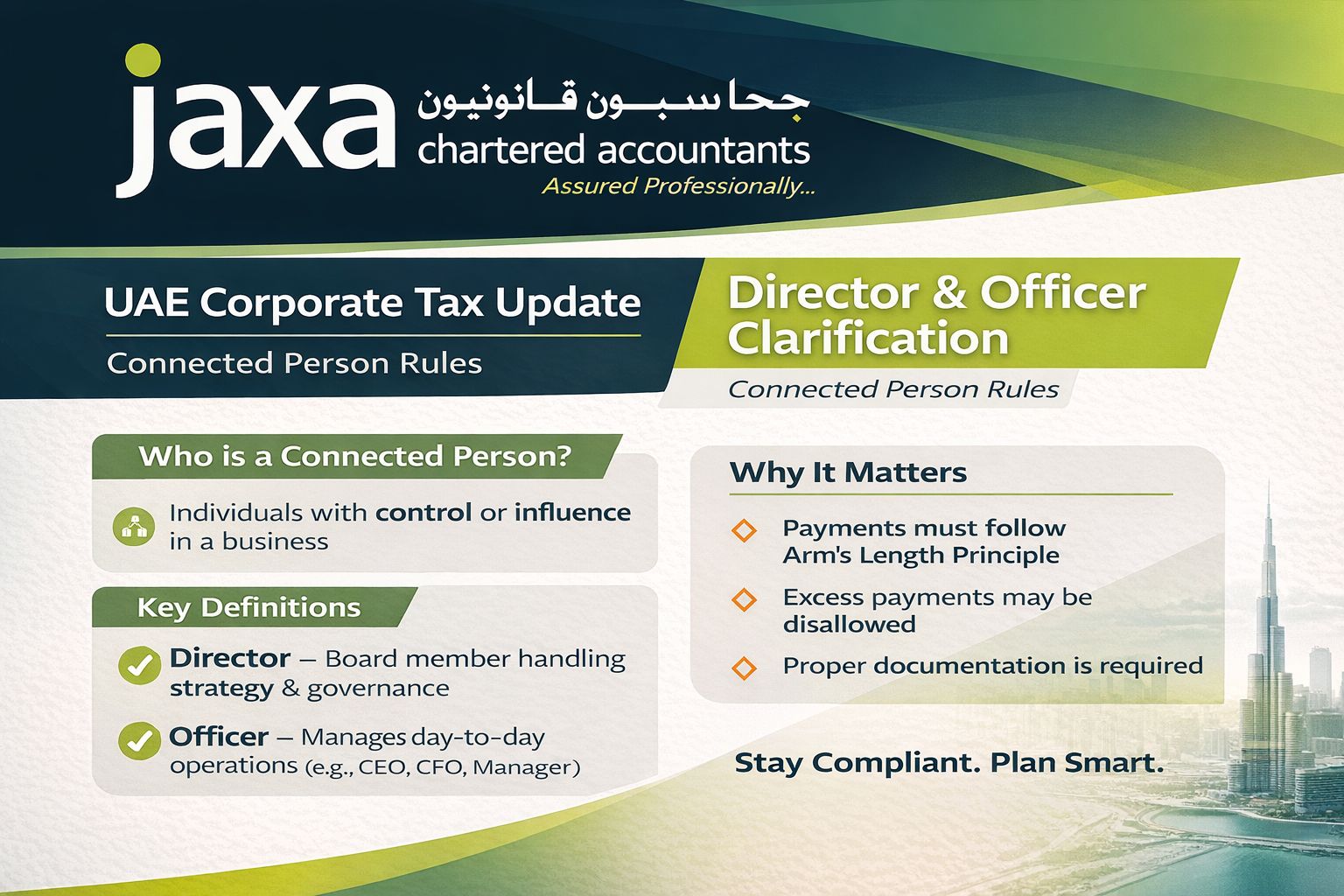

The UAE corporate tax regulation continues to evolve, with increased regulatory clarity and precision. In a significant development, the UAE Federal Tax Authority (FTA) has issued Public Clarification CTP010, providing detailed guidance on how the terms “ Director” and “Officer” should be interpreted under Article 36 of the UAE Corporate Tax Law.
This development is particularly relevant for businesses to identify connected persons and assess the deductibility of expenses under UAE corporate tax, while maintaining accurate corporate tax compliance and disclosure.
Connected Person in UAE corporate tax: Rules for deductible expenses and compliance
Under UAE corporate tax, payments involving a connected person are subject to specific compliance and disclosure requirements. If a business makes payments or provides benefits to such individuals, those costs are deductible only to the extent they meet the market value for their services, aligning with the arm’s length principle, and must be separately disclosed in the UAE corporate tax return.
Misclassification of Director or Officers can directly impact deductible expenses and disclosure under the UAE Corporate tax and lead to:
- Disallowance of expenses
- Inaccurate UAE corporate tax disclosure
- Increased UAE corporate tax compliance risk and potential penalties
With the release of Public Clarification CTP010, the UAE FTA has reinforced the principle of substance over form in UAE corporate tax, emphasizing that businesses must assess actual roles, authority, and decision-making power- not merely job titles- when identifying connected persons.
Overview of UAE corporate tax
The implementation of UAE corporate tax on 1st June, 2023, marks a significant transformation in the nation’s fiscal framework. This federal initiative represents a significant step towards strengthening its tax system with global standards.
It supports economic diversification, strengthens investor confidence, and ensures smooth UAE tax compliance for businesses ranging from startups to multinational enterprises.
What are the connected persons in the UAE corporate tax?
The connected person rules under UAE corporate tax are designed to ensure that all transactions between related parties comply with the arm’s length principle. These rules play a significant role in preventing profit-shifting/reduction and ensuring fair taxation under the UAE corporate tax regulations.
A connected person under the UAE corporate Tax law includes individuals with direct or indirect ownership, control, or some influence over a business. This extends to shareholders, directors, officers, key personnel, and other key decision makers.
If the total payment or benefits provided to a connected person, including transactions with their related parties, exceed AED 500,000, businesses are required to complete the disclosure requirement by submitting the Connected Person Disclosure Schedule as per UAE corporate tax regulations.
Classification of “Director” under UAE Corporate tax
The latest UAE corporate tax update provides clarity on the definition of a Director under UAE corporate tax law, particularly in relation to connected persons and deductible expenses.
- A director is generally a member of the board of directors or equivalent governing body, as defined in the entity’s MOA or other constitutional documents, responsible for strategic oversight and governance under UAE corporate tax law.
- Executive, non-executive, temporary, permanent, or alternative director, including any member of a board committee, falls within the scope of a connected person under UAE corporate tax.
If a Taxable Person does not have a board of directors, the term “director” refers to a Person that holds a position on any equivalent governing body (including but not limited to board of trustees or board of governors
Designation alone is the determining factor, i.e., a person’s job title may include the term “director” but they may not hold a position on the board of directors or an equivalent governing body as per the Taxable Person’s incorporation or constitutional documents. In such a situation, they will not be considered a “director” for CT purposes.
Under UAE corporate tax compliance, director remuneration, such as fees, incentives, bonuses, or other benefits, must correspond to the Market Value of the service or benefit provided by the Connected Person to be considered as allowable deductions as per UAE corporate tax regulations.
Understanding “Officer” in the Context of Corporate Tax in the UAE
The term “officer” under UAE corporate tax generally refers to individuals who are key personnel and decision makers in the business.
It is a broader definition and focuses on the actual role and authority within the business.
The officer can be a person who;
- who possesses the authority and responsibility for planning, directing, and controlling the activities of a Taxable Person; or
- as the authority to make strategic decisions in relation to financial, operational, or commercial matters of a Taxable Person; or
- has the authority to enter into agreements or to approve actions that legally or contractually bind a Taxable Person.
Officers may include individuals holding the position of:
- Chief Executive Officer (CEO)
- Chief Financial Officer(CFO)
- General Manager (“GM”)
- Chief Financial Officer (“CFO”)
- Chief Operating Officer (“COO”)
- Chief Commercial Officer (“CCO”)
- an authorised representative with discretionary authority (collectively referred to as “C-suite”)
Generally business should evaluate the above based on a formal appointment or job title. However, it should not be relied upon as the sole criterion since even in the absence of a formal title, a person, through their actual conduct, effectively
- has the authority and responsibility for planning, directing, and controlling the activities, or
- have the authority to make strategic decisions, take or approve actions that legally or contractually bind a Taxable Person
Tax implications for Directors and Officers under UAE corporate tax
Under UAE corporate tax law, directors and officers are classified as connected persons, which introduced key compliance obligations within the UAE corporate tax framework.
- Arm’s length pricing: The compensation of directors and officers must reflect fair market value in alignment with the arm’s length principle.
- Transfer pricing obligations: Businesses must keep strong transfer pricing documentation to ensure transfer pricing compliance in the UAE.
- Deductibility rules: The payments/benefits to the extent that meet market value criteria would be allowed as a deduction under the UAE corporate tax law
- Regulatory review: The UAE FTA may examine such a transaction to ensure UAE corporate tax compliance.
It should be noted that if a Person is considered a Related Party as well as a Connected Person of a Taxable Person, such Person will only be considered a Related Party for the Corporate Tax Law.
UAE Corporate Tax Compliance: What Businesses Should Do Next
To stay compliant with UAE corporate tax, businesses should:-
- Ensure accurate classification of connected persons in the UAE
- Identify individuals with decision-making authority
- Review organizational roles and responsibilities
- Maintain documentation for market value transactions
- Ensure accurate corporate tax filing in the UAE
- Conduct periodic compliance health checks to avoid risk
Failure to comply with corporate tax regulations in the UAE may result in disallowed expenses and hefty penalties.
Documentation checklist for Directors & Officers as per the UAE corporate tax law
To ensure compliance with the UAE Corporate Tax Law, businesses must maintain proper documentation for all payments and benefits provided to connected persons, including directors and officers.
Such documentation includes:
- Proper HR contracts of employment or similar
- Defined job profiles of the employees/connected person
- Complete accounting records and supporting calculations
- Evidence of arm’s length pricing through benchmarking
- Internal approvals, including board resolution for directors’ or officers’ compensation
- Proper commercial justification for each payment or payment provided
Types of Payments or Benefits Covered
The definition of payments or benefits under UAE Corporate Tax is broad and includes:
- Salaries, bonuses, and share-based compensation
- Employer contributions to pension or retirement schemes
- Interest on loans provided to connected persons
- Non-cash benefits (housing, education, allowances)
- Any other financial or in-kind benefits linked to the role
Compliance Note
All payments to connected persons, including directors and officers, must comply with the arm’s length principle.
Failure to maintain proper documentation may result in:
- Adjustment to taxable income due to disallowed expenses
- Exposure to double taxation
- Missing corporate tax return filing and transfer pricing records
Why choose Jaxa Auditor- a Best Corporate tax service provider in the UAE
Jaxa Chartered Accountants is a trusted accounting and auditing firm in the UAE that services clients across the UAE and Dubai, with over 18 years of proven expertise. As an accredited UAE FTA tax agent, we bring deep regulatory insight and practical solutions to stay compliant and navigate complex compliance requirements.
Here’s what sets us apart:
- Trusted expertise: Our certified team of qualified auditors, chartered accountants, and tax consultants in Dubai brings extensive knowledge of UAE tax regulations.
- End-to end support: Our expertise gives complete guidance from initial assessment to final compliance and reporting.
- Client-centric solutions: Our services are customized to match the unique requirements and provide dedicated support at every stage.
- Global compliance standards: Our auditors in Dubai help to adhere to international compliance standards such as IFRS to enhance business credibility.
Start your UAE corporate tax compliance journey with our trusted expertise. If you are looking for the latest UAE corporate tax update, speak to our experts.



 Reach us on WhatsApp