
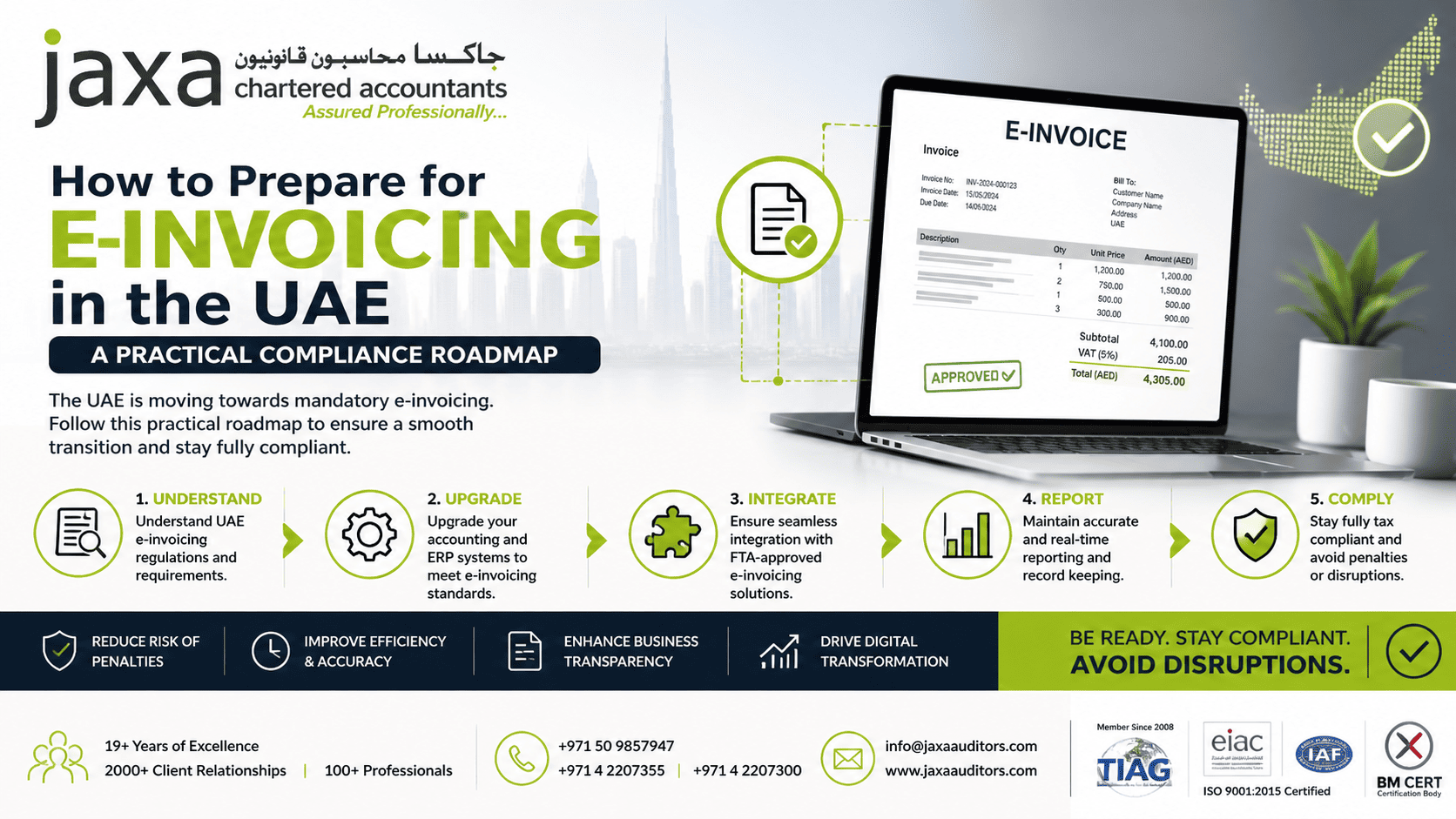

After the implementation of VAT in the UAE in 2018, the UAE is now set to launch a new phase of its major digital tax transformation. Under the UAE Electronic Invoicing System (EIS), the UAE E-invoicing compliance becomes mandatory from 31st July 2026 onwards. This requires all businesses in B2B and B2G transactions to issue structured invoices and integrate them with an Accredited Service Provider (ASP), irrespective of UAE VAT registration.
Driven by the UAE Ministry of Finance and the UAE Federal Tax Authority (FTA), this structured initiative focuses on strengthening tax transparency, reducing tax evasion, and accelerating the Emirate’s digital economy.
If your company operates within the UAE across various industries, proactive preparation is a must. Jaxa Chartered Accountants, a prominent FTA-approved Tax Agent in the UAE, outlines a step-by-step compliance strategy, internal controls, and a practical implementation roadmap.
What is an E-invoicing system in the UAE?
The e-invoicing in the UAE is the process of issuing, receiving, and managing invoices in a standardized electronic format, such as XML, ensuring efficient digital processing and compliance. This approach replaces manual invoicing and PDF invoices, allowing businesses to streamline invoicing through automation and integrate it with accounting and financial software. Every invoice is authenticated and transmitted securely through a centralized network, ensuring seamless real-time tax reporting to the UAE FTA.
As enforced by the UAE MoF, e-invocing is a mandatory compliance for UAE VAT-registered businesses, supporting accurate compliance with tax regulations and fostering a more efficient tax ecosystem.
UAE E-Invoicing Compliance Checklist
To meet UAE E-invoicing regulations, invoices must be generated in a structured XML format and processed through an Accredited Service provider (ASP), replacing traditional formats like PDFs. To remain compliant with the UAE e-invocing mandate, businesses must adhere to the following:
- Structured electronic format: The UAE e-invoicing system requires invoices to be generated in XML format through an Accredited service provider rather than traditional PDF or physical format.
- Mandatory ASP integration: Invoices are required to be transmitted and routed via a certified Accredited service provider approved by the Ministry of Finance.
- Regulated invoice framework: Invoice must adhere to a standardized format like PINT-AE or UBL, which are structured uniformly for smooth processing and system integration.
- Mandatory invoice data fields: To ensure the UAE E-invoicing mandate, all invoices must incorporate all key data elements covering business details, VAT registration, and accurate tax information.
- Timely invoice submission: Invoices and credit notes must be submitted within the timeframe as per UAE Tax Laws through the UAE e-invoicing system.
- Secure data retention: All invoicing data must be retained securely, ensuring accuracy, integrity, and accessibility for inspection during the UAE FTA audit.
Benefits of UAE E-invoicing for business
Adopting e-invoicing in the UAE allows businesses to automate invoicing, improve tax compliance, and support ongoing digital transformation initiatives.
- Enhanced VAT compliance
- Faster invoice processing and payments
- Improved cash flow
- Real-time validation & error reduction
- Seamless integration with the ERP system
- Better business analytics and reporting
What is the required format for UAE E-Invoice?
To remain compliant with UAE e-invoicing regulations, invoices must be granted in a structured digital format that ensures accurate reporting and seamless validations. There are 51 mandatory fields that include:
- Unique invoice identification number
- Full supplier and customer details with VAT number
- Transaction and issuance dates
- Description of goods/services, unit price, quantity, and discount.
- VAT calculator details, including tax amounts and rates
This structured approach ensures data integrity, facilitates real-time validation, reduces fraud risk, and strengthens tax compliance across the UAE.
Who must comply with UAE E-invoicing?
The UAE e-invocing framework will apply to a wide range of entities as part of its phased rollout beginning in 2026. The following categories are required to comply:
- All VAT-registered businesses across sectors
- Entities operating within the VAT groups, even if they share a single Tax registration Number (TRN)
- Businesses involved in B2B transactions
- Suppliers engaged in B2G transactions
- Selected government entities
Scope of UAE E-invoicing
E-invoicing in the UAE applies to all taxable businesses in the UAE, including:
- UAE-registered entities
- Cross-border trading entities
- Companies supplying goods and services
- Online and e-commerce business
- VAT-registered freelancers and self-employed professionals.
With the UAE’s transition to a digitized tax system, e-invocing compliance has become a necessity across all taxable entities.
UAE E-invoicing Exemption categories
As per UAE E-invoicing regulations, certain transactions are excluded from the mandatory e-invoicing requirement in the UAE. such as
- Business-to-customer transactions
- Non-commercial sovereign government activities
- VAT-exempt or zero-rated financial services
- International passenger flights with e-ticket issuance
- Air freight transport with an airway bill(temporary exemption for 24 months)
- Other categories determined by the Minister
UAE E-Invoicing Penalties for Non-Compliance
While a specific e-invoicing penalty framework is yet to be released, the UAE will apply existing administrative penalties under the Tax Procedure Law, outlined in Ministerial Decision No 106 of 2025. As a result, businesses may face the following consequences.
| Violation | Penalty amount |
| Failure to appoint an Accredited service provider within a prescribed timeframe | AED 5000 per month or part thereof for the delay |
| Failure to issue and transmit an electronic invoice within the timeframe | AED 100 per invoice or credit note, capped at AED 5000 per month |
| Failure to issue and transmit an electronic credit note within a prescribed timeline | AED 100 per document, capped at AED 5000 per month |
| Failure by the issuer to notify the FTA of system failure within the required timeframe | AED 1000 per day or part thereof |
| Failure by the recipient to notify the FTA of system failure within the required timeframe | AED 1000 per day or part thereof |
| Failure to notify the Accredited Service Provider (ASP) of changes in registered data within the required timeframe | AED 1000 per day or part thereof |
UAE E-Invoicing Update: Extension of deadline for ASP Appointment
The UAE Ministry of Finance (MoF) has officially extended the deadline for businesses to appoint an Accredited Service Provider (ASP) under the upcoming E-invoicing Framework.
Who is affected?
The extension applies to businesses with annual revenue of AED 50 million and above.
New Deadline
The revised deadline for the ASP appointment is now 30 October 2026, replacing the earlier deadline of 31 July 2026.
The implementation deadline for the UAE e-invoicing system remains unchanged, and businesses must live by 1st January 2027.
Businesses must continue preparing their ERP system, integration process, and compliance framework to ensure a smooth transition before the go-live date.
How to Prepare for UAE E-invoicing ( July 2026 rollout)
Businesses should initiate e-invoicing in the UAE preparation early to upgrade the system, onboard ASP, and achieve compliance well in advance before the scheduled implementation.
- Align with UAE E-invoicing rollout timelines: The UAE will introduce e-invoicing through a phased approach, beginning in July 2026. Large businesses will be onboarded first, followed by SMEs and other taxable persons.
- Appoint an approved Accredited service provider (ASP): All taxable businesses must engage an UAE FTA-approved ASP to manage invoice exchange under the UAE E-Invoicing framework. The onboarding is completed via the Emaratax portal, with the provider adhering to a structured format like UBL or PINT-AE.
- Prepare your accounting system: Ensure to update your ERP accounting system with all mandatory information and integrate it with the ASP.
- Pre-integration testing: Ensure to validate the invoice process. Check data accuracy and train the internal team on updated workflows during the pilot phase (July to Dec 2026).
- Prepare your internal team: Train your team to handle e-invoicing requirements.
- Connect with UAE VAT compliance: Integrate e-invoicing with your UAE VAT reporting processes.
- Track regulatory updates: Stay updated with UAE FTA regulations to maintain regular compliance.
- Stay compliant and report on time: Ensure seamless integration between E-invoicing and VAT reporting system, establish protocols for handling system failures, and stay aligned with UAE FTA guidelines.
Jaxa Auditors: Your Partner for UAE E-Invoicing Compliance
Jaxa Chartered Accountants is an experienced UAE FTA tax agent with over 18 years of expertise in accounting, auditing, corporate tax, and VAT services. It provides end-to-end guidance in helping businesses navigate the complexities of UAE e-invoicing with confidence.
Our e-invoicing services in the UAE are built to help businesses across the UAE and Dubai to comply with the latest UAE FTA regulations. From initial assessment to full implementation and ongoing support, we act as your trusted advisor for e-invoicing implementation while keeping your invoicing accurate, compliant, and ready for regulatory review.
As an approved UAE FTA tax agent, it delivers seamless integration, timely invoice submission, and ensures adherence to UAE FTA regulations.
Our services:
- Expert guidance on UAE e-invoicing regulations
- ASP onboarding and system integration support
- ERP readiness and invoice configuration
- Alignment with UAE VAT and corporate tax compliance
- Ongoing compliance and regulatory support
Stay compliant. Stay ahead. Schedule your UAE E-invoicing readiness assessment today with Jaxa Auditors.
For expert assistance in implementing UAE E-invoicing, contact our experts.
FAQ
- What is e-invoicing in the UAE?
E-invoicing in the UAE refers to the creation, exchange, and storage of invoices in a structured digital format (such as XML) through an integrated system approved by the Ministry of Finance and the Federal Tax Authority (FTA).
- When will e-invoicing become mandatory in the UAE?
The UAE will introduce e-invoicing in phases starting from July 2026, with mandatory implementation beginning in 2027 based on business size and category.
- How can Jaxa help with UAE e-invoicing compliance?
Jaxa, a UAE FTA-approved tax agent with 18+ years of experience, provides end-to-end support, including compliance advisory, ERP readiness, ASP onboarding, and ongoing VAT and corporate tax alignment.
- Is E-Invoicing Mandatory in the UAE?
E-invoicing is not yet mandatory in the UAE; however, it will be introduced in phases. The pilot and voluntary phase begins on 1 July 2026. Mandatory compliance will start from 1 January 2027 for large businesses (with revenue ≥ AED 50 million), followed by smaller businesses from 1 July 2027. Businesses are advised to begin preparations early to ensure a smooth transition.
- What is Peppol in UAE E-Invoicing?
Peppol (Pan-European Public Procurement Online) is a standardized e-invoicing network adopted in the UAE to facilitate structured, secure, and interoperable invoice exchange between businesses and the UAE FTA.
- What are the advantages of E-invoicing in the UAE?
The advantages of e-invoicing in the UAE include faster transactions, improved data accuracy, reduced errors, and enhanced compliance with VAT and tax regulations.


 Reach us on WhatsApp