
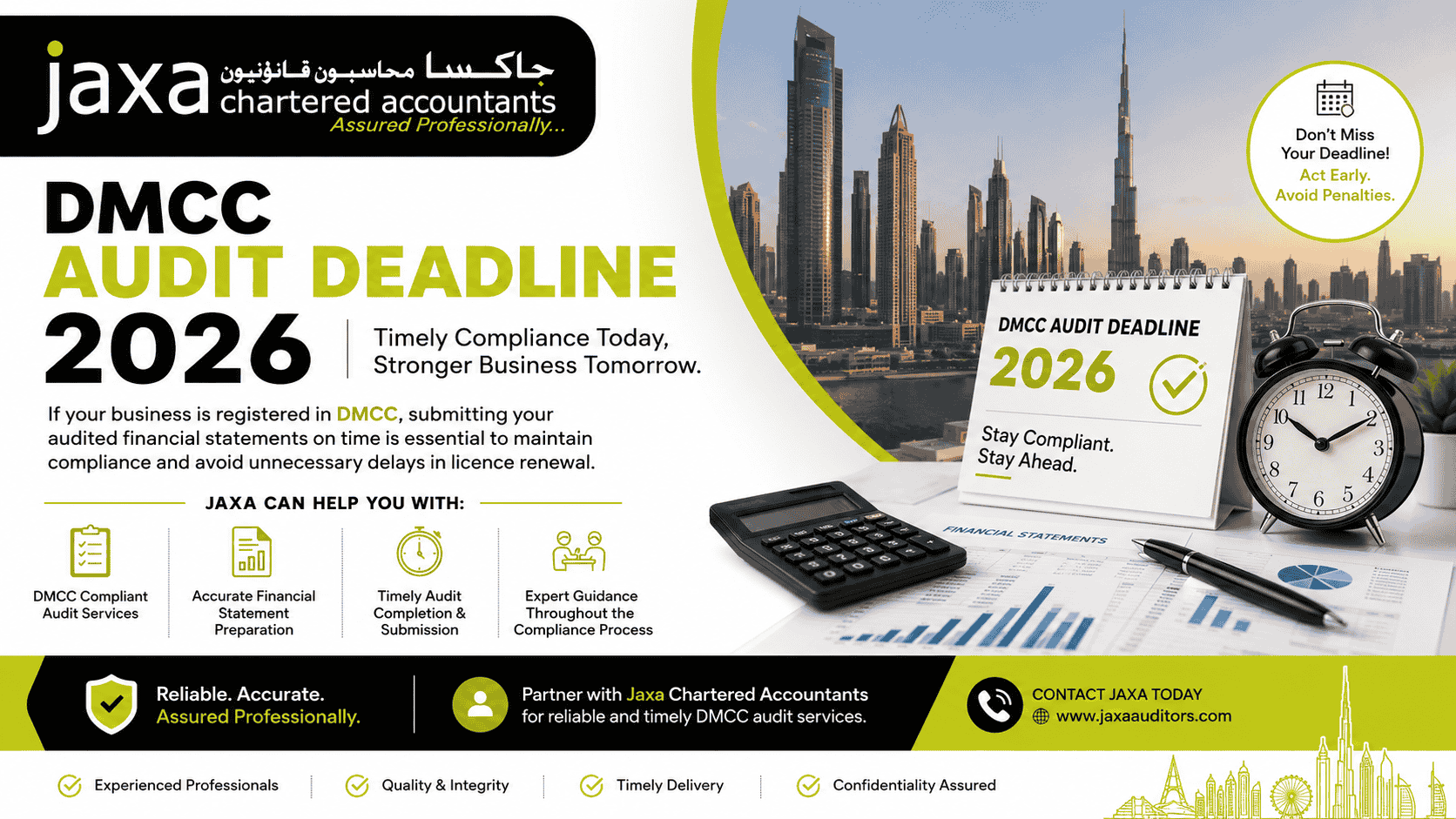

For companies registered in the Dubai Multi Commodities Centre (DMCC), meeting the DMCC audit submission deadline is an important regulatory responsibility. As per DMCC regulations, each entity must prepare and submit financial statements prepared by a DMCC-approved auditor within the prescribed timeframe.
Submitting your DMCC audit report is not simply an administrative task; it serves as a main indicator of your company’s financial integrity and regulatory compliance. As the deadline for the year 2026 approaches, businesses should proactively organize financial documents and coordinate with DMCC-approved auditors to avoid last-minute delays, penalties, and compliance issues.
Staying ahead of audit requirements can support regulatory compliance and maintain its status within one of Dubai’s premier free zones.
Overview of DMCC Free Zone
The Dubai Multi Commodities Centre (DMCC) is one of the UAE’s most established free zones, offering a dynamic environment for businesses looking for growth and international expansion. DMCC offers a strategic location, modern infrastructure, and business-friendly benefits.
Located in Jumeirah Lakes Towers (JLT), Dubai, DMCC provides businesses with access to global markets, flexible company setup, and a strong regulatory framework. Today, it is a home to a diverse community of entrepreneurs, SMEs, and multinational companies operating across various industries.
When is the DMCC Audit filing deadline?
All DMCC-registered companies with a financial year ending 31st December 2025 are required to file an audited financial statement by 29 June 2026 as per the DMCC company Regulations.
As per the DMCC regulations, the audit report must be filed within 180 days from the end of the company’s financial year.
The filing window provides businesses with sufficient time to prepare financial statements, resolve discrepancies, and work closely with a DMCC-approved auditor such as Jaxa to ensure a smooth audit process.
Do not wait for a deadline extension, so businesses should plan an audit early.
Key documents needed for DMCC Audit compliance
Companies preparing for a DMCC audit must have relevant legal, operational, and corporate records, which must be organized and easily accessible. Such documents are:
- Valid Trade License
- Memorandum & Article of Association (MoA & AoA)
- Passport copies of shareholders and directors
- Balance Sheet & Profit & Loss Statement
- Bank Statements
- Debtor & Creditor Reports
- VAT registration and VAT-related documents
- Fixed asset and depreciation records
- Supporting invoices and transaction documents
Keeping these documents prepared in advance can help to streamline the audit process and avoid unnecessary delays and penalties.
Why every DMCC company needs an Annual Audit
A DMCC audit delivers several benefits beyond regulatory compliance, including:
- Smooth license renewal
- Improved financial visibility
- Enhanced business credibility
- UAE corporate tax preparation
- Adherence to DMCC regulation & UAE financial reporting requirements
- Increased investor confidence
- strengthen internal control
- Risk management
Risk of non-compliance with DMCC Audit requirements
Missing the DMCC audit deadline may encounter compliance risk with DMCC regulations. Companies failing to submit financial statements may face blocking of the portal, delay in trade license renewal, and other restrictions that affect business operations.
Preparing early and working with a DMCC-approved audit firm can ensure timely filing submission and uninterrupted business operations.
How to submit your DMCC audit report
Smooth preparation can make the DMCC audit process faster, hassle-free, and less stressful. By keeping accurate records and planning ahead, businesses can avoid last-minute complications and ensure timely compliance with DMCC regulations.
- Keep accurate financial records: Ensure that all financial transactions are properly recorded and supported with relevant documents.
This consists of:
- Sales invoices
- Bank statements
- Payroll records
- VAT-related documents
- Invoices for Expenses
Step 2: Review & reconcile accounts:
Regularly review and reconcile your financial records rather than leaving everything until the last minute.
Ensure that bank statements are complete, cash balances are accurate, and inventory records are updated before the audit begins.
Step 3: Verify your financial reporting standards:
Since DMCC and UAE Corporate Tax require audited financial statements to be prepared as per IFRS standards, businesses should assess their accounting records and financial statements to ensure full compliance with IFRS requirements prior to audit.
Step 4: Select a DMCC-approved auditor: Before starting the audit process, verify that the chosen audit firm is included on the DMCC-approved audit list. A licensed audit firm, such as Jaxa Chartered Accountants, can guide you throughout the audit process, ensure compliance with DMCC regulations, and ensure timely submission of audited financial statements.
Step 5: Review your documents: Ensure your documents are accurate and up-to-date. DMCC auditors may request key corporate documents to verify company information and compliance status.
Keep documents such as:
- Trade license
- company incorporation documents
- Office lease agreements
- Passport copies of shareholders
Step 6: Facilitate the audit process: The auditors will assess the financial statement, accounting records, internal control and compliance procedures to verify the accuracy of financial reporting and identify any areas requiring clarification.
Auditors may raise queries or request additional documents to support their review. So, business must be well-prepared in advance.
Step 7: Obtain the final audit report: Once the audit procedure is completed, the auditor will issue the audit report and audited financial statements required for DMCC compliance.
The final audit report includes:
- Independent auditor’s report
- Audited financial statement
- Notes and disclosure
- Management representation
Step 8: Submit your DMCC Audit report: Following the completion of the audit, companies must submit their audit report and financial statements through the designated DMCC Member Portal. Companies should ensure that all information is complete, accurate, and submitted within the required deadline to avoid compliance risk.
Common pitfalls to avoid during DMCC Audit
A well-organized business may face challenges during the audit process. Understanding some common challenges can help businesses prepare accordingly and avoid unnecessary risk.
- Missing supporting documents: Incomplete financial records, missing invoices or unavailable bank statements may delay audit completion.
- Errors in financial statements: Inaccurate accounting entries, misclassifications, or reporting errors may require revision before the audit is finalized.
- Unreconciled accounts: Mismatch in bank records, customer accounts, or supplier records may arise challenges during the audit review.
- Regulatory compliance issues: Failure to comply with DMCC reporting requirements or applicable accounting standards may result in a delay in completing the audit.
- Last-minute audit planning: Delaying audit preparation or appointing a DMCC auditor may create unnecessary pressure and increase the risk of missed deadlines.
Who is eligible to conduct a DMCC audit?
Not all audit firms are authorized to conduct audits for DMCC-registered companies. Companies must appoint an auditor from the DMCC-approved auditor list to perform their annual audit. Only auditors recognized by DMCC, such as Jaxa Chartered Accountants are authorized to issue audit reports accepted by the free zone authority.
Selecting a qualified DMCC-approved auditor, such as Jaxa Auditors, a UAE FTA tax agent, is required to ensure a complaint and hassle-free audit submission process.
Best practices for the timely DMCC Audit Deadline 2026
Meeting the DMCC Audit deadline 2026 becomes much easier when businesses adopt a proactive approach to compliance and financial management.
- Plan your audit in advance
- Reconcile accounts regularly
- Keep supporting documents organized
- Lervage Digital accounting tools
- Track important compliance dates
- Engage a DMCC- approved Auditor early
Consider these practices to achieve the DMCC audit report in 2026 to maintain regulatory compliance and avoid last-minute filing challenges.
How Jaxa Auditors Ensures DMCC Audit Compliance
Preparing for the DMCC Audit deadline 2026 involves more than simply gathering documents at the end of the year. Meeting the DMCC Audit deadline can be challenging without the right expertise and preparation.
With 19 years of industrial expertise, Jaxa Auditors, a UAE FTA tax agent and trusted accounting, auditing, and tax advisory firm, helps businesses to handle DMCC audit requirements with confidence.
From maintaining financial records to coordinating with approved auditors, working with experienced audit professionals such as Jaxa Chartered Accountants can help businesses navigate the process efficiently and costly delays.
Our services include:
- Accounting & bookkeeping services in the UAE
- Audit & assurance
- Audit submission support
- Audited Financial Statement Preparation
- Certified DMCC- approved auditor
- UAE Corporate tax and VAT compliance
Don’t leave your DMCC audit until the last minute
Jaxa’s experienced audits and chartered accountants can help you prepare, review, and submit your audited financial statement while ensuring complete compliance with DMCC regulation and UAE corporate tax requirements.
Book a Free consultation today.



 Reach us on WhatsApp