
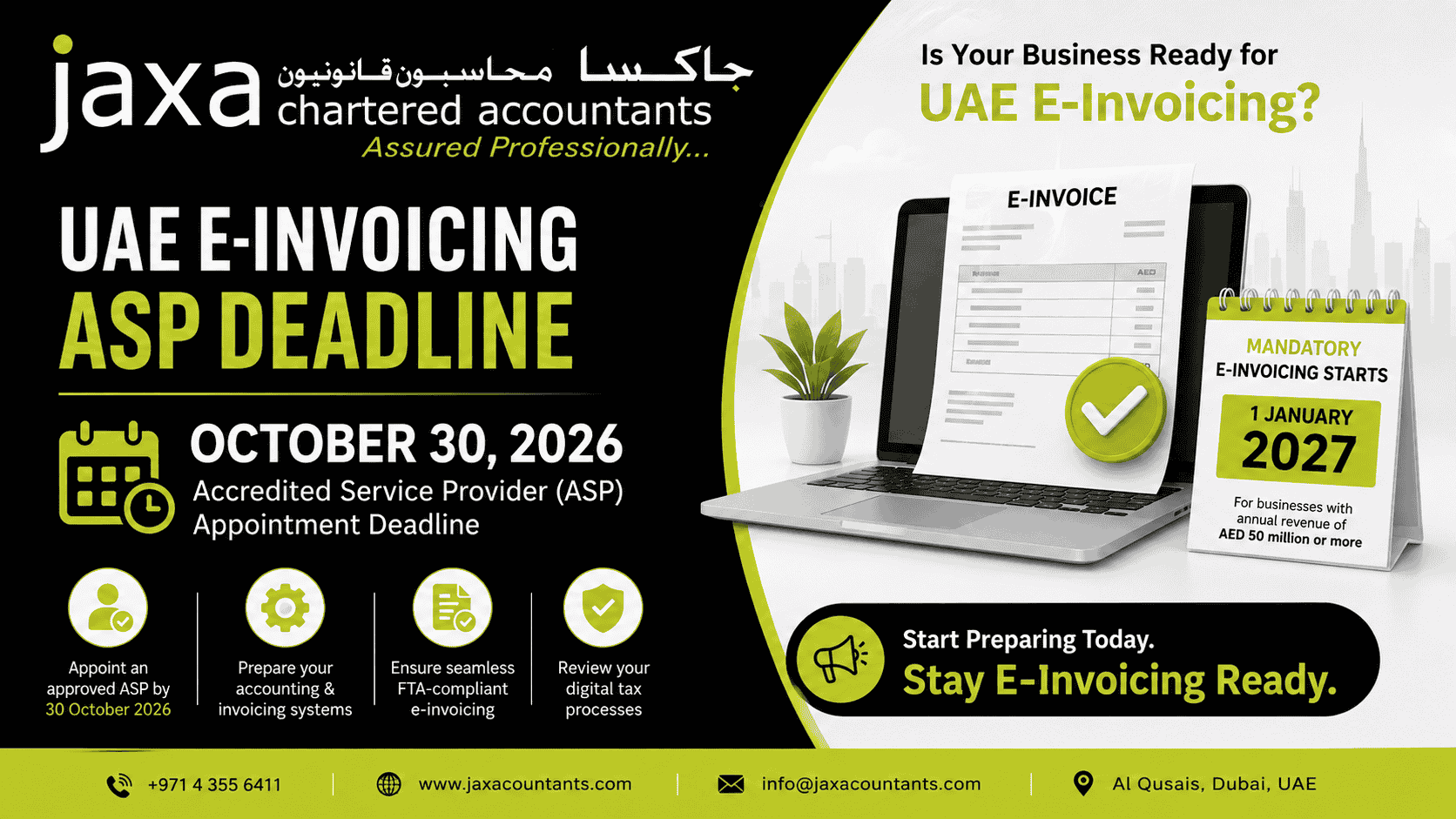

The UAE Ministry of Finance has officially extended the deadline for appointing an Accredited Service Provider (ASP) under the implementation of UAE’s E-Invoicing system. As per the Ministerial Decision No. (66) of 2026 amending the existing Ministerial Decision No. 244 of 2025, businesses now have approximately three months, extended from July 31, 2026, to October 30, 2026. This obligation applies to VAT-registered businesses with annual revenue exceeding AED 50 million, giving them an additional timeframe to appoint an Accredited Service Provider (ASP) and prepare for the mandatory UAE E-Invoicing Implementation before the mandatory implementation date of January, 1, 2027.
Understanding the UAE E-Invoicing ASP Deadline Extension
The UAE Ministry of Finance (MoF) has extended the deadline for appointing an Accredited Service Provider (ASP) to give eligible businesses more time to prepare for the national E-invoicing rollout. The extension reflects industry feedback highlighting the need for a larger pool of accredited providers, greater implementation flexibility, and improved access to cost-effective E-invoicing solutions.
To strengthen the UAE’s E-invoicing ecosystem, the MoF has accredited 42 ASPs as of date, with additional providers currently progressing through the accreditation process. This expanded network is expected to offer businesses greater flexibility while selecting an E-invoicing partner.
The Ministry also revised the framework to allow UAE companies to deliver white-label E-invoicing services in collaboration with global technology companies, supporting local capability development and digital transformation.
Despite the revised 30 October 2026 ASP appointment deadline, the mandatory UAE E-invoicing go-live date of January 1, 2027 remains unchanged. Businesses covered under Phase 1 must be fully prepared to issue and receive electronic invoices through an accredited provider by 1 January 2027.
What has changed?
The UAE Ministry of Finance (MoF) has extended the Phase 1 deadline for appointing an Accredited Service Provider (ASP) from July 31, 2026, to October, 30, 2026. The extension applies to VAT-registered businesses with annual revenue of AED 50 million or more.
What has not changed?
The mandatory Phase 1 go-live date remains January 1, 2027. Businesses must be fully prepared to issue and receive electronic invoices through an Accredited Service Provider(ASP).
Why This Extension Matters
The extended deadline gives eligible businesses valuable additional time to strengthen their UAE E-invoicing compliance efforts. During this time, organizations should focus on:
- Evaluate and appoint the most appropriate Accredited Service Provider(ASP)
- Completing onboarding and contractual planning
- Integrating ERP and finance systems for E-invoicing integration
- Validate data and ensure regulatory compliance
- Conduct testing of E-invoicing workflows before mandatory rollout
Although the deadline has been extended, businesses should maintain momentum to avoid last-minute implementation challenges ahead of the mandatory January 1, 2027 compliance date.
Reason behind the UAE E-Invoicing Deadline
The deadline extension reflects the Ministry of Finance’s commitment to ensuring a successful rollout of the UAE e-invoicing system. Key reasons include:-
- Support a smoother transition to the UAE E-invoicing framework.
- Provide businesses with a wider choice of Accredited Service Providers(ASPs)
- Encourage greater competition and more competitive pricing
- Allow additional time for implementation planning and system readiness
UAE E-invoicing Implementation Timeline
While the deadline for appointing an Accredited Service Provider (ASP) has been extended. The overall UAE E-invoicing implementation schedule remains unchanged. The Ministry of Finance and Federal Tax Authority have confirmed that businesses should continue preparing for the mandatory rollout.
Key milestones include:
| Dates | Milestone |
| July 1, 2026 | Launch of the pilot phase and voluntary adoption of the E-invoicing system |
| October 30, 2026 | Deadline for eligible businesses to appoint an Accredited Service Provider(ASP) |
| January, 1, 2027 | Mandatory E-invoicing begins for VAT -registered businesses with annual revenue above AED 50 million |
| March 31, 2027 | Deadline to appoint an Accredited Service Provider (ASP) for other businesses |
| July 1, 2027 | Mandatory Phase 2 UAE E-invoicing implementation for VAT-registered businesses with annual revenue below AED 50 million. |
The MoF and FTA have reiterated their commitment to ensuring a structured and predictable transition while supporting businesses in achieving compliance with the national E-invoicing framework.
How businesses should prepare for UAE E-invoicing
The extension of the UAE E-invoicing Accredited Service Provider (ASP) deadline to October 30, 2026 gives eligible businesses additional time for mandatory compliance. Businesses should use this period to strengthen their UAE E-Invoicing readiness, complete system upgrades, and ensure a smooth transition before the January 1, 2027 implementation date.
Priority action for business
- Choose an accredited Service Provider: Evaluate and appoint an ASP that aligns with your operational, technical, and compliance requirements.
- Prepare your system for E-invoicing: Review your ERP, accounting, and invoicing systems to ensure they support the UAE E-invoicing framework, including structured electronic invoices and seamless system integration.
- Conduct a compliance gap assessment: Review your invoicing, VAT, and reporting processes to identify areas that require updates for UAE E-invoicing compliance.
- Plan system integration and testing: Allow sufficient time to integrate your ERP or accounting system with your accredited service provider(ASP) and ensure a seamless transition to the UAE E-invoicing framework.
- Prepare for a smooth implementation: Plan system integration, validate invoice data, and complete end-to-end testing to ensure a seamless transition to the UAE E-invoicing framework and compliance with regulatory requirements.
- Review VAT and compliance processes: Ensure VAT reporting, invoicing, and tax compliance procedures align with the UAE E-invoicing framework.
- Enhance Invoice data readiness: Review and standardize invoice data to support accurate electronic invoicing and compliance with the UAE E-invoicing framework.
- Plan your UAE E-invoicing implementation: Create a structured roadmap covering ASP selection, system integration, testing, employee training, and compliance milestones to ensure readiness before the mandatory implementation date.
Potential consequences of delayed UAE E-invoicing preparation
- Higher implementation and compliance cost
- Reduced availability of Accredited Service Providers (ASPs)
- Limited time for system integration and testing
- Increased risk of implementation errors.
- Higher risk of non-compliance with the UAE E-invoicing framework
- Compliance gaps and reporting issues
- Operational inefficiencies during the transition
Prepare Today for Tomorrow’s Compliance
The revised ASP deadline offers valuable time to strengthen your UAE E-invoicing readiness. Businesses with a complex ERP environment, multiple legal entities, or high transaction volumes may require additional time for integration, testing, and process alignment. Businesses should utilize this opportunity for system assessment, appoint an Accredited Service Provider(ASP), and finalize the implementation activities well before the mandatory January 1, 2027 deadline.
However, organizations should not postpone implementation, as non-compliance may lead to regulatory penalties. According to the UAE E-invoicing, penalties may include AED 5000 per month for implementation delays and AED 100 per invoice for failure to transmit electronic invoices.
Final Words
The extension of the UAE E-invoicing ASP deadline provides businesses with additional time to prepare, but the mandatory implementation date of January 1, 2027 remains unchanged. Early planning, system readiness, and timely ASP selection are essential for achieving compliance and avoiding last-minute challenges.
Jaxa Chartered Accountants, an UAE FTA-approved tax agent and a leading VAT consultant in the UAE, helps businesses navigate every stage of the UAE E-invoicing journey. From E-invoicing readiness assessment and VAT compliance reviews to ERP integration support, tax advisory, accounting, and regulatory compliance, our experienced professionals provide practical solutions tailored to your business.
If your business is preparing for the UAE’s mandatory E-invoicing rollout, Jaxa Auditors can help you achieve compliance with confidence while minimizing operational disruption and ensuring alignment with the latest UAE FTA and MoF requirements.
Stay compliant. Stay Ahead.
Speak with Jaxa Auditors’ UAE FTA-approved tax agent for expert guidance and trusted UAE VAT, corporate, and UAE E-Invoicing compliance support.

 Reach us on WhatsApp