
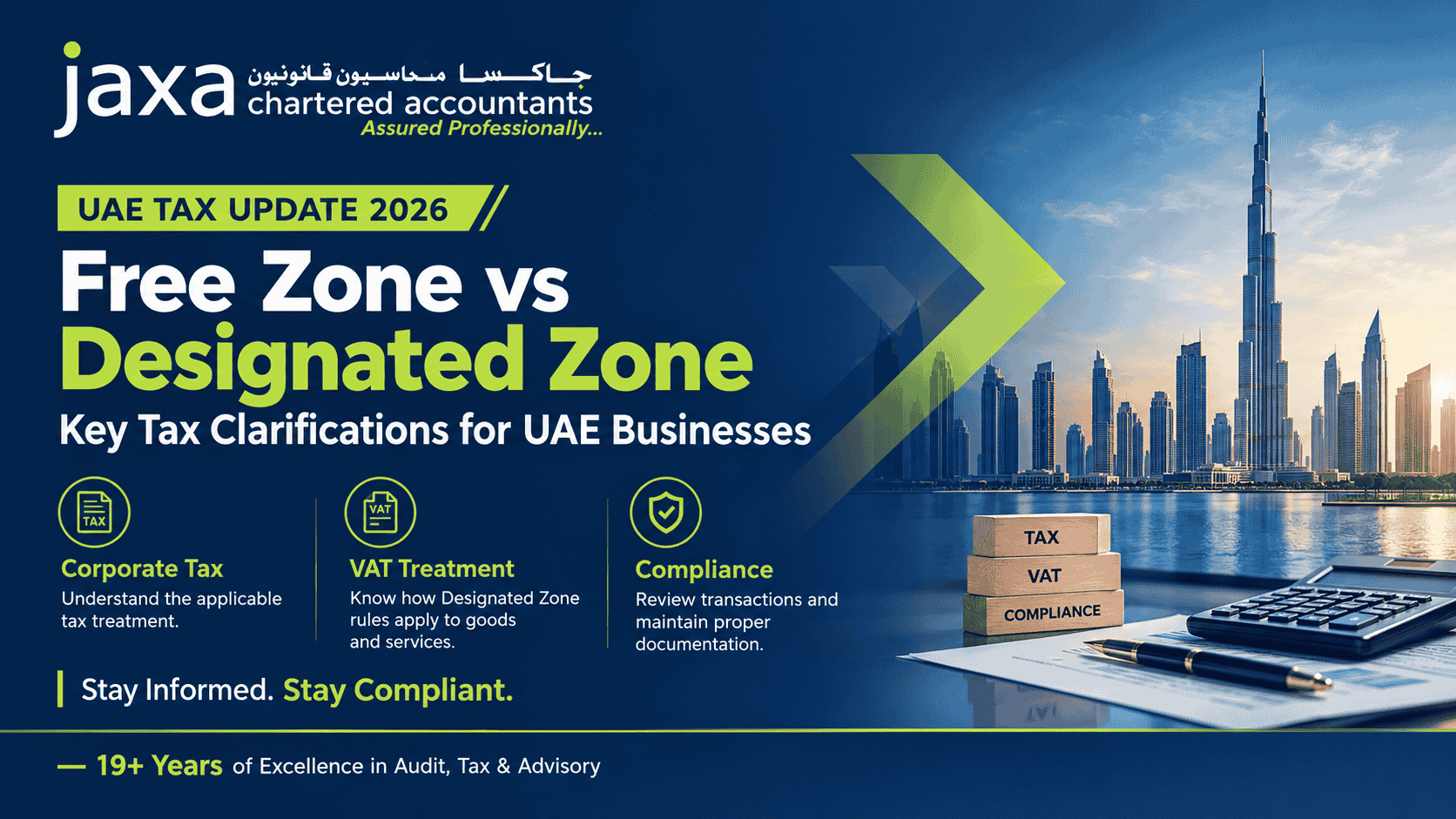

Explore the latest UAE Tax Update 2026 on Free Zones and Designated Zones, including Corporate Tax implications, VAT treatment, and essential compliance requirements for businesses.
The UAE Federal Tax Authority (FTA) has released Public Clarification TAXP010 on October 02, 2026, providing guidance on the treatment of Free Zones and Designated Zones for UAE tax purposes. The UAE FTA confirms that these classifications are not uniform across UAE Corporate Tax, VAT, and Excise Tax, and businesses must assess their tax status separately under each applicable tax framework.
The tax status of a location is not necessarily the same across UAE tax laws. It may qualify as a Free Zone for Corporate Tax purposes but not as a VAT-designated Zone, while separate rules apply for Excise Tax. An incorrect classification could affect QFZP eligibility, VAT treatment of goods, and applicable rules for the movement of excise goods, while maintaining compliance.
What is a Free Zone in the UAE?
A Free Zone in the UAE is a geographically defined area established through a Cabinet decision based on a proposal from the Minister. These zones provide businesses with various licensing options, infrastructure, and operational facilities to support commercial activities.
For companies considering setting up a business in a UAE Free Zone, understanding the applicable tax regulations is essential. The applicable treatment depends on the relevant UAE tax laws, the nature of business activities, the location, and whether the prescribed conditions are satisfied.
Under the UAE corporate tax regime, a Qualifying Free Zone Person (QFZP) may benefit from a 0% corporate tax rate on Qualifying Income, subject to meeting the applicable conditions. Similarly, a Free Zone is not automatically a VAT Designated Zone, and separate requirements apply for Excise Tax Designated Zone status.
Therefore, businesses operating in a UAE free zone should assess their status separately under UAE corporate tax, VAT, and Excise Tax rules to determine the correct tax treatment and maintain compliance.
What is a Designated Zone in the UAE?
A Designated Zone is an area specifically identified by a Cabinet Decision for UAE VAT purposes. Not every Free Zone in the UAE is classified as a Designated Zone.
For certain VAT purposes, a Designated Zone is treated as being outside the UAE in relation to specific supplies of goods, subject to the conditions prescribed under the UAE VAT legislation.
The special treatment is primarily relevant to transactions involving the movement and supply of goods within, to or from a Designated Zone.
However, the special VAT treatment applicable to a Designated Zone does not automatically apply to every transaction carried out within the zone.
Businesses should therefore determine whether the location is officially classified as a Designated Zone and assess the nature of each transaction before determining its VAT treatment. The applicable conditions, movement of goods, and supporting documentation should also be carefully reviewed to ensure compliance with UAE VAT requirements.
Free Zone vs Designated Zone: What is the Difference?
Although the terms Free Zone and Designated Zone are sometimes used interchangeably, they have different meanings and serve different purposes under the UAE tax framework.
| Area | Free Zone | Designated Zone |
| Primary tax relevance | UAE corporate tax | UAE VAT, particularly supply of goods in special cases |
| Relevant legislation | UAE corporate tax law and applicable regulations | UAE VAT legislation and applicable Cabinet Decisions
|
| 0% Corporate Tax | May apply to Qualifying income of a Qualifying Free Zone Person(QFZP), subject to the applicable conditions | Designated Zone status does not itself provide a 0% Corporate Tax rate. |
| Special VAT treatment | Not automatically available merely because a business operates in a Free Zone | May apply to certain supplies of goods subject to the applicable conditions |
| Automatic tax exemption | No | No |
| Compliance Requirement | UAE Corporate tax registration, return filing and compliance with applicable QFZP conditions; VAT obligations may also apply | UAE VAT registration and compliance with applicable VAT rules, including requirements relating to qualifying transactions.
|
A business may therefore be located in a Free Zone without that zone being a Designated Zone for UAE VAT purposes
This is one of the most important things businesses should understand while evaluating their UAE tax obligations.
What is a UAE Corporate Tax Designated Zone?
For UAE corporate tax purposes, the term Designated Zone refers to a specific type of Free Zone that meets the conditions prescribed under the UAE corporate tax legislation.
To be considered a Designated Zone for corporate tax purposes, the area must:
- Be a VAT Designated Zone, and
- Qualify as a Free Zone under the UAE Corporate Tax
Therefore, a location being classified as a Designated Zone for VAT purposes, by itself, does not make it a Designated Zone for UAE Corporate Tax purposes.
Businesses should assess the status of their location under the applicable UAE corporate tax legislation and the UAE FTA guidance before determining whether the special UAE corporate tax treatment applicable to activities carried out in or from a Designated Zone can be relied upon.
Why does this matter for businesses?
The distinction is particularly relevant to businesses engaged in the distribution of goods or material in or from a Designated Zone.
Under the UAE Corporate Tax framework, distribution of goods or material in or from a Designated Zone is recognized as a Qualifying Activity, subject to the applicable conditions.
Consequently, businesses seeking to rely on this activity while determining their Qualifying Income must carefully consider whether the distribution activity is actually carried out in or from a UAE Corporate Tax Designated Zone.
Conditions for Qualifying Distribution Activities
Under the UAE Corporate Tax regime, distribution of goods or materials in or from a Designated Zone is a Qualifying Activity, subject to the applicable conditions.
The activity may include the purchase and sale of tangible goods or materials, together with related activities such as:
- Importing goods
- Storing and handling goods
- Transporting goods
- Exporting goods
However, specific conditions must be satisfied for income from the activity to qualify
When goods are imported into the UAE, they must be imported through a Designated Zone. The goods must be supplied to a customer for resale, processing, or alteration for subsequent sale or resale, or to a Public Benefit Entity, subject to the conditions prescribed under the UAE Corporate Tax regulations.
VAT in the UAE: When is the Designated Zone Treated as Outside the UAE?
Under UAE VAT, a Designated Zone is a specific fenced area listed under Cabinet Decision No. 59 of 2017, as amended. Under Article 51(1) of the VAT Executive Regulation, a Designated Zone may be treated as outside the UAE for VAT purposes when the required conditions are met.
The key requirements include:
- The area must be fenced and secured with customs controls over the movement of people and goods.
- Maintain procedures for the storage and processing of goods
- Ensure the operator complies with UAE FTA-prescribed procedures
Businesses should not assume that every part of a listed Designated Zone automatically qualifies. Ensure that the specific area where they operate meets the applicable requirements.
This is applicable for businesses operating in a large or expanded Free Zone, where different areas may have different customs and security arrangements.
The special VAT treatment mainly applies to supplies of goods. Services supplied in a Designated Zone generally remain subject to the normal UAE VAT rules, subject to the applicable conditions Why Ongoing QFZP Compliance Matters
Obtaining a Free Zone license does not automatically guarantee Qualifying Free Zone Person(QFZP) status. Businesses must continue to meet the applicable UAE corporate tax requirements throughout the relevant tax period.
Failure to satisfy the required conditions may result in the loss of the preferential Corporate tax treatment available to QFZPs, in accordance with UAE Corporate Tax legislation.
Free zone businesses should regularly review:
- Free zone and corporate tax designated zone status
- Qualifying and non-qualifying activities
- Nature and source of income
- Customer and transaction profiles
- Import and distribution arrangements
- Transfer pricing requirements
- Accounting records and financial statements
- Supporting documents and compliance records
Excise Tax: The Warehouse Keeper Requirement
For UAE Excise tax, which applies to products such as tobacco and tobacco products, electronic smoking devices, carbonated drinks, sweetened drinks and energy drinks, a Designated Zone may be
- A fenced free zone with required security controls, customs supervision and an appointed warehouse keeper; or
- Another geographical area approved by the UAE FTA, meeting the required security conditions and having a registered Warehouse Keeper.
The Warehouse Keeper is responsible for supervising the Designated Zone and maintaining the required security and control measures.
Businesses should verify with the Free Zone authority or Warehouse Keeper whether their location qualifies as a UAE FTA -approved Excise Tax Designated Zone.
Key compliance steps for UAE Free Zone business
Businesses operating in a UAE Free Zone should review their tax position carefully following the latest UAE FTA classification.
Key compliance steps for UAE free zone include:
- Verify your free zone and designated zone status: Businesses should confirm how their location is classified for:
- UAE corporate tax
- Corporate tax designated Zone
- UAE VAT designated zone
- Excise tax designated zone
Businesses should not rely solely on their free zone license or the name of the zone while determining their tax treatment. Businesses must seek official confirmation from their free zone authority whether the zone is a Free Zone/Designated Zone for VAT and CT purposes.
- Review your business activities: Analyse whether your business activities meet the conditions for UAE Free Zone tax benefits.
This is generally important for businesses seeking QFZP status and the 0% corporate rate on Qualifying income.
- Assess transactions: Review the nature, location, and movement of transactions to determine the correct UAE corporate tax and VAT treatment.
- Maintain documentation: Keeping proper documentation is an important part of UAE tax compliance
Depending on the nature of the business and transaction, relevant records may include:
- Tax invoices
- Contracts and agreements
- Custom documentation
- Goods movement records
- Accounting records
- Documents supporting Free Zone or Designated Free Zone status
- Check UAE FTA requirements: Review the latest FTA guidance and Designated Zone list and confirm your status with the relevant free zone authority when required.
Accurate classification is essential for maintaining UAE free zone tax compliance and applying the correct tax treatment.
How Jaxa Auditors, a UAE VAT and Corporate Tax consultant in the UAE, helps?
Navigating the 2026 UAE FTA clarification on Free Zones and Designated Zones can be challenging. Thus, it reinforces the need for businesses to assess their tax position separately under UAE Corporate Tax and Excise Tax.
Jaxa Chartered Accountants, a UAE FTA tax agent as well as a leading VAT and Corporate Tax consultant and advisory firm in Dubai, helps businesses manage UAE tax requirements, assess the applicable Free Zone and Designated Free Zone rules, and determine the appropriate tax treatment for their activities and transactions.
With 19+ years of experience, 2000+ clients, and 100+ professionals, Jaxa provides the best audit, tax, accounting, advisory, and consultancy services to businesses across the UAE.
Need guidance on the 2026 UAE Free Zone tax update?
Get support for auditing services in Free Zone
Rely on Jaxa’s expertise to assess your Free Zone, Corporate tax, and VAT obligations in the UAE.
Speak with Jaxa Chartered Accountants, an FTA-approved tax Agency for expert UAE tax guidance. Now.




 Reach us on WhatsApp