
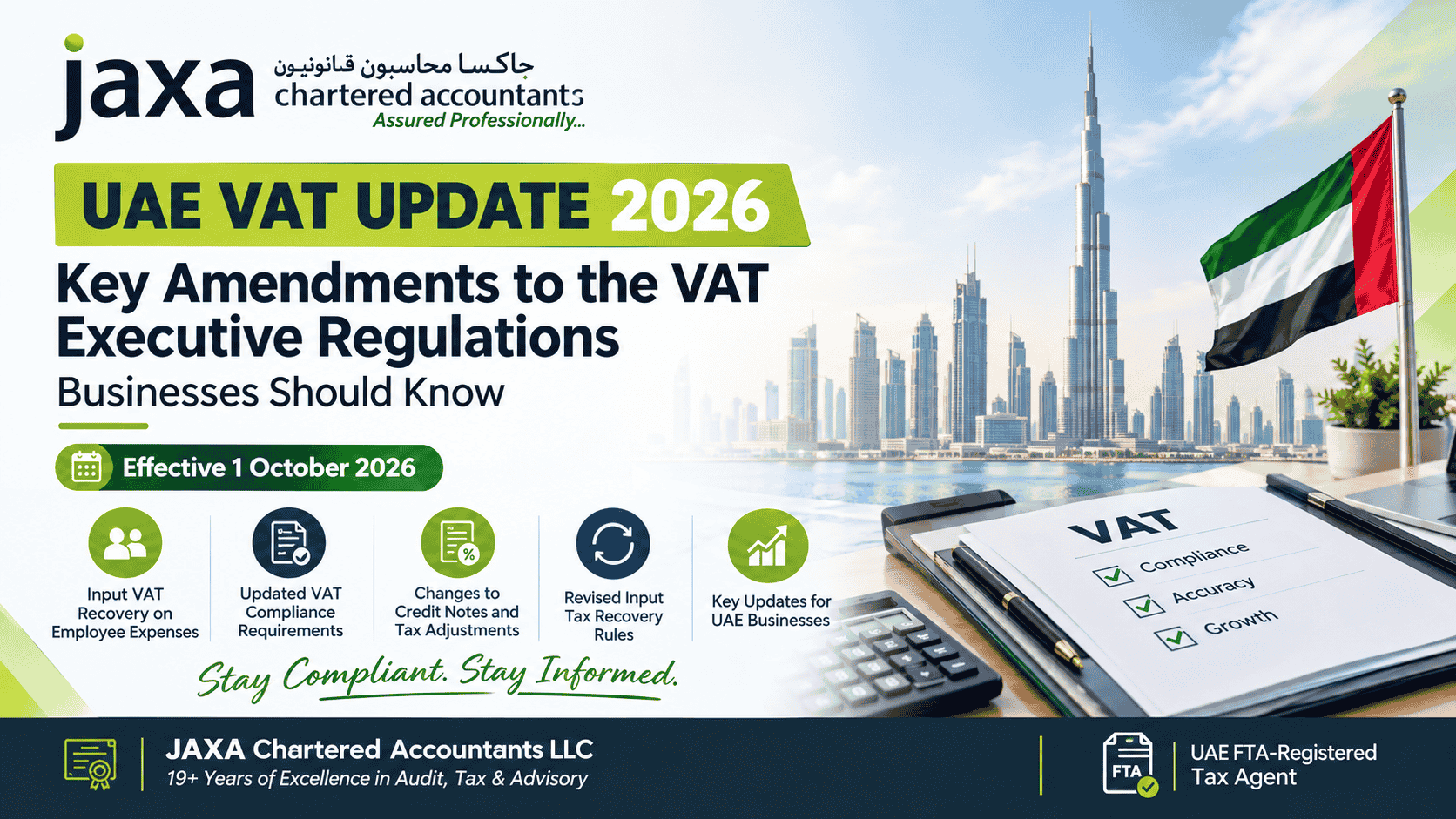

Explore UAE VAT Amendments effective October 1, 2026, under Cabinet Decision No. 149 of 2026. Understanding key changes and compliance requirements with Jaxa Chartered Accountants.
The UAE VAT framework continues to evolve with new regulatory changes aimed at clarifying tax treatment and strengthening compliance. The new Cabinet Decision No.149 of 2026 introduces amendments to the UAE Executive Regulations, addressing important aspects of VAT treatment and compliance. These changes cover the conditions for input VAT recovery on employee expenses, restrictions on certain cash transactions, the treatment of composite supplies, and tax credit note requirements. The amendments take effect from October 1, 2026, subject to specific timelines for certain provisions.
Businesses must assess the impact of these UAE VAT regulatory changes on their accounting procedures, tax reporting, and compliance practices. Staying updated about the latest UAE VAT regulations can help businesses maintain accurate records, apply the correct tax treatment, and meet their tax obligations. A professional VAT consultant in the UAE can provide guidance on interpreting the amendment and implementing appropriate compliance measures.
Here, in this article, we explain five key changes and the actions businesses should consider.
-
30-day rule for determining whether a person is outside the UAE
Cabinet Decision No.149 of 2026 amends the UAE VAT Executive Regulations by replacing the phrase “less than a month” with “less than 30 days”. Under the revised Article 52(2), a person may be treated as being outside the UAE for the relevant VAT provision if their presence in the UAE is less than 30 days and is not effectively connected with the supply.
This clarification provides greater certainty as to what constitutes short-term presence in determining whether the recipient’s presence in the UAE affects the VAT treatment of certain services, particularly the application of zero-rating rules for exported services.
Businesses should assess the recipient’s physical presence and its connection with the supply before applying the relevant VAT treatment. The amendment took effect on October 1, 2026.
-
Input VAT Recovery on Employee Benefits:
Cabinet Decision No. 149 of 2026 clarifies the conditions for recovering input VAT on certain goods or services provided to employees free of charge.
Businesses may recover input VAT on eligible employee expenses where the relevant conditions are met, including circumstances involving legal obligations, contractual obligations, or documented company policies.
Key compliance actions: businesses should review employee benefits, employment contracts, and supporting records to verify eligibility before claiming input VAT when filing the UAE VAT Return.
-
New Restriction on Input VAT recovery on Cash Payments:
Cabinet Decision No. 149 of 2026 introduces a restriction on input VAT recovery for supplies exceeding the value specified, where the consideration is paid or intended to be paid in cash.
Key points:
- Cash payment restriction: Input VAT may not be recoverable on supplies exceeding the prescribed threshold when the consideration is paid or intended to be paid in cash.
- Threshold clarification: The applicable monetary limit and related conditions will be specified in a separate Ministerial Decision.
- Payment procedures: Businesses should review their cash payment arrangements and identify potentially affected transactions.
- Record-keeping: Keep accurate invoices, payment records, and other relevant accounting documentation.
Business Action: Monitor official UAE tax updates and review payment procedures to prepare for the implementation of the prescribed threshold.
-
Revised rules for Composite Supplies:
Effective October 1, 2026, Cabinet Decision No. 149 of 2026 introduces a new provision under Article 4 of the UAE VAT Executive Regulations to clarify the treatment of supplies comprising multiple components.
Key changes:
- Economic substance: the nature and economic substance of a transaction determine whether its components are interconnected and cannot be separated.
- Single component supply: where these conditions are met, the transactions must be treated as a single composite supply.
- VAT Treatment: the supply follows the VAT treatment applicable to its principal component.
- Separate pricing: Separately identifying or pricing components does not, by itself, establish that they constitute separate supplies.
What businesses must do: Review bundled goods and services, contracts, pricing structures, and invoicing practices to determine whether the components are genuinely separate or constitute a single composite supply under the amended rules.
-
Tax Credit note requirements under UAE VAT regulations
Cabinet Decision No. 149 of 2026 amends Article 60(1)(a) of the UAE VAT Executive Regulations to clarify the labelling requirement for tax credit notes. The documents must clearly display the words “tax credit note” to meet the prescribed documentation requirements.
Key compliance actions:
- Update tax credit note templates and accounting systems
- Ensure the required wording appears clearly on each credit note
- Review document formats to align with the amended UAE VAT requirements.
This clarification takes effect from October 1, 2026. Businesses should review their existing documentation procedures to ensure UAE VAT compliance.
-
Revised Input Tax Apportionment Rules
The revised UAE VAT rules introduce changes to how businesses calculate recoverable input VAT when making both taxable and exempt supplies.
Key changes:
- Revised calculation: Recoverable input tax is calculated based on the value of supplies eligible for input recovery relative to the value of total supplies.
- Separate Methodologies: government entities and charities are subject to specific calculation methods.
- Effective date: the revised provision applies from the first tax year commencing after October 1, 2027.
Compliance Tip: Businesses must review their current input VAT apportionment methods, assess the potential impact on VAT recovery, and prepare their accounting system and procedures for the change.
Which business sectors are most affected by the UAE VAT cash payment rules?
The UAE VAT amendment introduces restrictions on input VAT recovery for certain cash-paid suppliers exceeding the threshold specified by the Minister. Businesses should review their payment procedures, maintain proper transaction records, and assess the potential impact of VAT recovery to ensure compliance with the revised UAE VAT regulations.
Key points:
- Construction and contracting companies: businesses that make cash payments to subcontractors and building material suppliers should review their payment methods and supporting documentation.
- Cleaning and manpower service providers: companies that incur expenses for transport, accommodation, and other operational services should assess their cash payment arrangements and maintain appropriate purchase and payment records.
- Restaurants and cafes: food businesses that produce fresh produce, meat, and other supplies from local vendors should have payment methods and ensure that transactions are properly documented.
- Trading and wholesale business: Traders handling frequent supplier payments should maintain proper invoices and payment records
- Transport and Logistics businesses: businesses making payments for fuel, vehicle repair, and other operational expenses should review cash transactions and evaluate the impact on input VAT recovery.
- Small retail companies: retailers must maintain accurate purchase invoices and payment records for cash payments to support UAE VAT compliance.
Compliance Action: Review cash-payment procedures, maintain supporting invoices and payment records, and monitor the applicable threshold and conditions under the relevant Ministerial Decision.
Note: Not all cash payments automatically result in the loss of input VAT recovery. The restriction depends on the prescribed threshold and applicable conditions.
UAE E-invoicing 2027: Prepare for the Upcoming Requirement
E-invoicing is a separate compliance requirement that businesses should prepare for alongside the UAE VAT amendments.
Key points to know:
- Implementation: Businesses with annual revenue of AED 50 million or more must appoint an Accredited Service Provider by October 30, 2026. Those below AED 50 million must appoint an ASP by March 31st, 2027.
- Phase 1-Go Live: Businesses meeting the AED 50 million revenue or more threshold must implement e-invoicing by January 1, 2027.
- Phase 2 Go-Live: Businesses below the AED 50 million threshold must implement e-invoicing by July 1, 2027, subject to available scope and requirements.
- Structured Data: A PDF or emailed invoice alone does not qualify as an electronic invoice under the new system. An e-invoice must comply with the prescribed structured data format and transmission requirements.
Compliance Action: Review annual revenue, confirm the applicable implementation timelines, and prepare an accounting system for UAE E-invoicing requirements.
How can businesses prepare for the UAE VAT Amendments 2026?
To comply with the amendments introduced by Cabinet Decision No.149 of 2026 to the UAE VAT Executive Regulations, businesses should review their existing tax procedures and stay ahead of the revised requirements.
Key compliance steps:
- Review employee benefit policies and input VAT recovery procedures
- Assess zero-rated transactions under the clarified 30-day rule
- Monitor the prescribed threshold and conditions for cash-payment restrictions.
- Review bundled goods and services under the revised composite supply rules.
- Update tax credit note template to meet the amended documentation requirements
- Evaluate the impact of the revised input tax apportionment methods
- Maintain accurate VAT records, invoices, and supporting documentation.
Prepare early and stay ahead with a UAE FTA tax agent – Jaxa Auditors, which can help you to identify compliance gaps, improve VAT return accuracy, and reduce the risk of errors and potential penalties.
Your Next Steps for UAE VAT Compliance in 2026
The UAE VAT amendment, effective from October 1, 2026, highlights the importance of reviewing existing tax practices and adapting to updated compliance requirements. Seeking expert tax guidance is necessary to navigate the UAE VAT amendment 2026 to maintain compliance and minimize the risk of costly errors.
Take Action today: Review your VAT compliance procedures and seek professional guidance to understand the revised UAE VAT Executive Regulations 2026.
Consult Jaxa Chartered Accountants, an accounting, audit, and tax firm with 19+ years of experience and a registered UAE FTA tax agent, so that businesses can access professional support for UAE VAT registration, VAT return filing, input VAT recovery reviews, tax compliance, and related advisory services.
Our UAE VAT consultants at Jaxa offer expert guidance on UAE VAT amendments, tax compliance, review tax procedures, and manage UAE VAT registrations, VAT return filings, and compliance requirements with expert guidance.
Jaxa Chartered Accountants: 19+ years of excellence in Audit, tax & Advisory.
Need expert guidance on UAE VAT compliance? Speak with our experts. We are just a call or message away.
For more FTA updates, check our website: jaxaauditors.com.
FAQ
- Will the UAE VAT rate change in 2026?
No. The standard UAE VAT rate remains 5%. The 2026 amendments primarily affect VAT recovery, documentation, and compliance requirements.
- What are the key UAE VAT amendments effective from October 1, 2026?
Cabinet Decision No. 149 of 2026 introduces changes to input VAT recovery, cash payments, employee benefits, composite supplies, and tax credit not requirements. These amendments took effect on October 1, 2026.
- Do businesses need to update their tax credit note formats in 2026?
Yes. Businesses should review their tax credit note templates to ensure that the required wording, including tax credit note” is clearly displayed as per the amended regulation effective from October 1, 2026.
- How can Jaxa Chartered Accountants help with UAE VAT compliance?
Jaxa Chartered Accountants is a UAE FTA-registered tax agent with 19+ years of experience in audit, tax, and advisory. Our services include
- UAE VAT return filing
- UAE VAT registration
- UAE VAT health check
- UAE FTA correspondence audit
- UAE Corporate tax registration and return filing support
- Do UAE businesses need professional assistance with the UAE VAT amendments?
Professional guidance can help businesses understand the revised requirements and identify potential compliance gaps. Jaxa Chartered Accountants offers UAE VAT registration, VAT return filing, and tax advisory services to help businesses meet their obligations.




 Reach us on WhatsApp