
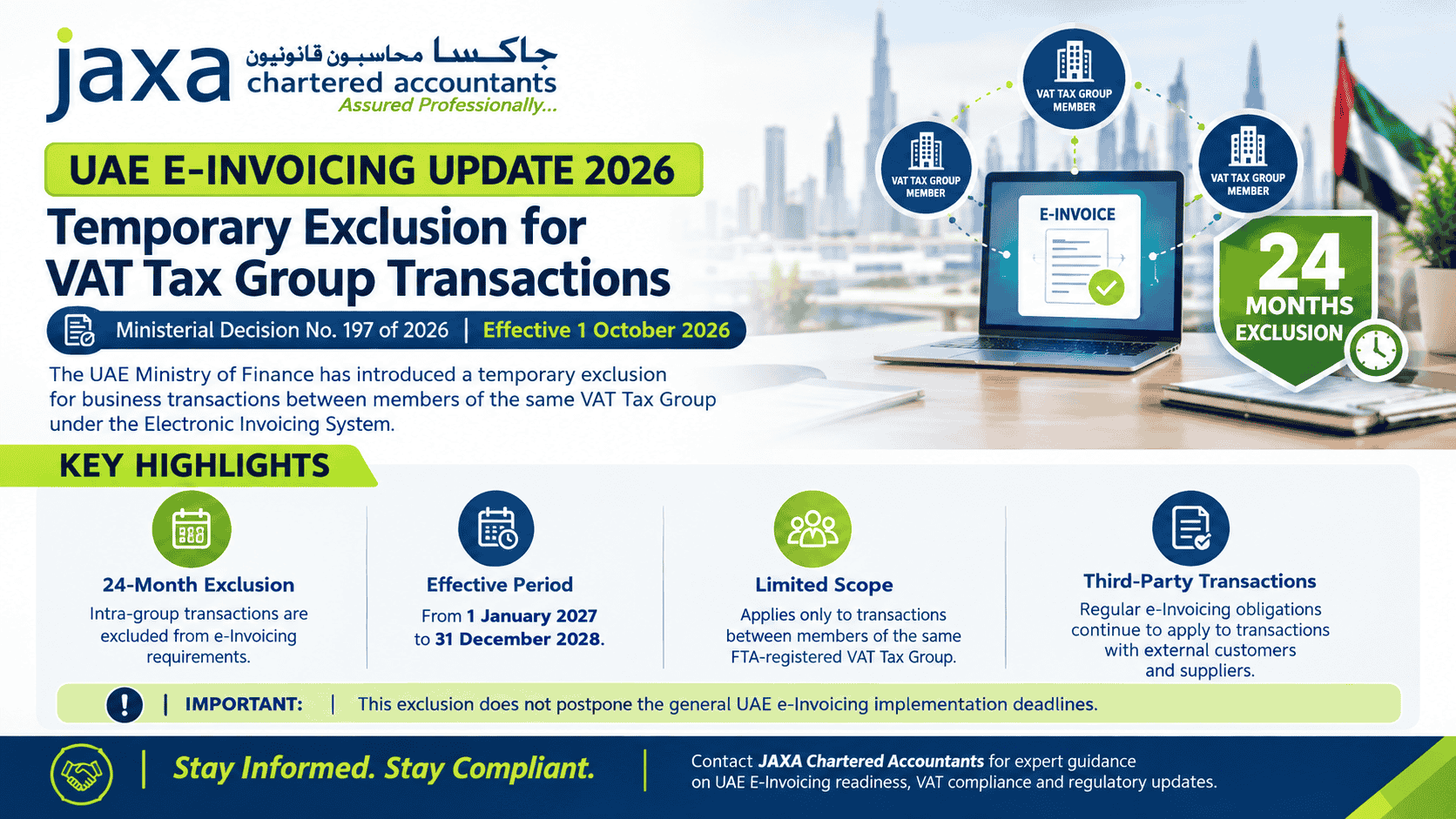

Explore the latest UAE E-invoicing: UAE Minister Decision No. 197 of 2026, including tax group exemptions, e-invoice record retention, and a 24-month tax group transaction exclusion. Get expert help from Jaxa Chartered Accountants.
The UAE Ministry of Finance has introduced amendments to the UAE E-invoicing framework, highlighting a key step in the evolution of the digital tax framework. This change brought key updates to VAT compliance, VAT return filing requirements, invoice record retention, transactions between members of the same tax Group, and the removal of specific system-failure provisions, with the amendments taking effect on October 1, 2026.
With the phased implementation of UAE E-invoicing approaching from 2027, businesses must understand these regulatory changes in strengthening VAT compliance to ensure they remain aligned with the evolving UAE tax regulations, including applicable VAT return filing requirements.
KEY HIGHLIGHTS
- 24-Month Exclusion: Intra-group transactions are excluded from e-Invoicing requirements.
- Effective Period: From 1 January 2027 to 31 December 2028.
- Limited Scope: Applies only to transactions between members of the same FTA-registered VAT Tax Group.
- Third-Party Transactions: Regular e-Invoicing obligations continue to apply to transactions with external customers and suppliers.
About: Latest UAE E-invoicing Update
The UAE Ministry of Finance has issued amendments to the country’s E-invoicing system through Ministerial Decision No. 197 of 2026, revising certain provisions of Ministerial Decision No. 243 of 2025, effective from October 1, 2026.
The key updates focus on three key areas that businesses should consider while reviewing UAE E-invoicing and tax compliance procedures.
- Temporary Exclusion for Intra-Tax Group Transactions
- Revised rule in E-invoicing Record Storage
- Clarification on the deadline for issuing E-tax invoices and credit notes
- Removal of specific system failure provisions
One must understand the scope of each amendment and its implications for businesses and determine how the revised provisions apply to their existing e-invoicing procedures and tax compliance obligations.
-
Intra-Tax Group Transactions Excluded from UAE-E -invoicing for 24 Months:
As per the amended regulations, transactions between members of the same UAE VAT tax Group will be classified as excluded transactions for a temporary period of 24 months, effective from January 1, 2027.
This update provides eligible businesses to reassess their intra-group transaction processes under the revised e-invoicing regulations.
Key factors:
- Identify transactions conducted between members of the same VAT tax Group
- Determine which transactions qualify for temporary e-invoicing exclusion.
- Review internal invoicing workflows and update relevant accounting procedures
- Maintain appropriate transaction records to support VAT reporting and compliance.
Note: Businesses must continue to meet existing VAT obligations, such as maintaining accurate records, filing UAE VAT returns on time, and other compliance requirements.
- Relaxed Rule for storage of UAE E-Invoicing Records: As per Ministerial Decision No. 197 of 2026, which amends Article 11 of UAE E-invoicing regulations, the requirement to store electronic invoices, electronic credit notes, and associated data within the UAE has been removed. This amendment eliminates this geographical restriction on storing e-invoicing records exclusively within the UAE.
These records must be easily accessible and provided to the UAE Federal Tax Authority upon request.
Best Practices for UAE E-invoicing Record Storage
Business should:
- Maintain complete records: Keep all electronic invoices, electronic credit notes, and associated data.
- Provide UAE FTA access :Records must be fully accessible to UAE FTA upon request
- Comply with retention periods: Retain records for the period prescribed under the UAE Tax Procedure Law
- Protect record integrity:Ensure that stored data records remain secure, intact, and retrievable
The removal of the UAE-only storage requirements gives businesses greater flexibility in managing UAE E-invoicing records.
- Revised Deadline for Electronic tax Invoice and credit note issuance.
According to the new amendment, businesses must note that the deadline of 14 business days from the date of the business transaction for issuing and transmitting electronic tax invoices and electronic credit notes through the UAE E-invoicing has been set. This differs from the previous timeframe, which was specified as 14 days.
- Revised system failure reporting requirements:
The new amendment eliminates the existing rules on system failure under Ministerial Decision no. 243 of 2025. The definition of “System failure” has been removed from Article 1 of Ministerial Decision no. 243 of 2025 while Article 12 has been repealed. So, businesses are no longer required to notify the FTA of a system failure within two business days under these specific provisions.
UAE E-Invoicing Implementation 2026-2027: Key Deadlines and Business Requirements
The UAE is introducing mandatory electronic invoicing in phases. Businesses should take time to appoint an Accredited Service Provider and prepare their accounting system ahead of the relevant deadline.
Key Implementation Deadline
| Deadline | Requirement |
| October 30, 2026 | Appoint an Accredited Service Provider (ASP) for businesses with annual revenue of AED 50 million or more |
| January 1, 2027 | Mandatory e-invoicing implementation begins for the first phase |
| March 31, 2027 | Deadline for business to appoint an ASP with annual revenue below AED 50 million |
| July 1, 2027 | E-invoicing implementation begins for the second phase |
How businesses can prepare
- Appoint an Accredited Service Provider: Select an ASP approved under the UAE E-invoicing framework.
- Review accounting software: Assess whether existing accounting or ERP software can integrate with the UAE E-invoicing system.
- Prepare for structured E-invoices: Ensure invoices can be generated and exchanged in the required electronic format.
- Plan system integration: Coordinate with the chosen ASP to complete onboarding, testing, and technical integration before the applicable deadline.
Preparing in advance and taking necessary steps helps businesses in avoiding last-minute challenges, it would help businesses in transitioning to the new system smoothly while maintaining UAE VAT compliance.
Stay ahead in 2027 with Jaxa Auditors by your side
How businesses can prepare for the Updated UAE E-Invoicing Framework
As the UAE E-invoicing requirements continuously bring new updates, businesses should review their existing processes and take necessary steps to prepare for the applicable compliance deadline.
Key areas to focus:
- Review Tax Group Transactions: Find out transactions between members of the same VAT tax group and assess whether they qualify for temporary exclusion from E-invoicing requirements for 24 months from January 1, 2027.
- Review record-retention practices: Ensure electronic invoices, electronic credit notes, and other connected data are retained for the period prescribed under UAE Tax procedures law and can be provided to the FTA upon request.
- Assess system readiness: Review your existing accounting software or ERP system to determine if it supports UAE E-invoicing requirements.
- Update compliance procedures: Align invoicing workflows and record-keeping practices with the applicable E-invoicing requirements.
- Track key deadlines: Confirm your relevant ASP appointment and implementation dates based on business type and annual revenue.
- Seek professional expertise: Consult a qualified tax professional for expert advice on UAE E-invoicing, tax group transactions, and VAT compliance.
Stay compliant with confidence—seek expert help from Jaxa Chartered Accountants UAE FTA tax agent, for expert tax and E-invoicing Guidance.
Prepare for UAE E-Invoicing with Jaxa Chartered Accountants
The UAE’s updated E-invoicing regulations highlight the importance of staying informed about evolving tax requirements. With the right preparation and expert guidance, businesses can navigate these changes more effectively.
With expertise in UAE tax regulations, Jaxa Auditors, a UAE FTA-registered tax agent, provided expert tax guidance to businesses in navigating UAE VAT compliance and e-invoicing requirements.
Our seasoned experts offer comprehensive audit, tax, and advisory services to businesses across the UAE. With 19+ years of experience and as a UAE FTA tax agent, our VAT experts support businesses:
- UAE VAT registration
- UAE VAT return filing
- UAE VAT compliance
- UAE VAT audit services
- UAE E-invoicing preparation and implementation
- UAE VAT health check
- UAE VAT Refund Assistance
Along with this above, our experts also provide corporate tax services, audit and assurance, and accounting and bookkeeping services in the UAE.
Our VAT consultants in the UAE support businesses in reviewing tax procedures, maintaining accurate financial records and adapting to changes in UAE tax regulations.
Stay prepared for Tomorrow’s Tax Requirements
Speak to Jaxa Auditors to strengthen your UAE tax compliance and prepare for UAE E-invoicing implementation.
Book a Free Consultation Now.



 Reach us on WhatsApp
