
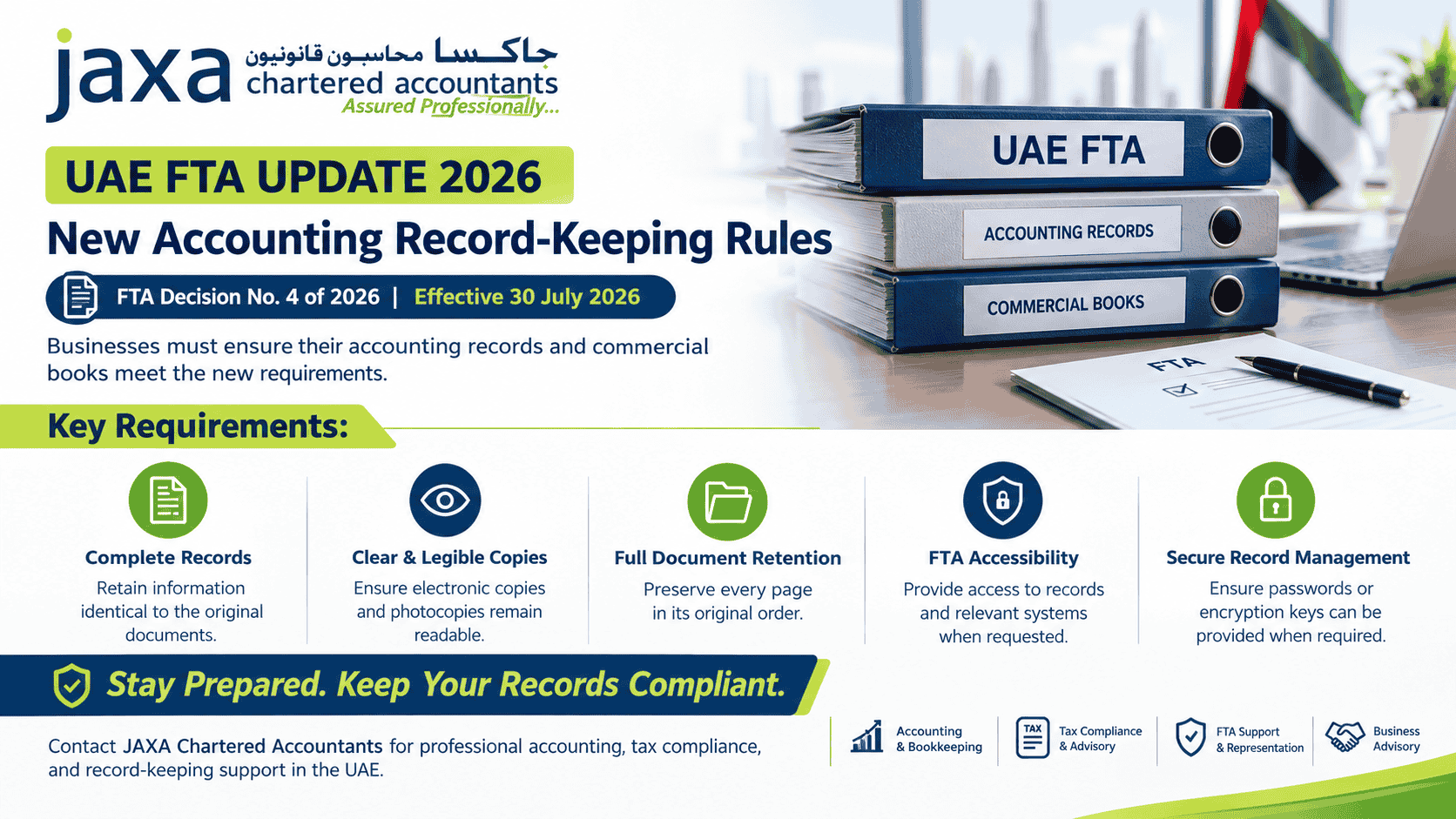

Understand UAE FTA Decision No. 4 of 2026 and accounting record-keeping requirements. Explore document accuracy, electronic records, retention and UAE Corporate tax compliance.
Effective 30th July, 2026
As the UAE Corporate tax landscape continues to evolve, businesses are placing greater emphasis on maintaining accurate financial records and meeting ongoing compliance obligations. Beyond meeting registration and corporate tax filing obligations, businesses must ensure that their accounting record and supporting documents are complete, accurate, legible and accessible.
To address these record-keeping considerations, the FTA issued Decision No. 4 of 2026 outlining the rules and requirements for maintaining information contained in accounting records and commercial books. This Decision was issued on June 2, 2026 and effective from July 30, 2026. This measure is relevant to businesses reviewing their accounting processes, digital document storage and tax compliance processes.
These requirements are relevant to businesses that rely on digital accounting systems, electronic document storage and scanned copies of supporting records. This article outlines the key requirement of FTA Decision No. 4 of 2026 and explains its impact on accounting and tax compliance.
Jaxa Chartered Accountants LLC’s tax consultant guides businesses in interpreting the requirements of FTA Decision No.4 of 2026 identifying potential record-keeping gaps and implementing appropriate compliance measures.
Existing UAE Corporate Tax Record-Keeping Requirements
Before understanding the significance of UAE FTA Decision No. 4 of 2026, businesses must first consider the existing record-keeping obligations set by the UAE Corporate tax law and its Executive Regulations.
According to Article 56 of Federal Decree Law No. 47 of 22 on taxation of Corporations and Businesses, as amended, it requires Taxable persons to maintain records and documents that support the importation reported while filing UAE Corporate tax Return and submitting other documents to the UAE Federal Tax Authority. These records must also enable the UAE FTA to readily ascertain the taxable person’s taxable income.
Similarly, exempt persons must maintain records and documents that enable the FTA to verify their exempt status under UAE Corporate tax regulations.
Keeping accurate and complete records is essential for UAE corporate tax compliance and corporate tax audits. Adhering to UAE Corporate tax record-keeping requirements enables businesses to maintain reliable financial documentation, support the accuracy of their tax return, meet FTA compliance obligations and ensure they are adequately prepared for UAE Corporate tax audit.
The UAE Corporate tax Executive Regulation further specifies the types of accounting and commercial books that businesses must maintain. These include:
- Balance sheets and profit and loss accounts
- Payroll and employee-related record
- Fixed asset registers and inventory records
- Invoices, contracts, licenses and business correspondence
- Documents supporting tax election, assessments, determinations and calculations, including their underlying basis or methodology.
Maintaining a complete and reliable record helps businesses substantiate tax positions and respond to FTA requests.
What should UAE businesses do?
To strengthen UAE Corporate tax compliance, businesses should review whether their accounting records and tax calculations are supported by appropriate documentation. This includes checking that tax calculations, exemption claims, related-party transactions and other significant tax positions can be substantiated when required.
Jaxa Chartered Accountants LLC, a leading corporate tax consultant in the UAE, can guide businesses in reviewing their accounting documentation, identifying potential compliance gaps, and strengthening their record-keeping procedures to support Corporate tax reporting and FTA audit readiness.
What does FTA Decision No. 4 of 2026 mean for UAE Businesses?
As per FTA Decision No. 4 of 2026 sets out specific requirements for maintaining accounting records and commercial books in the UAE. Businesses must ensure that their records meet the prescribed standards for completeness, accuracy, legibility and accessibility, especially when documents may be requested by the UAE FTA during a corporate tax audit or compliance review.
Key record-keeping requirements:
Under the Decision, business should ensure that their accounting records and supporting documents meet the following requirements:
- Document completeness: Retain the full content of original documents, including all relevant information and details
- Original document integrity: Ensure that electronic copies and photocopies accurately reproduce the information contained in the originals
- Legibility: Keep records clear, readable, and suitable for review.
- Preservation of documents details: Ensure that copies retain the relevant information contained in the original documents. Businesses should avoid incomplete scans or missing pages that could prevent the information from being verified.
- Full document scanning: Ignore partial scanning, as retaining only selected pages does not meet the prescribed requirements.
- FTA accessibility: Organize records so they can be retrieved and provided to the UAE FTA when requested.
Preparing for a UAE Corporate tax audit
Maintaining accurate accounting and supporting records is essential for UAE Corporate tax compliance. Businesses should regularly review their record-keeping procedures, verify the accuracy of digital documents and ensure that financial records are readily available to meet FTA requirements. These measures help maintain UAE corporate tax return, minimize compliance risks and improve audit preparedness for UAE corporate tax or FTA tax inspection.
Key requirements under the UAE Accounting Record-keeping rules
- Electronic Record-keeping Requirements: Maintaining electronic records is an important part of UAE corporate tax compliance. Under FTA Decision No.4 of 2026, Electronic Copies and Photocopies must meet specific quality standards to ensure that the information in the original documents remain clear and legible throughout the applicable record-keeping period.
Key requirements for electronic copies and photocopies:
Businesses should ensure that retained documents meet the following standards:
- Readability: Electronic copies must display clearly on a computer screen, allowing the information to be read without difficulty.
- Accuracy: The information in a retained copy must match the original document.
- Copy quality: Photocopies must use suitable paper and ink to prevent the information from fading during the required retention period.
- Colour flexibility: Non-coloured copies of coloured documents are acceptable, provided all information remains clearly legible.
- Long-term accessibility: Electronic record must remain readable and accessible throughout the applicable record-retention period.
The best thing is to periodically review the digital copies to identify missing pages, unreadable scans, incomplete attachments and documents that cannot be opened or reproduced.
- UAE FTA Access to Electronic Accounting records and system: FTA Decision No. 4 of 2026 establishes requirement for providing the FTA with access to their accounting records and commercial books upon request including access to the system in which these records are stored.
Businesses must ensure that password-protected or encrypted electronic records remain accessible to the FTA upon request. Where required under FTA Decision No. 4 of 2026, the necessary password or encryption keys must be provided to facilitate access to the relevant records and system.
These requirements are particularly relevant to businesses using cloud-based accounting software, an entire resource planning (ERP) platform and electronic document management system to maintain UAE corporate tax records.
To support effective record management and regulatory compliance, business should:
- Maintain access control: Establish appropriate procedures for authorised access to accounting records and supporting documentation.
- Ensure system continuity: Preserve access to records when accounting software is upgraded, replaced or migrated.
- Preserve historical records: Retain historical accounting information in complete, legible, and reproducible formats.
- Establish retrieval procedures: Implement clear processes for locating and providing records in response to FTA requests.
- Protect digital records: Utilize appropriate security measures and regular backups to safeguard electronic records against loss, damage or unauthorized access.
Businesses should ensure that their accounting records remain accessible and retrievable, including after software changes or system migrations. Historical records should be preserved in a complete and legible format to facilitate compliance with UAE FTA requirements.
Maintaining accessible electronic records helps businesses respond to information requests and prepare the necessary documentation for a UAE corporate tax audit or FTA inspection.
- UAE Corporate tax record retention: UAE FTA decision No. 4 of 2026 introduces specific requirements for the quality completeness and accessibility of accounting records and commercial books. However, the existing statutory record-retention periods under UAE tax legislation remain applicable.
Under Article 56 of the UAE Corporate tax law, taxable persons are required to retain relevant records and documents for seven years after the end of the relevant tax period.
Business should:
- Identify the statutory retention period applicable to each category of record.
- Preserve records for the full required period.
- Ensure that retained documents remain readable and accessible
- Check whether an audit, dispute or other circumstances require additional retention
- Avoid disposing of records until the applicable retention obligation has been satisfied.
The key distinction is that the retention period determines how long records must be kept, while FTA Decision No. 4 of 2026 establishes requirements for the condition: completeness, readability and accessibility of those records. Business should ensure that retained documents continue to meet the applicable standard throughout the required retention periods.
- Keep Records Readily Accessible: Businesses must ensure that accounting records and supporting documents are properly organized, easy to review and easily accessible to the UAE FTA upon request. Effective record management helps businesses respond promptly to information requests and prepare for a UAE Corporate tax audit.
- Organize documentation: Maintain accounting records in a structured format for easy retrieval.
- Consistent file management: Use clear file names and retain all relevant attachments and supporting documents.
- Centralized digital storage: Store records in a secure digital archive with appropriate access controls.
- Regular backups: Protect electronic records against accidental loss or damage.
- Document retrieval procedures: Establish clear processes for locating and submitting records during UAE FTA inquiries or a corporate tax audit.
Jaxa Auditors, a UAE FTA tax agent, with 19+ years of experience, supports businesses with accounting, auditing, taxation and compliance needs.
Why Record-Keeping Matters for UAE corporate tax audits
A UAE corporate tax audit may take place several years after a corporate tax return has been filed. If supporting documents are incomplete, inaccessible or poorly organized, verifying past transactions and justifying the tax treatment applied can become challenging. Maintaining a clear audit trial helps preserve their tax position and respond efficiently to the UAE FTA requests.
Businesses should retain appropriate evidence for key tax positions, particularly those involving:
- Transfer pricing and related party transactions
- Participation exemption claims
- Tax loss utilization
- Business restructuring relief and Qualifying Group Relief
- Interest deduction limitations
- Free Zone corporate tax treatment
Full complete and accessible documentation helps businesses demonstrate compliance with UAE corporate tax regulations and respond effectively to FTA queries during UAE Corporate Tax audits.
Best practice for UAE Corporate Tax Record-Keeping and Compliance
To comply with the FTA Decision. No 4 of 2026, businesses should ensure that accounting records and commercial books the applicable requirements for completeness, legibility and accessibility.
- Review records: Check accounting records and supporting documents for accuracy and completeness.
- Verify copies: Ensure electronic copies and photocopies are complete, legible and maintained in the required page order.
- Check supporting evidence: Identify missing invoices, contracts, bank statements and other relevant documents.
- Improve document management: Establish reliable digital archiving and retrieval procedures.
- Review retention periods: Ensure records are preserved for the applicable statutory retention period.
- Reconcile financial information: Check consistency between accounting records, financial statements and corporate tax calculations.
- Conduct periodic compliance reviews: Identify missing documents and address record-keeping gaps before an FTA request or corporate tax audit.
How Jaxa Auditors can help
Jaxa Chartered Accountants provide audit, tax, and accounting with compliance and advisory services to help businesses navigate UAE tax compliance requirements. With 19+ years of experience, Jaxa supports businesses in reviewing their accounting processes, strengthening documentation practices and preparing for UAE corporate tax compliance obligations.
For professional guidance on UAE Corporate tax record-keeping and compliance, connect with Jaxa Auditors.
Seek our team of experts for Corporate tax services in the UAE
Navigating UAE corporate tax regulations requires accurate record-keeping, proper documentation and a clear understanding of applicable tax legislation. Jaxa Auditors, a UAE FTA tax agent offers professional audit, tax, and advisory services to help businesses manage their compliance obligations effectively.
Our team of corporate tax consultants assists businesses in understanding UAE corporate tax requirements, reviewing accounting and documentation practices and preparing for FTA reviews and corporate tax audits. With 19+ years of experience, we provide guidance tailored to each businesses’ tax and compliance needs.
For expert assistance with FTA Decision No. 4 of 2026 , UAE corporate tax record-keeping requirements and tax compliance, contact our team to discuss your business requirements.
Stay updated. Stay confident. Trusted Expertise.
FAQ
- What is FTA Decision No. 4 of 2026?
This Decision establishes rules and requirements for maintaining information contained in accounting records and commercial books. It addresses the completeness, accuracy, legibility, and accessibility of records maintained by businesses.
- When did FTA Decision No. of 2026 come into effect?
The Decision was issued on June 02, 2026 and became effective on July 30, 2026.
- How long must UAE corporate tax records be retained?
Generally, Corporate tax records must be retained for seven years after the end of the relevant tax period.
- Does FTA Decision No. 4 of 2026 change the UAE corporate tax record-retention period?
No. The Decision establishes standards for maintaining accounting records and commercial books; it does not change the existing statutory retention periods. Under Article 56 of UAE corporate tax law, relevant records must generally be retained for seven years following the end of the relevant tax period.
- How Jaxa assists with UAE tax record-keeping compliance?
Jaxa Chartered Accountants, a best UAE FTA tax agent, helps businesses in staying updated with UAE tax latest updates. Our experts provide audit, accounting , tax and advisor services to help businesses review their documentation practices, identify potential compliance gaps and strengthen their readiness for UAE tax reviews and audits.




 Reach us on WhatsApp
