
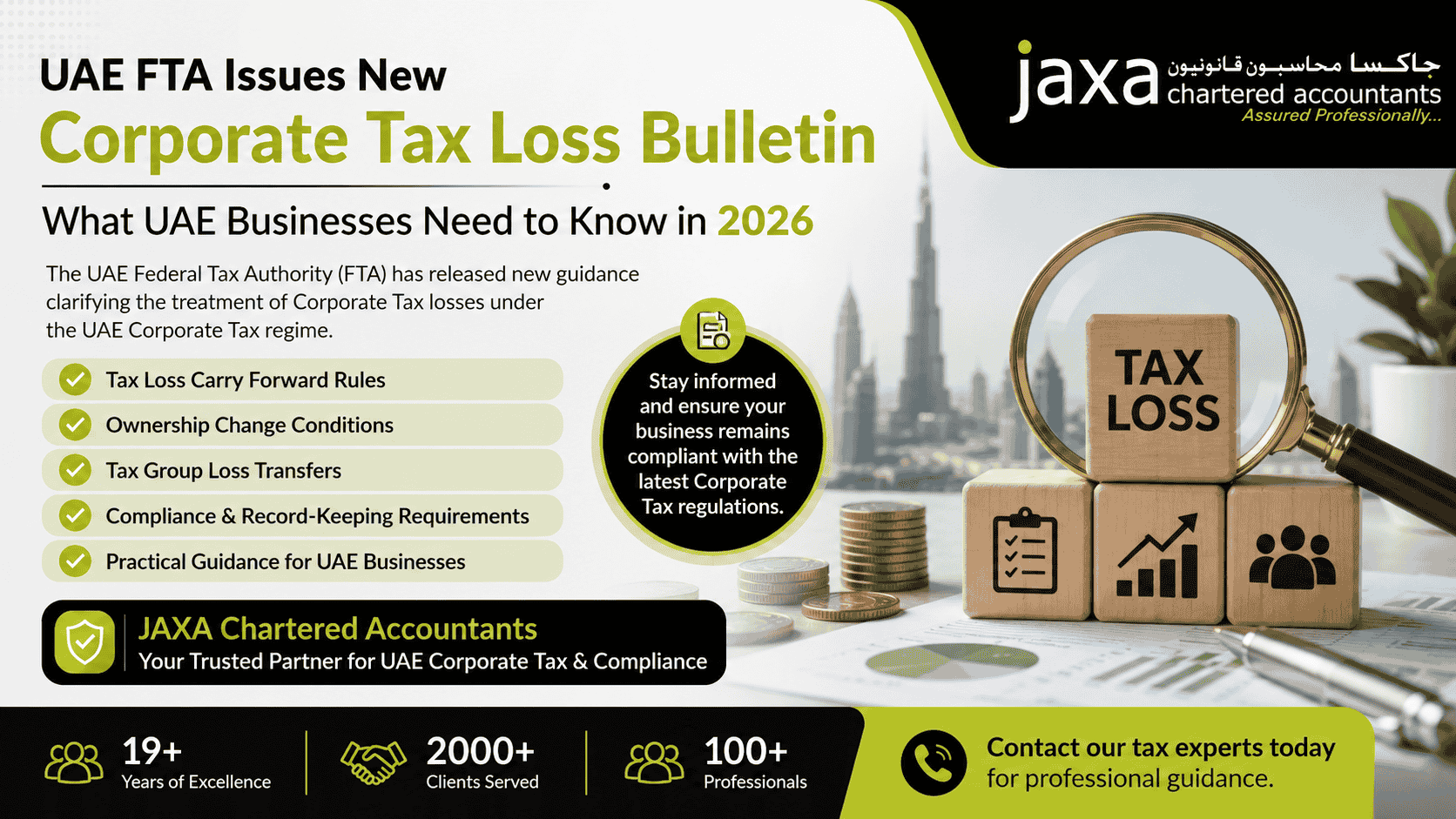

As the UAE corporate tax framework evolves, the Federal Tax Authority (FTA) continues to provide practical guidance to help businesses understand and apply the corporate tax law correctly. On 25th June, 2026, the UAE FTA published the Basic Tax Information Bulletin on corporate tax losses, summarising valuable information on the treatment of tax losses, including the rules for carrying corporate tax losses forward, transferring losses within qualifying groups, and the circumstances under which losses may be forfeited.
These bulletins provide businesses with simplified but valuable guidance for companies preparing for UAE corporate tax returns and reviewing their tax position while helping them manage tax losses accurately and remain compliant with the UAE Corporate Tax Law.
In this guide, we examine the key provisions of the UAE FTA’s latest bulletin, discuss their practical implications, and explain how businesses can ensure compliance with the UAE Corporate Tax law while effectively managing tax losses.
Who should read the UAE FTA’s corporate tax Loss Bulletin?
The UAE FTA’s Basic Tax Information Bulletin on Corporate Tax Losses is a valuable resource for business and professionals responsible for managing corporate tax compliance in the UAE. It provides practical guidance on the key aspects of tax loss treatment under the UAE corporate tax regime.
The bulletin explains:
- Definition and calculation of a corporate tax loss
- Items that do not qualify as a tax loss
- Relief available for eligible tax losses
- Rules for carrying forward tax losses
- Limitation on the utilization of carried forward losses
- Circumstances where tax losses may be forfeited
- Conditions for transferring tax losses within qualifying groups
- The impact of electing for Small Business Relief (SBR)
Understanding these sections can help businesses apply the UAE corporate tax rules correctly, minimize compliance risk and make informed tax planning decisions.
What are corporate tax losses in the UAE?
A corporate tax loss arises when a business’s allowable tax-deductible expenses exceed its accounting revenue earned during a tax period, resulting in a negative taxable income. Subject to the provisions of UAE corporate tax law, qualifying expenses such as operating costs, employee salaries, office rent, depreciation of business assets, and eligible interest expenses may contribute to the calculation of a tax loss.
Suppose: A company reports AED 100,000 in Revenue but has AED 120,000 in eligible business expenses during a financial year. Since its allowable deductions exceed its income, the company records a corporate tax loss of AED 20,000. This loss may be carried forward and utilized in future tax periods, depending on its eligibility under the UAE corporate tax law.
It is to be noted that corporate tax losses are calculated differently from accounting losses. The UAE corporate tax law applies specific rules when calculating taxable income, meaning some expenses may not be deductible, and certain types of income may be exempt.
What counts as a UAE corporate tax loss?
A corporate tax loss is not solely based on the profits or losses reported in a company’s financial statements. Instead, it is calculated after applying the adjustments required under the UAE Corporate tax law to the reported profits or losses to determine the taxable income for the relevant tax period.
As a result, an accounting loss and a corporate tax loss may differ. This is due to a factor in which corporate tax computation takes into account several tax-specific adjustments, including:
- Non-deductible expenses that must be added back, such as entertainment excesses, fines and penalties, etc.
- Exempt income that is excluded from taxable income, including qualifying dividends and eligible gains under the participation exemption.
- Transfer pricing adjustments where transactions between related parties do not comply with the arm’s length principle.
The corporate tax computation, after applying all adjustments required under the UAE corporate tax law, determines whether a business has incurred a corporate tax loss. These adjustments determine the final taxable income or tax loss for the relevant tax period, which may differ from accounting results.
Can UAE corporate tax losses be carried forward?
One of the key features of the UAE corporate tax regime is the ability to carry forward eligible corporate tax losses. With the provision of the UAE corporate tax law, eligible corporate tax losses may be carried forward to future tax periods. This allows businesses to offset qualifying tax losses against future taxable income, helping to reduce their corporate tax liability once they become profitable.
The ability to carry forward corporate tax losses provides important tax relief for businesses that experience temporary financial setbacks. By offsetting eligible tax losses against future taxable profits, businesses can improve cash flow while ensuring compliance with the UAE corporate tax framework.
Businesses must meet eligibility criteria and comply with the limitations under the UAE corporate tax law. Before claiming corporate tax loss relief in the UAE, it is advisable to review the applicable conditions to ensure accurate corporate tax reporting and compliance.
Which losses cannot be claimed as UAE Corporate tax losses?
Not every loss recorded by a business qualifies as a corporate tax loss under the UAE corporate tax law. Certain losses are specifically excluded and cannot be utilized to offset future taxable income.
These include:-
- Losses incurred before the UAE corporate tax regime came into effect on 1st June 2023.
- Losses incurred before a business became a taxable person under corporate tax law.
- Losses arising from activities that do not generate taxable income, such as activities related to exempt income.
Understanding these exclusions is important, as only eligible corporate tax losses can be carried forward and utilized in accordance with the conditions prescribed under the UAE corporate tax law.
What tax relief is available for UAE corporate tax losses?
Under the UAE corporate tax law, businesses that incur eligible corporate tax losses may benefit from tax relief in two ways, subject to the applicable conditions:
- Carrying forward eligible corporate losses to offset future taxable income
- Transferring tax losses to another eligible taxable person within the same qualifying group, enabling the recipient to offset the transferred losses against its taxable income.
Eligible businesses should assess their eligibility carefully, as both reliefs are subject to specific requirements under the UAE corporate tax regime.
How does tax loss carry forward relief work?
Under the UAE corporate tax law, a taxable person may carry forward eligible corporate tax losses to future tax periods, provided the relevant conditions are met. This allows businesses to offset qualifying tax losses against future taxable income and potentially reduce their corporate tax liability.
While carrying forward corporate tax losses, businesses should be aware of the following key rules:
- Up to 75% of taxable income can be offset: In each future tax period, a taxable person may utilize carried forward tax losses to offset up to 75% of its taxable income for that period, calculated before applying any tax loss relief. The remaining taxable income, if any, will continue to be subject to the UAE corporate Tax.
- Tax losses must be utilized on a first-in, first out (FIFO) basis: If a business has tax losses from multiple tax periods, the oldest eligible tax losses must be utilized the oldest available tax losses first. This first-in, first-out (FIFO) approach ensures tax losses are applied in the order in which they were incurred.
- Tax losses must be fully utilized within the permitted limit: Under the UAE corporate tax law, a taxable person is required to utilize carried forward tax losses to the maximum amount permitted under the UAE CT law, including the 75% utilization limit. It is not permitted to claim a lower amount to retain more tax losses for future tax periods. Any remaining eligible tax losses may be carried forward as per the UAE CT law.
Example:
Suppose a company has:
Taxable income: AED 1,000,000 ( before applying tax loss relief)
Carried forward corporate tax losses: AED 3,000,000
Since only 75% of the taxable income can be offset, the company can utilize AED 750,000 of its carried-forward tax losses.
The outcome would be:
Taxable income after tax loss relief: AED 250,000
Remaining tax losses available for future tax periods: AED 2,250,000
The businesses cannot choose to utilize less than AED 750,000 to preserve more tax losses for future years.
- A business must use its own tax losses before transferred tax losses: If a taxable person has both its own carried forward tax losses and tax losses transferred from another eligible taxable person, it must first utilize its own carried forward tax losses before utilizing any transferred tax losses.
A taxable person cannot transfer its own tax losses to another eligible taxable person until it has first fully utilized its own carried forward tax losses for that specific period.
Partnering with the best corporate tax advisor in Dubai, such as Jaxa Chartered Accountants, provides accounting, tax computation, and FTA compliance services, helping businesses to apply the latest FTA guidance with confidence.
What are the limitations on carrying forward tax losses?
The UAE corporate tax law allows eligible tax losses to be carried forward, subject to certain conditions. Key limitations include:
- Change in ownership: The right to carry forward tax losses may be restricted if there is a change in ownership of more than 50%, either directly or indirectly.
- Continuity of business: Where ownership changes by more than 50%, the taxable person can generally continue to carry forward tax losses only if it carried on the same or similar business or business activity.
- Business continuity assessment: the key factors while considering business continuity include:
- Continued use of substantially the same business assets
- Maintenance of the core business operations
- Changes that represent the natural development or expansion of the existing business rather than a completely new business activity.
- Listed company exception: The ownership change restriction does not apply if the taxable person’s shares are listed on a recognized stock exchange, as per UAE corporate tax
Under what circumstances are UAE corporate tax losses forfeited?
Under the UAE corporate tax regulations, a taxable person may forfeit its eligible tax losses in certain circumstances:
- If there is a change in ownership exceeding 50% and the business no longer carried on the same or similar business activity.
- UAE Corporate tax deregistration, where the taxable person ceases to be subject to UAE corporate tax.
What are the conditions for transferring tax losses?
Under the UAE corporate tax, tax losses can only be transferred between eligible taxable persons if all the following conditions are fulfilled:
| Conditions | Requirement |
| Judicial person | Both entities must be judicial such as LLCs. Tax losses cannot be transferred to or from a natural person. |
| Resident person | Both entities must be resident persons for UAE corporate tax. The transfer of tax losses is not possible to or from a non-resident person even if such person is subject to UAE corporate tax. |
| 75% ownership | One taxable person must directly or indirectly own at least 75% of the ownership interest of the other or the third person owns at least 75% of each taxable person. |
| Not an exempt person | Neither entity can qualify as an exempt person under the UAE corporate tax law |
| Not a qualifying free zone person (QFZP) | Tax loss transfer are not available for qualifying free zone person (QFZP)
|
| Same financial year | Both entities must have the same financial year-end |
| Same accounting standards | Both entities must prepare financial statements using the same accounting standards, such as IFRS. |
With extensive experience in UAE corporate tax implementation and as an FTA-approved tax agent, Jaxa Chartered Accountants helps businesses implement the latest UAE FTA guidance while ensuring compliance with the UAE corporate tax law.
What is the impact of electing for small business relief (SBR)?
A resident person who elects for small business (SBR) under the UAE corporate tax law should be aware of the implications for the treatment of tax losses.
- Tax losses that arise during a tax period in which SBR is claimed cannot be carried forward.
- Carried forward tax losses can be used in the tax periods in which SBR is not availed.
Why the UAE FTA’s Corporate Tax Loss Bulletin is Important
The UAE FTA’s Basic Tax Information Bulletin on Corporate Tax Losses, published on 25th June 2026, provides businesses with practical guidance on the application of the UAE corporate tax law. By clearly understanding the treatment of corporate tax losses, the bulletin helps businesses better understand their corporate tax obligations and support consistent corporate tax compliance.
For businesses, this bulletin helps:
- Accurately calculate eligible tax losses
- Understand eligibility for tax loss relief
- Apply the carry-forward and transfer loss rules with confidence
- Reduce the risk of errors in corporate tax return preparation
- Comply with the latest UAE corporate tax requirements
- Applying the rules related to small business relief (SBR)
If clarification is required, seeking advice from a UAE FTA-registered tax agent as well as an accounting and auditing firm in the UAE, such as Jaxa Chartered Accountants, can help businesses interpret the FTA guidance correctly and meet corporate tax compliance with confidence.
How Jaxa, the best UAE Tax Agent, can help
Navigating and applying corporate tax rules in the UAE is always challenging. From determining tax losses, claiming tax loss relief, and meeting the latest FTA updates, businesses need to ensure every step complies with the UAE corporate tax law. A small mistake in corporate tax computation can affect a business’s tax position and compliance with UAE FTA regulations.
That’s where Jaxa Auditors can help.
As a UAE FTA-registered tax agent with over 19 years of accounting, auditing, and taxation experience, Jaxa supports businesses across the UAE with reliable corporate tax advisory and compliance services. Our tax agents in the UAE help you interpret the latest FTA guidance.
Our corporate tax experts help you:
- Assess and calculate eligible tax losses
- Determine eligibility for tax loss carry forward and transfer loss
- Evaluate the impact of SBR on your corporate tax position
- Prepare an accurate corporate tax return
- Ensure compliance with UAE FTA regulations
Whether you’re planning to prepare for the UAE corporate tax return or registering for corporate tax, deregistering UAE corporate tax, or need guidance for FTA corporate tax updates, Jaxa Auditors is there for you for practical, business-focused services tailored to your specific requirements while helping you stay compliant.
Need expert UAE corporate tax guidance? Speak to Jaxa Auditors to ensure your business meets corporate tax obligations with confidence.



 Reach us on WhatsApp