
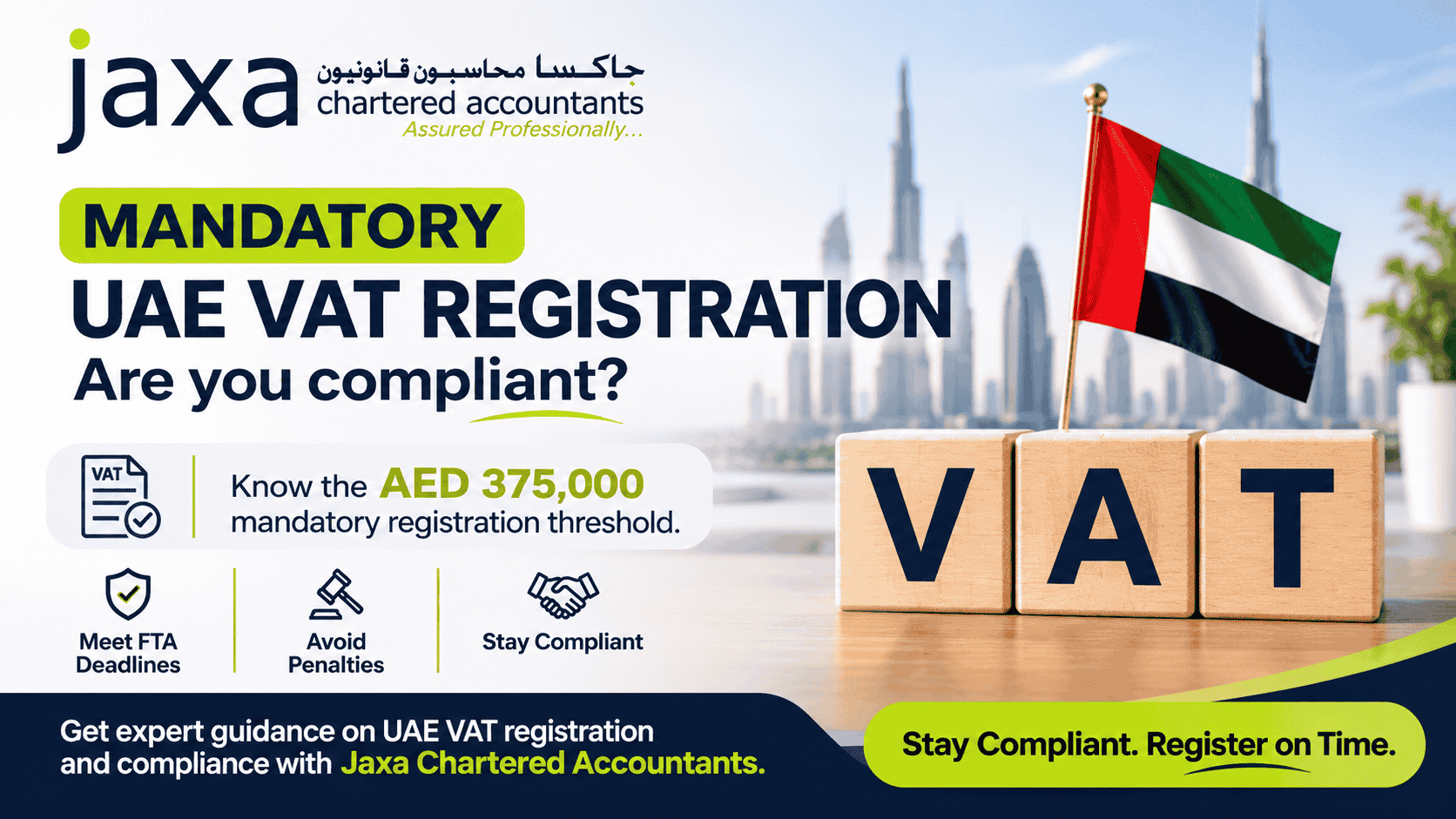

For businesses operating in the UAE, knowing when to register for UAE VAT with the UAE FTA is a crucial aspect of financial and regulatory compliance. The UAE VAT registration threshold of AED 375,000 determines when a business must file for VAT registration with the Federal Tax Authority. Understanding these requirements helps businesses to meet compliance deadlines and manage their tax responsibilities effectively.
Whether you operate a mainland business, a free zone company or an e-commerce business in the UAE, VAT registration becomes mandatory. Once taxable turnover exceeds AED 375,000, businesses must complete the UAE VAT registration process through the UAE FTA’s EmaraTax portal within the prescribed timeframe.
This article examines the mandatory registration threshold, necessary documentation, and the FTA’s Emaratax application process, alongside important VAT penalty and E-invoicing updates in 2026.
What is mandatory VAT registration in the UAE?
Under UAE VAT legislation, businesses are required to register for VAT in UAE in the Federal Tax Authority’s Emartax portal when their taxable turnover meets the mandatory registration threshold of AED 375,000.
The registration requirements apply when:
- The total value of taxable supplies and imports exceeds AED 375,000 over the previous 12-month period.
- The business anticipates exceeding AED 375,000 in taxable supplies and imports within the following 30 days.
For example, a company generating AED 400,00 in taxable supplies and imports over the past 12 months must assess its mandatory VAT registration obligations.
UAE VAT Registration Deadline
Once a business becomes eligible for mandatory VAT registration, it must submit its application to the UAE FTA within 30 days of becoming liable to register. Failure to register within the stipulated deadline may attract FTA administrative penalties.
What is Voluntary VAT Registration in the UAE?
Voluntary VAT registration in the UAE allows businesses to register with UAE VAT even when their taxable turnover has not reached the mandatory registration threshold.
The voluntary VAT registration threshold is AED 187,500.
Who can apply for Voluntary UAE VAT registration?
A business may qualify for voluntary VAT registration when:
- Its taxable supplies and imports exceeded AED 187,500 over the previous 12 months.
- Its expected taxable supplies and imports exceed AED 187,500 within the next 30 days.
- Its qualifying table expenses exceed AED 187,500 over the previous 12 months or are expected to exceed this amount within the next 30 days.
For example: A newly established business with AED 100,000 in taxable sales and AED 220,000 in qualifying taxable business expenses may qualify for voluntary VAT registration, even though its sales remain below the mandatory registration threshold.
Mandatory vs Voluntary VAT Registration in the UAE: Key Differences
The UAE VAT framework provides two types of VAT registration: mandatory and voluntary. While both require businesses to comply with UAE FTA regulations, they differ in eligibility threshold, registration obligations, and application requirements.
Comparison of Mandatory and Voluntary VAT Registration
| particulars | Mandatory VAT registration | Voluntary VAT registration |
| Registration threshold | AED 375,000 | AED 187,500 |
| Nature of registration | Legally required | Optional for eligible businesses |
| Turnover assessments | Taxable supplies and imports | Taxable supplies and imports |
| Expenses -based eligibility | Not applicable as standalone threshold | Qualifying taxable expenses can establish eligibility |
| Assessment timeline | Previous 12 months or subsequent 30 days | Previous 12 months or subsequent 30 days |
| Application deadline | Within 30 days of becoming liable to register | No equivalent mandatory 30-day application deadline |
| Post-registration obligation | VAT returns, tax payments, and record maintenance | VAT returns, tax payments, and record maintenance |
Mandatory registration is a statutory obligation for businesses meeting the AED 375,000 threshold, whereas voluntary registration provides eligible businesses with the option to register once they meet the AED 187,500 threshold.
Once registered, businesses under both categories must comply with application VAT invoicing, reporting, payments and record-keeping requirements prescribed by the UAE FTA.
Who needs Mandatory VAT Registration in Dubai and across the UAE?
Mandatory VAT registration applies to eligible businesses across the UAE and Dubai, regardless of their legal structure or location. The following business categories must assess their UAE VAT obligations.
- Mainland companies
- Free zone companies
- Sole establishments and freelancers
- Non-residents business
- Designated zone business
Multiple branches and trade license: where branches operate under the same legal entity, their relevant taxable supplies are considered together while assessing the mandatory VAT registration threshold.
How to calculate Taxable turnover for VAT Registration in the UAE?
Calculating taxable turnover accurately is key to determining whether a business meets the mandatory VAT registration threshold in the UAE. The calculation is based on the value of relevant taxable supplies and imports, rather than the business’s net profit.
What is included in the calculation?
The following categories are generally considered when assessing the VAT registration threshold:
- Standard-rated supplies: goods and services subject to the standard rate of 5% VAT.
- Zero-rated supplies: Qualifying exports, certain healthcare and educational services and other supplies eligible for 0% VAT.
- Imports: imported goods and services that would be taxable if supplies within the UAE.
What is excluded?
The following are generally excluded from the registration threshold calculation:
- VAT-exempt supplies, including qualifying financial services
- Qualifying Supplies of bare land
- Certain Exempt passenger transport services
- Out of Scope supplies
Periodic monitoring of taxable turnover is essential to identify registration obligations and maintain compliance with UAE FTA requirements.
What documents are required for registering VAT in the UAE
To fulfil mandatory VAT registration in the UAE, businesses must submit the required documents through the FTA Emaratax portal. The key documents:
- Valid UAE trade license
- Passport and Emirates ID copies of owners, partners or authorized signatures
- Memorandum of Association (MoA)
- UAE business address and contact details
- Bank account details
- Financial statements and supporting documents showing taxable turnover
- Custom registration details where applicable
Note: Ensure all documents are accurate and completed before submitting your UAE VAT registration applications. Missing information may lead to UAE FTA clarification requests and delays in obtaining your Tax Registration Number (TRN). Businesses must comply with the applicable 30-day VAT registration deadline.
Step-by-step process to register VAT in the UAE Through Emaratax
VAT registered businesses can complete their mandatory VAT registration in the UAE online through the FTA’s Emaratax portal. Follow these steps to apply for a UAE VAT Tax Registration Number (TRN):
- Log in to Emaratax: Access the FTA Emaratax portal using UAE Pass or your registered email address.
- Create a taxable person profile: Select New Taxable Person Profile from your dashboard.
- Access your taxable person account: Click View to open the relevant account
- Start VAT registration: Select Register under Value Added Tax.
- Enter business details: Provide your trade license details, legal structure, business activities and relevant business details.
- Declare taxable turnover: Report taxable supplies and imports for the previous 12 months or expected turnover for the next 30 days, as applicable.
- Upload supporting documents: Attach the required identification, business, financial and other supporting documents.
- Review and submit: verify the application form and submit for the UAE FTA review.
What happens after submitting the UAE VAT Registration Application?
The UAE FTA estimated processing time is 20 Business days from receipt of a completed application. Once it is approved, the business can access its VAT registration Certificate and Tax Registration Number (TRN) through the Emaratax dashboard.
Businesses must charge VAT on applicable taxable supplies from the effective registration date stated in the certificate.
Penalties for Missing the mandatory VAT registration Deadline in the UAE
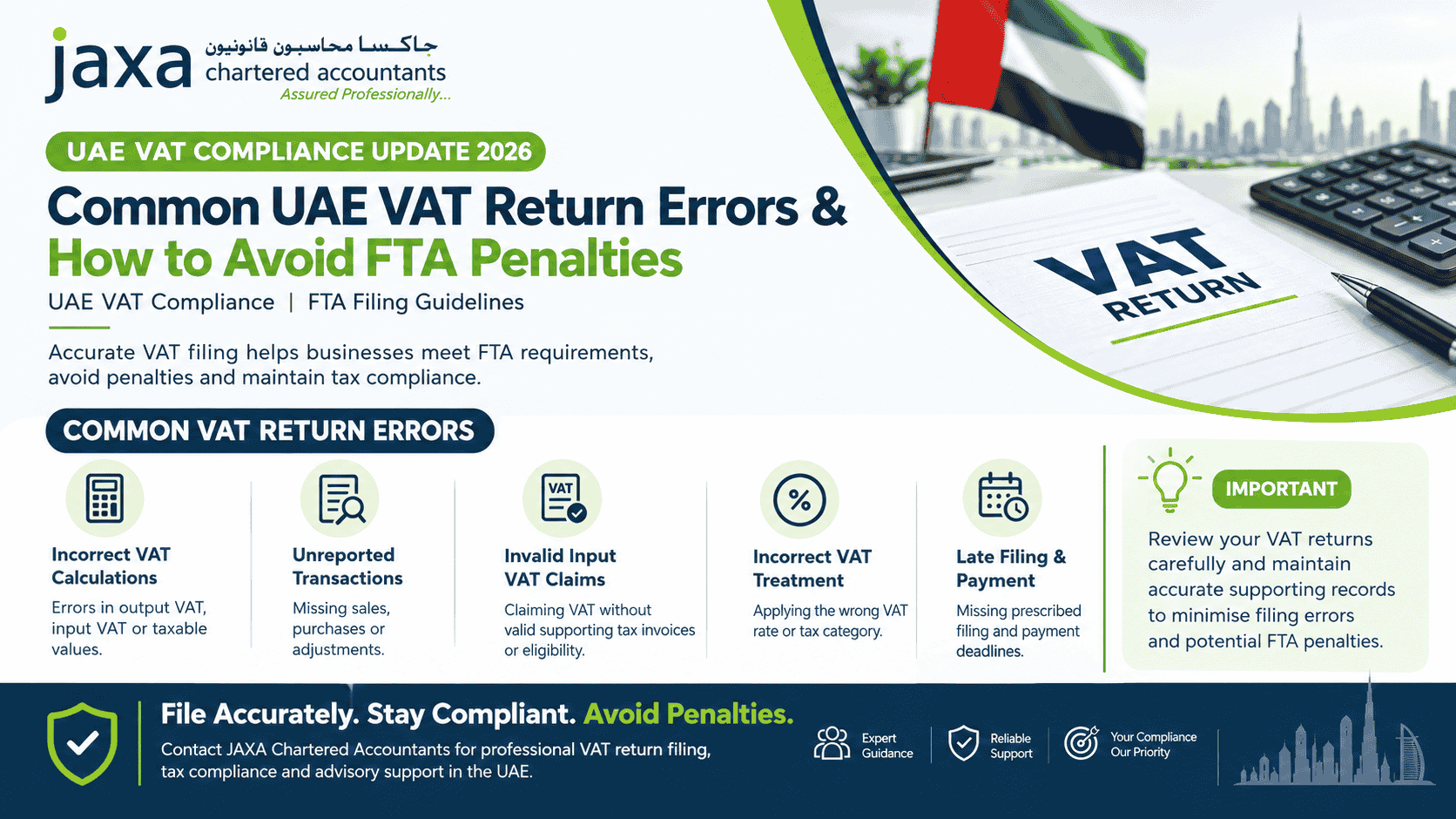
Failure to comply with UAE VAT registration and filing requirements can expose businesses to significant administrative penalties. Under Cabinet Decision No. 129 of 2025, effective April 14, 2026, the UAE revised its tax penalty framework, changing the way several VAT violations are penalized.
Key VAT Penalties Business should know:
- Late VAT Registration: Businesses that fail to apply for mandatory VAT registration in the UAE within the prescribed 30-day period may face an administrative penalty of AED 10,000.
- Late VAT return filing: AED 1000 for the first violation and AED 2000 for a repeated violation.
- Late VAT Payment: 14% per annum on outstanding tax, calculated monthly.
- Voluntary Disclosure before auditor notification: 1% of the tax difference per month, calculated according to the applicable rules.
- Errors not disclosed before audit notification: 15% of the tax difference as a fixed penalty, plus 1% per month under the applicable calculation rules.
- Late VAT deregistration: AED 1000 initially, with an additional AED 1000 for each subsequent month, subject to a maximum of AED 10,000.
Note. regular monitor taxable turnover, register VAT within the stipulated timeframe, file accurate VAT returns and settle outstanding VAT within the timeframe.
Need assistance with UAE VAT Compliance? Jaxa Chartered Accountants, an expert VAT consultant in the UAE, provides VAT registration, return filing, compliance reviews and avoids unnecessary financial exposure.
2026 UAE Tax compliance updates: Every UAE VAT registered businesses
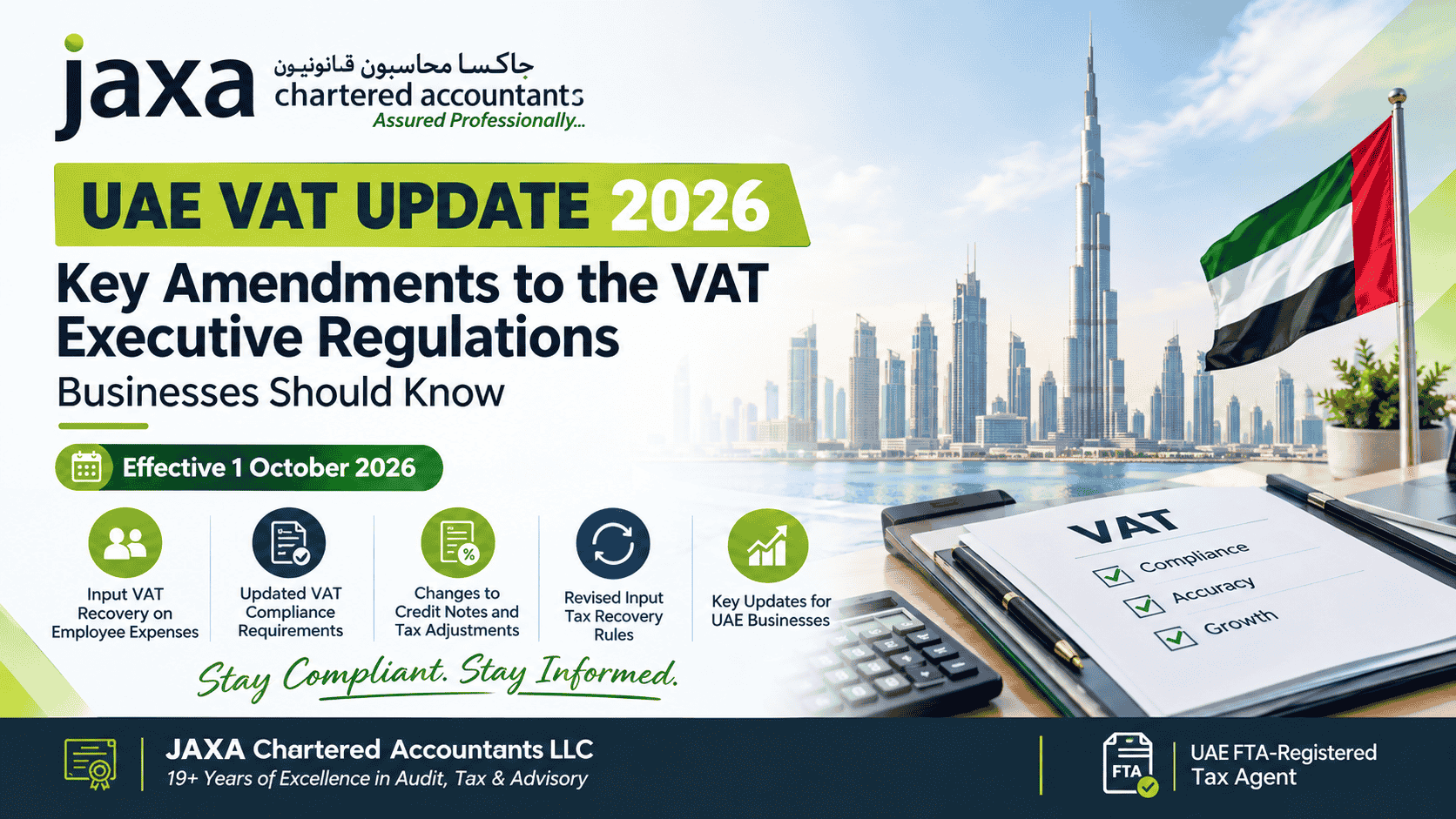
The UAE is introducing a national e-invoicing system under Ministerial Decisions No. 243 and 244 of 2025. The pilot phase began on 1 July 2026, using a Peppol-based five-corner model involving Accredited Service Providers (ASPs) and electronic reporting to the FTA.
Implementation will be phased:
- Revenue of AED 50 million or more: Appoint an ASP by 30 October 2026; implement by 1 January 2027.
- Revenue below AED 50 million: Appoint an ASP by 31 March 2027; implement by 1 July 2027.
The mandate covers in-scope B2B and B2G transactions, including those involving free zone businesses, subject to specified exclusions. Businesses should prepare their invoicing and accounting systems ahead of the applicable deadlines.
The Revised Penalty Regime
Cabinet Decision No. 129 of 2025 revised the UAE’s administrative tax penalties, effective 14 April 2026. However, the AED 10,000 penalty for late VAT registration remains applicable, reinforcing the importance of monitoring taxable turnover and registering within the prescribed deadline.
Best VAT services in the UAE
JAXA Chartered Accountants, an FTA-Registered Tax Agent in the UAE, helps businesses navigate mandatory VAT registration requirements with confidence. Our team assists mainland, free zone, and offshore entities in evaluating taxable turnover, determining registration eligibility, and completing VAT registration applications through the EmaraTax portal.
Our VAT services in the UAE:
- UAE VAT registration
- UAE VAT deregistration
- UAE VAT return filing
- UAE VAT health check
- UAE VAT refund assistance
- UAE VAT advisory and compliance
- UAE VAT compliance reviews
- UAE FTA Emara Tax assistance
With experienced tax professionals and in-depth knowledge of UAE VAT regulations, JAXA helps businesses manage their VAT responsibilities efficiently.
Your business deserves expert VAT support.
Connect with JAXA Chartered Accountants for reliable VAT solutions across the UAE.




 Reach us on WhatsApp
