
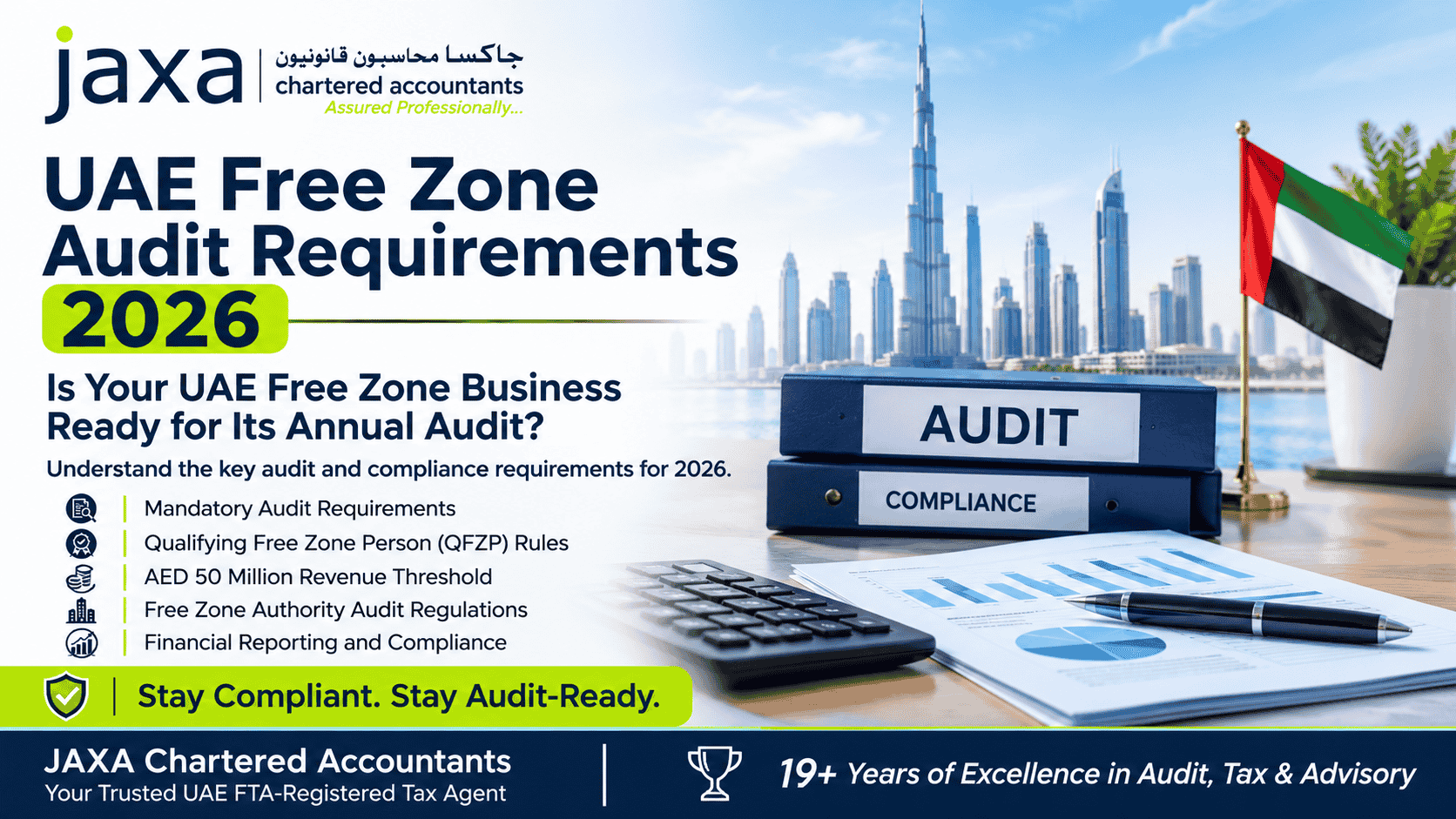

Running a business in a UAE Free Zone offers several advantages, including flexible ownership structure, streamlined company formation, business-friendly regulations, and 100% foreign ownership. Despite these benefits, businesses operating in the Free Zone must adhere to the financial reporting standards and compliance regulations set by their respective authorities.
One of the key compliance responsibilities for Free Zone companies is appointing an approved auditor in the UAE to conduct annual audits and prepare audited financial statements in accordance with the UAE Free Zone regulations.
Failure to meet the requirements may lead to hefty penalties. Partnering with seasoned auditors in the UAE, who provide specialized Free Zone auditing services, helps businesses meet annual audit requirements, prepare accurate financial statements, and ensure timely submission in accordance with applicable Free Zone regulations.
Why Free Zone audits in the UAE is required in 2026
A Free Zone audit is more than an annual compliance requirement. It provides an independent assessment of a company’s financial records and verifies whether its financial reporting meets the applicable regulatory standards. Several UAE Free Zone authorities, including DMCC, JAFZA, DIFC, RAKEZ and DDA, require companies to submit audited financial statements in accordance with their respective regulations, adhering to specific deadlines.
Failure to meet audit requirements or submission deadlines may lead to compliance risks, including:
- Delays or complications in trade license renewal
- Financial penalties for non-compliance
- Restriction on certain business services
- Less credibility with banks and investors
With continued emphasis on regulatory compliance in 2026, Free Zone companies must ensure that their annual audit obligations comply with the requirements of their respective authorities. Early audit planning and engagements with qualified auditors in the UAE can help businesses meet statutory deadlines and maintain compliance.
Do Free Zone companies need an Audit in the UAE?
Yes, many UAE Free Zone companies are required to conduct annual audits under their respective Free Zone authority regulations. Free Zone Authorities such as DMCC, JAFZA, DIFC and RAKEZ have specific requirements for audited financial statements, approved auditors and submission deadlines.
Under Ministerial Decision No. 84 of 2025, applicable from tax periods beginning on or after January 1, 2025, audited financial statements are mandatory for:
- All Qualifying Free Zone Persons (QFZPs), regardless of revenue.
- Taxable persons with annual revenue exceeding AED 50 million, provided they are not part of a Tax Group.
- All Tax Groups, which must prepare audited special purpose financial statements.
Meeting the applicable audit and financial reporting requirements is essential for maintaining compliance and avoiding regulatory complications.
Free Zone audit requirements under UAE Corporate Tax
Companies established in UAE Free Zones are subject to the UAE Corporate Tax regime and must comply with the UAE FTA registration, reporting, and filing requirements.
However, the 0% Corporate tax rate is available only to businesses that qualify as a Qualifying Free Zone Person (QFZP) and meet the prescribed conditions.
To qualify for the 0% corporate tax rate on qualifying income, a Free Zone company must generally:
- Maintain adequate substance in the UAE
- Derive Qualifying Income as per the UAE corporate tax regulations.
- Ensure non-qualifying revenue remains within the prescribed de minimis threshold.
- Comply with applicable transfer pricing requirements
- Prepare and maintain audited financial statements.
- Not elect to be subject to corporate tax under standard regime.
- Meet the other applicable conditions for maintaining QFZP status.
Is an audit mandatory regardless of revenue?
Yes, under Ministerial Decision NO. 84 of 2025, every QFZP must prepare and maintain audited financial statements, irrespective of its annual revenue.
For instance, a Free Zone company generating AED 2 million in annual revenue must undergo the audit requirement to maintain compliance with QFZP conditions.
UAE corporate tax filing and audit deadlines
Businesses must also consider their annual corporate tax filing deadlines while planning their audits. Under UAE corporate tax regulations, the corporate tax return and any applicable tax payments are generally due within nine months from the end of the relevant tax period.
Example:
- Financial year-end: December 31, 2026
- Corporate tax return deadline: September 30, 2027
- Audit preparation: submit the audited financial statement before filing the corporate tax return in the UAE.
Plan your audit today for seamless tax compliance tomorrow. From Free Zone audits to corporate tax compliance, Jaxa’s expert audit, statutory, and financial reporting services in the UAE support your business at every stage.
UAE Audit Requirements and Submission Deadlines Across UAE Free Zones
Each UAE Free Zone authority follows its own financial reporting and audit regulations. Businesses must follow the applicable regulations, appoint eligible auditors, and meet the deadlines specified by their respective authorities.
- DMCC (Dubai Multi Commodities Centre): Companies must submit audited financial statements, along with an auditor-signed summary sheet, within six months of the financial year-end through the DMCC member Portal. The audits must be conducted by DMCC-approved auditors.
- JAFZA: FZE and FZCO entities must submit annual audited financial statements through the Dubai Trade Portal in accordance with JAFZA’s reporting requirements, within three months of the financial year-end.
- DIFC: Companies must comply with annual audit and financial reporting obligations under DIFC regulations. Audit requirements and exemptions depend on the entity’s classification and applicable rules.
- RAKEZ: Registered companies must submit audited financial statements within six months of their financial year-end, prepared by a RAKEZ-approved auditor.
- DDA: Companies registered under Dubai Development Authority must meet the applicable statutory audit and financial reporting requirements, including the prescribed submission procedures.
- DWC (Dubai South): Businesses must comply with the authority’s annual audit and financial reporting requirements, ensuring that their financial statements are audited by qualified auditors in accordance with the authority’s regulations.
Note: Free Zone companies in the UAE must stay informed about the latest statutory audit requirements, financial reporting deadlines and approved auditor guidelines.
Engaging experienced auditing, accounting, and bookkeeping firms in the UAE ensures accurate financial reporting, timely audit submission, and compliance with the regulations of the respective Free Zone authorities.
Common mistakes businesses make during UAE Free Zone audits
Many UAE Free Zone companies encounter audit and compliance challenges due to inadequate preparation, poor financial record management, and delays in appointing approved auditors. Some common mistakes include:
- Incomplete financial records: Failing to maintain accurate accounting records, invoices and supporting documents required for statutory audits.
- Unreconciled bank statements: Neglecting regular bank reconciliations, resulting in discrepancies in financial statements.
- Poor audit coordination: Delayed communication between internal accounting teams and external auditors.
- Ignoring Free Zone audit requirements: Overlooking specific audit regulations, financial reporting standards and submission deadlines set by authorities such as DMCC, JAFZA, DIFC, and RAKEZ.
- Late auditor appointment: Delaying the appointment of an approved UAE Free Zone auditor, leaving insufficient time to complete the annual audit.
- Missing corporate tax compliance: Failing to align audited financial statements with applicable UAE corporate tax reporting and documentation requirements.
Avoiding these mistakes through proper audit preparation, accurate financial reporting and timely engagement with qualified auditors in the UAE helps businesses streamline the statutory audit process and maintain Free Zone compliance.
Who is eligible to conduct a Free Zone audit in the UAE?
Free Zone companies must appoint qualified auditors who meet the eligibility and approval requirements of their respective authorities. Some Free Zones maintain their own approved auditor list, while others accept auditors holding the relevant UAE professional license.
- DMCC: Companies must appoint an audit firm listed on the DMCC approved auditor list.
- RAKEZ: Businesses must engage auditors approved by RAKEZ.
- JAFZA: Audit reports must be issued by auditors holding the relevant Dubai Economic Department license.
- Other Free Zones: Auditor eligibility and registration requirements vary depending on the respective authority.
Under Ministerial Decision No. 84 of 2025, a Qualifying Free Zone Person (QFZP) must prepare and maintain audited financial statements to maintain UAE corporate tax compliance, irrespective of their annual revenue.
Before appointing an auditor, businesses should verify the firm’s professional license, Free Zone approval status and experience in statutory audits and UAE corporate tax compliance.
Documents required for a UAE Free Zone Audit
Auditing in the UAE Free Zone become easier when documents are ready from day one: key documents are:
- Company documents
- Valid trade license
- Memorandum of Association(MOA)
- Article of Association
- Accounting Records
- Trial Balance
- General Ledger
- Financial statements for the relevant financial year
- Banking documents
- Bank documents,
- Bank reconciliation statements
- Bank confirmation letter(s).
- Documents for Financial transactions
- Sales and purchase invoices receipts, contracts and supporting agreements
- Employee records
- Payroll records,
- Employee records and end-of-service benefit calculations
- Asset records
- Fixed asset register
- Depreciation schedules and supporting purchase documents
- Related -party transactions:
- shareholder details
- intercompany transactions
- Related-party loans
- transfer pricing documentation
- Tax records
- UAE VAT registration details
- UAE VAT return filing
- Corporate tax registration and filing records
- Previous audit reports
- Prior -year audited financial statements and audit reports
Maintaining complete and up-to-date accounting records helps auditors conduct the UAE Free Zone audit efficiently and identify potential financial reporting or compliance risk.
UAE Free Zone audit submission deadline and penalties
UAE Free Zone companies must meet the deadlines of audit submission set by their respective authorities while complying with UAE corporate tax filing requirements.
Failure or delays in submitting audited financial statements may lead to financial and operational risk, such as:
- Restriction on license renewal: Free Zone authorities may impose fines, delay license renewals or restrict business services for failure to meet audit submission requirements.
- Late Corporate tax filing may attract FTA administrative penalties
- Loss of QFZP benefits: A QFZP that fails to meet the prescribed audit requirement loses its qualifying status and associated 0% corporate tax benefits.
- Business disruption: Delayed audited financial statements may affect banking procedures, investor confidence and other business transactions.
Plan your annual Free Zone audits, financial statement preparation and UAE corporate tax filing well in advance to avoid penalties and maintain regulatory compliance.
Step-by-step Guide for UAE Free Zone Audit process
There are several stages involved in the annual audit process for UAE Free Zone companies:
- Review audit obligations: Check the applicable Free Zone regulations and corporate tax obligations.
- Finalize accounting records: Update financial transactions, reconcile bank statements, prepare supporting documents.
- Appoint an approved auditor: Engage an auditor meeting the relevant Free Zone authority’s approval requirements.
- Complete the audit: Engage an auditor meeting the relevant Free Zone authority’s approval requirements
- Submit supporting documents: Provide invoices, bank statements, contracts and accounting records.
- Review and complete the audit: Address auditor queries and finalize the financial statements.
- Submit audit report: Obtain the signed audit report and submit it within the prescribed deadline.
Early preparation and professional auditing services in the UAE help businesses ensure accurate financial reporting and timely regulatory compliance.
Simplify Your UAE Free Zone Audit Compliance
Staying compliant with UAE Free Zone audit regulations and Corporate tax requirements is important for protecting your business and maintaining QFZP eligibility. From preparing financial statements to meeting audit submission deadlines, businesses need reliable professional support at every stage.
Jaxa Chartered Accountants provides comprehensive auditing services in the UAE, helping businesses meet their statutory and Free Zone audit requirements. With an experienced team of professional auditors in the UAE, we support businesses with accurate financial reporting, audit compliance, and corporate tax requirements.
Jaxa Chartered Accountants is a UAE FTA-registered tax agent, with offices in Abu Dhabi, Sharjah and Jebel Ali, providing professional tax advisory, compliance, and auditing support to businesses across the UAE.
Professional Auditing services in the UAE. Confidence in Every Report.
Speak to Jaxa Auditors today for reliable audit services and expert guidance on your UAE tax compliance needs.
Expert Approved Free Zone Auditor. Reliable reporting. Complete Confidence.
FAQ
- How long does a Free Zone audit take in the UAE?
The time depends on the company’s transaction volume, quality of accounting records, business activities and availability of supporting documents.
- How can businesses choose the right auditor for a UAE Free Zone company?
Businesses should check the auditor’s professional qualifications, relevant experiences and approval status with the applicable Free Zone authority before making an appointment.
- What happens if a Free Zone company misses its audit submission deadline?
Failure to submit financial statements within the prescribed deadline may result in late-submission penalties, license renewals or other regulatory consequences depending on Free Zone authority.
- Why should businesses choose Jaxa for a Free Zone audit?
With more than 19+ years of experience, 100+ professionals and 2000+ clients, Jaxa offers professional audit, accounting and tax support to help businesses manage their financial reporting and regulatory compliance requirements.
- Is Jaxa an approved auditor in UAE Free Zone?
Jaxa Chartered Accountants is registered with several UAE Free Zone authorities.


 Reach us on WhatsApp
