
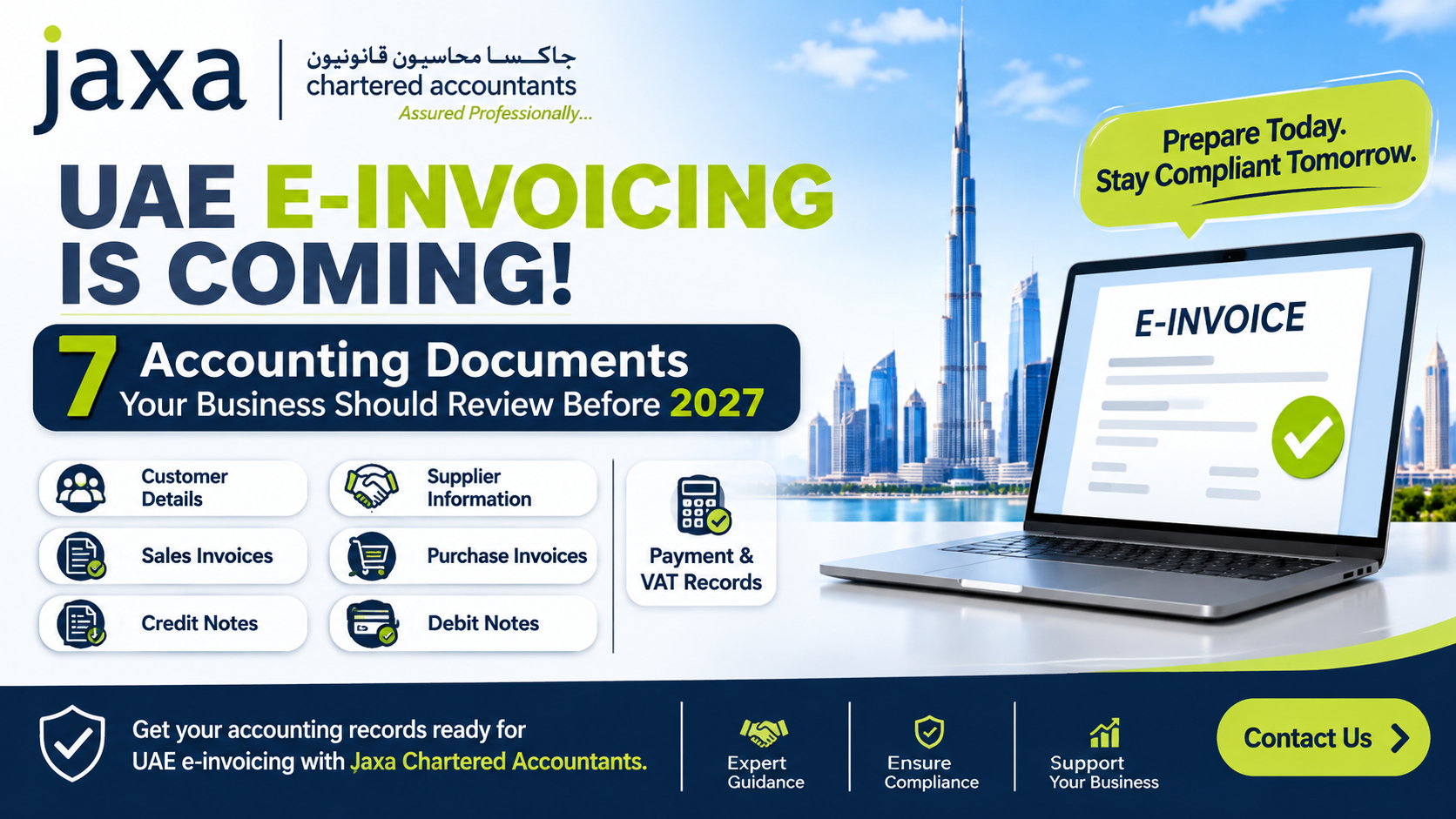

Start preparing for UAE E-Invoicing 2027 with these 7 key accounting documents that businesses should review before implementation in 2027. With the help of expert guidance, you can improve data accuracy, strengthen your business’s e-invoicing compliance readiness.
The UAE’s shift towards E-invoicing marks a significant step in the digital transformation of business transactions and tax compliance. With the new framework taking shape, businesses need to ensure that their financial data and accounting procedures are ready for electronic invoice exchange. A successful implementation depends on keeping clear financial records, validating customer and supplier records, reviewing VAT and invoice data, ensuring accounting system support e-invoicing and effective coordination with an Accredited Service Provider(ASP).
Preparing for e-invoicing begins with reliable financial data and well-maintained accounting records. Jaxa Chartered Accountants guides businesses through accounting, bookkeeping, tax compliance and advisory and E-invocing readiness services. Our expert guides throughout the implementation stages help businesses assess gaps in existing records, address data gaps and prepare their system for UAE-invoicing requirements. Reviewing your current accounting records is a practical first step towards improving UAE E-invoicing compliance readiness.
This article outlines 7 essential accounting documents and records that businesses should review to prepare for the UAE E-invoicing transition.
7 Key Accounting records to review before UAE E-invoicing
As the UAE prepares to implement E-invoicing, businesses within the applicable scope need to complete key preparation ahead of the relevant deadlines. Businesses with annual revenue of AED 50 million or more must appoint an Accredited Service Provider (ASP) by October 30, 2026, with mandatory implementation beginning on January 1, 2027. Appointing an Accredited Service Provider is only one aspect of UAE E-invoicing readiness. Businesses remain responsible for keeping accurate and complete accounting data.
A review of existing accounting records can help identify gaps before testing begins. The following several documents are particularly significant for supporting invoice generation, validating transactions and resolving discrepancies at the time of reconciliation.
- Company Registration and Tax Records
Company Registration and Tax Records contain key business identification and tax information. Any outdated or incorrect details may lead to mismatches between official records, accounting system and electronic invoices. Reviewing these records helps businesses maintain consistent information and prepare for UAE E-invoicing requirements.
Business should review:
- Trade license and company registration records
- Corporate tax registration records
- VAT registration certificate and Tax Registration Number (TRN)
- Registered business name and address
- Branch details and relevant tax registration information
Ensure that these records match the information maintained in your accounting system and other business systems.
- Customer Master Records
Customer records form the foundation of accurate invoicing. If a customer’s records have been created separately for small changes such as changes in billing contacts, the same buyer can appear multiple times. Businesses must identify and consolidate these records before UAE E-invoicing implementation to maintain consistent customer records and reduce the risk of invoice errors.
Review the following details:
- Customer’s registered legal name
- Billing address and relevant identification details
- UAE VAT registration number
- Customer classification and tax treatment
- Duplicate or inactive customer accounts.
Review the duplicate entries before transferring records to an e-invoicing network. Keep historical invoices and receipts linked while merging customer records. This maintains transaction traceability while eliminating duplicate entries.
- Supplier Records and Purchase ledger:
Key attention should be given to supplier records and purchase records, which forms an important part of UAE E-invoicing preparation. Ensure supplier invoices are recorded under the correct legal entity, especially when trading name or collection agents are involved.
Make a comparison on supplier statements with purchase ledger and payment records to identify unexplained credits or outstanding balances. Provide supporting documents to correct discrepancies for maintaining accurate and reliable accounting records.
Key areas to review:
- Invoice and credit note number and dates
- Customer details, transaction values and VAT calculations
- Reference linking credit notes and original invoices
- Reconcile supplier statements and purchase record
- Correct legal supplier details
Small errors in invoice records may cause major reconciliation discrepancies. Identifying missing invoices, duplicate entries and incorrect posting early helps businesses maintain accounting records in their invoicing system supporting electronic formats and data exchange standards.
- Product and Service records with VAT codes: Preparing UAE E-invoicing involves more than checking invoice number and customer records. The Ministry of Finance published a checklist that lists 51 numbered data fields, including product description, unit of measure and tax categories. Product and service details should be clear and consistent across accounting records. Before UAE E-invoicing implementation begins, check that item description, codes and VAT categories are accurate to help prevent invoice errors and reporting discrepancies.
Business should review:
- Product and service description
- Item code and service identifiers, where used
- Unit of measurement and pricing information
- Applicable VAT rates and tax categories
- Tax-exempt, zero-rate or other relevant transaction classifications
Ensure every product and service has a clear description and correct tax code instead of generic labels. Verify that each tax code reflects the correct VAT treatment and review repeated manual tax adjustment to identify before automating the e-invoicing process.
Confirm the applicable e-invoicing data requirements with their ASP before finalizing system setting.
- Sales Invoice and Credit Note Register:
Sales invoice and credit note registers are important for tracking sales transactions, adjustments and related VAT reporting. For reliable financial reporting and e-invoicing readiness, keeping accurate, complete, and reconciled registers is essential.
Business should verify the following:
- Unique invoice and credit note numbers
- Invoice dates and transaction details
- Customer information and transaction value
- VAT amounts and applicable tax treatment
- References linking credit notes to original invoices
Check invoice records with the accounting system to identify missing entries, duplicate invoice number and VAT reporting errors. Maintain supporting documents for all adjustments and verify that the invoicing system can generate and exchange data in the required electronic format.
- Reconcile customer receipts and advance payment records: Customer payment records show how much a business has received, what remains outstanding and how payments apply to sales invoice. These records should be reviewed to ensure that all transactions are correctly recorded. This is important for proper accounting and invoice management.
Key areas to focus on:
- Advance payments and customer deposits
- Unpaid invoices and part payments
- Payment dates and references
- Refund and credit adjustments
- Difference between bank records and accounting entries
Keep the supporting documents for every payment allocation. If there are any unmatched receipts, inaccurate entries or differences in payment balances should be resolved before implementation. Investigate unidentified receipts and track pending payment differences until they are resolved.
- Invoice Archives and Audit Trials: Under UAE E-invoicing requirements, electronic invoices, electronic credit notes and related records must be securely maintained and accessible if requested by the UAE FTA. Keeping organized invoice records is necessary for accounting accuracy and tax compliance.
Businesses should review the records and procedures:
- Copies of issued invoices and credit note
- Supplier invoices and supporting documents
- Records of invoice change and correction
- Transaction histories and approval records
- Data backups and document access procedures
Check whether your finance team can retrieve an invoice and its correction history without depending on anyone. Businesses should have a plan on how to retrieve and transfer their records if they change service providers. They should ensure their documents storage and retention practices meet the relevant UAE record-retention requirements.
Maintaining accessible and well-organized records strengthens audit readiness and supports compliance with UAE tax documentation requirements.
How Jaxa Chartered Accountants help in preparing UAE E-Invoicing in 2027?
Understanding the importance of these seven accounting records in order is an important step towards an efficient and well-planned UAE E-invoicing implementation in 2027. A successful transition to UAE E-invoicing starts with well-maintained financial records, reliable accounting system and proper compliance planning.
Jaxa Chartered Accountants, a UAE FTA tax agent with 19+ years of experience provides expert guidance to help businesses assess their audit readiness and identify gaps that need attention before implementation while meeting the UAE E-invoicing requirements with confidence.
Prepare early so that businesses can identify accounting errors, correct data inconsistencies and resolve system integration issues before UAE E-invoicing implementation. This reduces the risk of invoice processing challenges and compliance delays.
Our experts assist in evaluating their current accounting practice and prepare for the latest UAE E-invoicing framework.
Our services include:-
- E-invoicing readiness assessment
- Accounting data review
- System integration support
- ASP selection support
- Tax Compliance advisory
- E-invoicing implementation planning
If you need any support, work with Jaxa Auditors, an E-Invoicing Service Provider in the UAE to make this transition smooth and effective. We bring together accounting expertise and tax compliance knowledge to guide businesses through each stage of preparation.
With Jaxa, businesses receive structured professional support to strengthen accounting processes and prepare for a smooth transition to UAE E-invoicing.
Speak to Jaxa Auditor and Explore our accounting, tax, audit and E-invoicing advisory services in the UAE.

 Reach us on WhatsApp
