
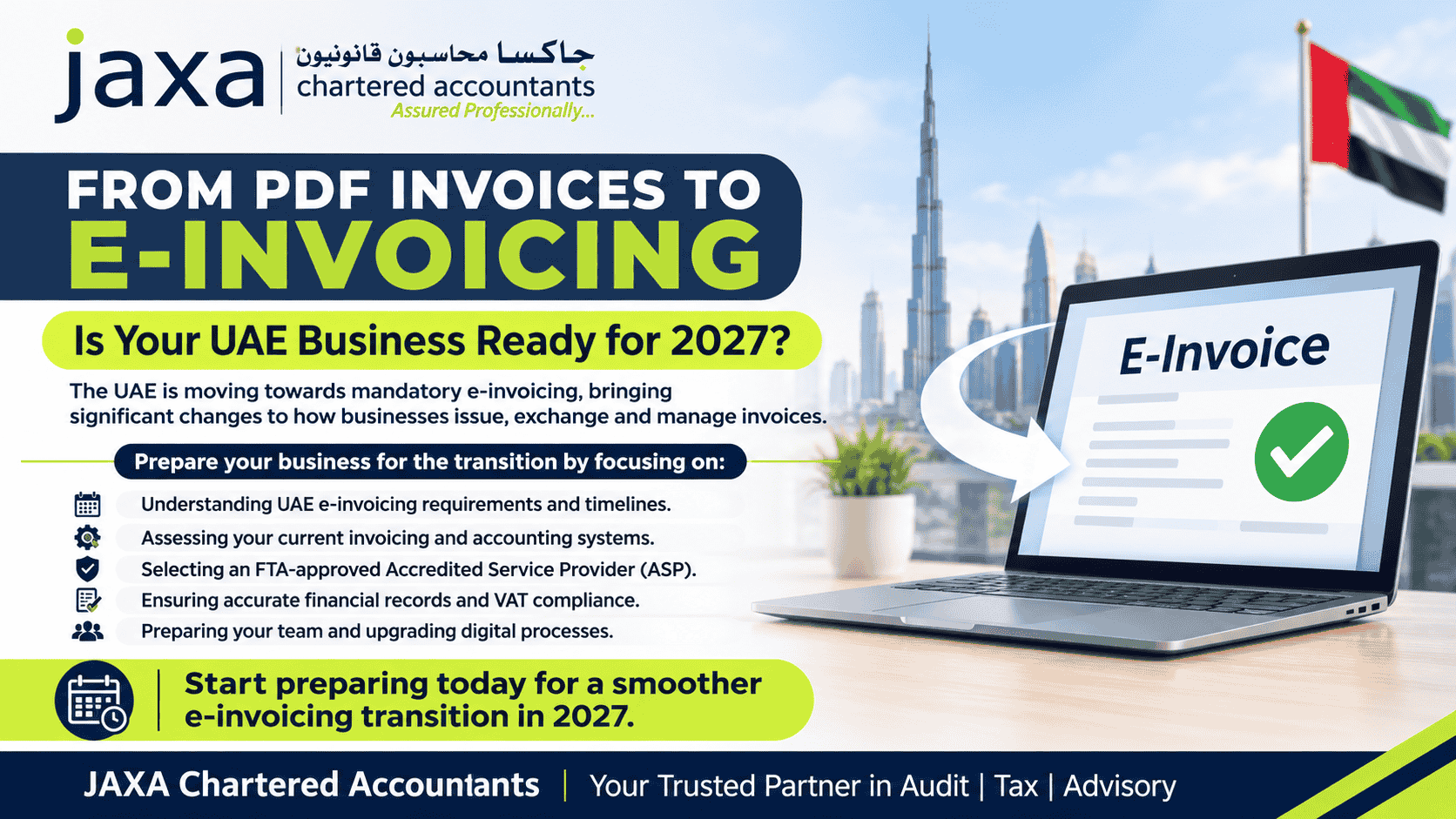

Moving beyond PDF invoices requires more than adopting a new billing format. The transition to UAE E-invoicing will require businesses to review their existing invoicing and accounting processes. Businesses need to assess the accuracy of their financial data, consistency of tax information, and compatibility of existing accounting systems with structured electronic invoicing requirements.
At Jaxa Chartered Accountants, a UAE FTA tax agent, we support businesses with accounting, bookkeeping, tax advisory, and UAE E-invoicing services. Our approach focuses on reviewing existing financial records, assessing system readiness, and addressing compliance requirements before implementing UAE E-invoicing.
With mandatory UAE E-invoicing set to roll out in 2027, businesses should start planning early, evaluate their current capabilities, and address potential gaps to support a smooth and compliant transition.
Understanding the UAE’s Move Towards E-invoicing
A PDF invoice shared electronically is not considered a compliant e-invoice under the UAE’s new regulatory framework.
Under the UAE E-invoice system, invoices must be created and exchanged in a structured electronic format that allows information to be automatically read and processed by a compatible system. The UAE follows a Peppol-based, five-corner model that enables standardized invoice exchange between suppliers, buyers, their respective Accredited Service Providers (ASPs), and the Federal Tax Authority (FTA).
The framework aims to improve invoicing accuracy, streamline transaction processing, minimize manual intervention, and strengthen tax compliance.
The UAE Ministry of Finance has introduced a phased implementation approach with voluntary adoption and a pilot programme commencing on July 1, 2026. Mandatory implementation will follow the prescribed timelines based on the applicable business categories.
The ASP appointment deadline for businesses with annual revenue of AED 50 million or more was revised to October 30, 2026, while their mandatory implementation date remains January 1, 2027,
Which businesses fall within the UAE E-invoicing Requirements?
The UAE’s E-invoicing framework applies to specified business transactions, with particular relevance to:
- Business-to-Business (B2B) transactions
- Business-to-Governement (B2B) transactions
Certain transactions and entities are excluded under the applicable regulations. Business-to-Consumer (B2C) transactions are not currently part of the mandatory UAE E-invoicing scope, subject to any future direction issued by the UAE Ministry of Finance.
Businesses should assess the nature of their transaction, review applicable exclusions, and identify the requirements relevant to their operations to ensure they are adequately prepared for the transition.
UAE E-invoicing: Key Implementation deadline
The Ministry of Finance has outlined an implementation schedule for UAE E-Invoicing. The deadlines vary according to business revenue and entity type.
| Business category | ASP appointment deadline | Mandatory implementation |
| Annual revenue of AED 50 million or more | October 30, 2026 | January 1, 2027 |
| Annual revenue of below AED 50 million | March 31, 2027 | July 1, 2027 |
| Government entities | March 31, 2027 | October 1, 2027 |
Under Ministerial Decision No.66 of 2026, the ASP appointment deadline for businesses with annual revenue of AED 50 million or more was revised to October 30, 2026. The implementation date remains unchanged at January 1, 2027.
Businesses should review the applicable timelines, appoint an ASP within the prescribed period, and prepare their accounting and invoicing system for the transition. Early preparation for UAE E-invoicing can help with integration and minimize disruption when mandatory UAE E-invoicing begins.
Getting your Finance Team ready for UAE E-invoicing in 2027.
The shift to e-invoicing in the UAE involves more than digitizing existing invoices. Businesses must adopt a structured invoicing process that enables invoice data to be exchanged and processed through a compatible system and reported to the UAE FTA. Traditional PDF invoices alone do not fulfill the new framework’s requirements.
- Check your compliance deadline: Businesses with annual revenue of AED 50 million or more must appoint an Accredited Service Provider (ASP) by October 30, 2026, and implement UAE E-invoicing by January 1, 2027.
Although the ASP appointment deadline has been extended, the implementation date remains unchanged. Finance teams should account for both milestones when planning provider selection, system integration, testing and internal training.
- Identify transactions within Scope: Review B2B and B2G transactions and assess applicable exclusions. B2C transactions are currently outside the mandatory scope. Free zone businesses should also assess their obligation.
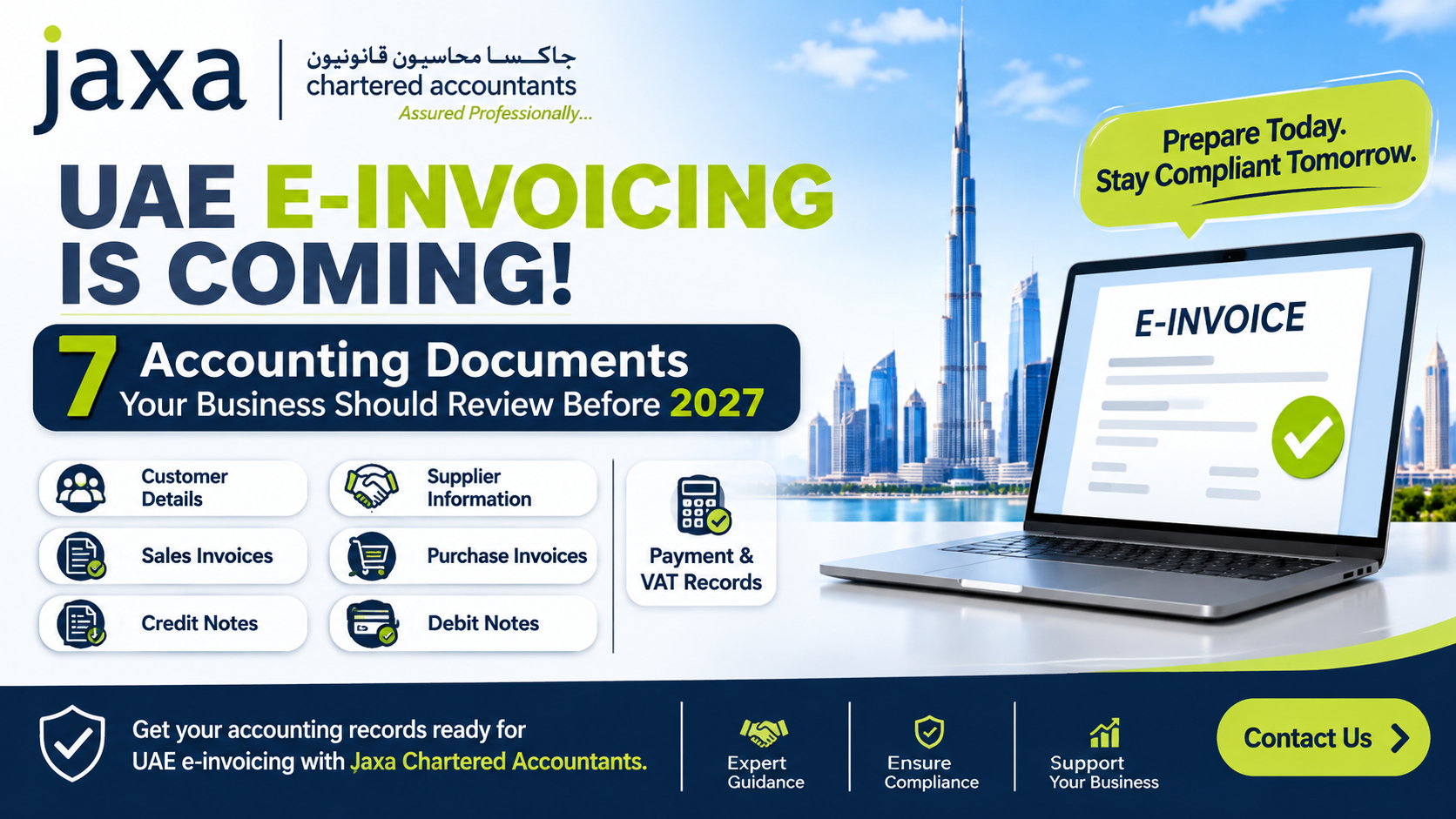
- Verify Customer and tax data: Ensure customer details, tax registration number, tax classifications, and invoice records are accurate and complete to avoid data validation errors.
Finance teams should review their existing records and:
- Verify customer and supplier legal names and addresses.
- Check applicable tax registration details.
- Validate tax categories, codes and calculations.
- Identify and correct duplicate or incomplete records.
Addressing data inconsistencies at the source can help prevent recurring errors during electronic invoice generation.
- Review accounting software compatibility: Check whether your existing accounting or ERP system can integrate with the selected ASP and support the required electronic invoice format.
Under the UAE framework, the supplier submits invoice data to its ASP in an agreed format. The ASP validates the data against the UAE requirements and converts it into the UAE-standard XML format if necessary. It then transmits the electronic invoice to the buyer’s ASP through the Peppol network and reports the relevant tax data to the FTA.
Finance and IT teams should therefore review system compatibility, data requirements and integration procedures to ensure their invoicing systems are implemented.
- Manage PDF and electronic invoices: Businesses should establish procedures for issuing electronic invoices and providing conventional invoice copies where required. A PDF copy may need to accompany the electronic invoice when the buyer has not yet adopted the e-invoicing system. However, it does not replace the supplier’s obligation to issue the electronic invoices.
Where a supplier issues an electronic tax invoice to a buyer who has not yet implemented E-invoicing, a regular tax invoice such as PDF must also be provided. The electronic tax invoice must still be issued through the prescribed E-invoicing system, as the PDF copy does not replace this requirement.
Preparing smaller UAE Businesses for UAE E-invoicing
The UAE E-invoicing rollout requires preparation across businesses of all sizes. Smaller UAE enterprises should begin assessing their UAE E-invoicing readiness ahead of the mandatory rollout. Those with annual revenue below AED 50 million must appoint an ASP by March 31, 2027, and implement the system by July 1, 2027.
Key preparation areas include invoice data accuracy, accounting software compatibility, system integration and internal invoicing procedures. Addressing these requirements early can reduce operational disruption during implementation.
Test Your UAE E-Invoicing Process Before Go-Live
Before going live, businesses should test the complete e-invoicing workflow to confirm that invoices are correctly generated, exchanged and reported. Testing should also cover rejections, corrections, and credit note processing.
Key areas to test include:
- Electronic invoice generation and exchange.
- Credit note issuance and reference to original invoices.
- Identification and correction of validation errors.
- Access to stored invoice records for review.
Ensure finance and IT teams understand their roles in managing rejected invoices and correcting data discrepancies. Clearly define who is responsible for reviewing failed submissions, correcting errors and completing follow-up actions. Documented procedures help ensure that issues are handled consistently after implementation.
Common UAE E-invoicing Challenges Businesses Should Address
Businesses may encounter operational difficulties if they delay preparation or rely entirely on existing manual invoicing processes.
Some common challenges include:
- Incomplete customer and supplier information.
- Incorrect VAT classifications or tax codes.
- Incompatible accounting and billing software.
- Lack of coordination between finance and IT teams.
- Limited understanding of electronic invoice requirements.
- Insufficient testing before mandatory implementation.
Identifying these gaps early can help businesses reduce implementation delays and maintain accurate financial records.
UAE E-Invoicing Readiness Checklist
Before transitioning from PDF invoices to structured electronic invoicing, businesses should review the following:
- Identify whether business transactions fall within the e-invoicing scope.
- Confirm the applicable implementation deadline.
- Review customer and supplier master data.
- Verify VAT classifications and invoice information.
- Assess accounting software and ERP compatibility.
- Select an officially accredited service provider.
- Complete contractual and onboarding requirements.
- Establish electronic invoice and credit note procedures.
- Test system integration and invoice exchange.
- Train finance and accounting teams.
A structured readiness assessment can help businesses identify compliance gaps before the mandatory implementation phase.
Prepare E-invoicing with Jaxa Chartered Accountants
Get professional support for UAE E-invoicing and tax compliance with Jaxa Auditors
As a UAE FTA-registered tax agent, Jaxa offers:
- UAE E-Invoicing Readiness and Advisory
- UAE VAT Registration and Deregistration
- UAE VAT Return Preparation and Filing
- UAE Corporate Tax Registration and Filing
- Accounting and Bookkeeping Services
- UAE Tax Compliance and Advisory
With 19+ years of experience, 3,000+ clients, and 100+ professionals, we support businesses in managing their accounting and tax obligations across the UAE.
Prepare for UAE E-Invoicing with Jaxa Chartered Accountants. Contact our team for expert accounting, VAT and tax advisory support.




 Reach us on WhatsApp
