
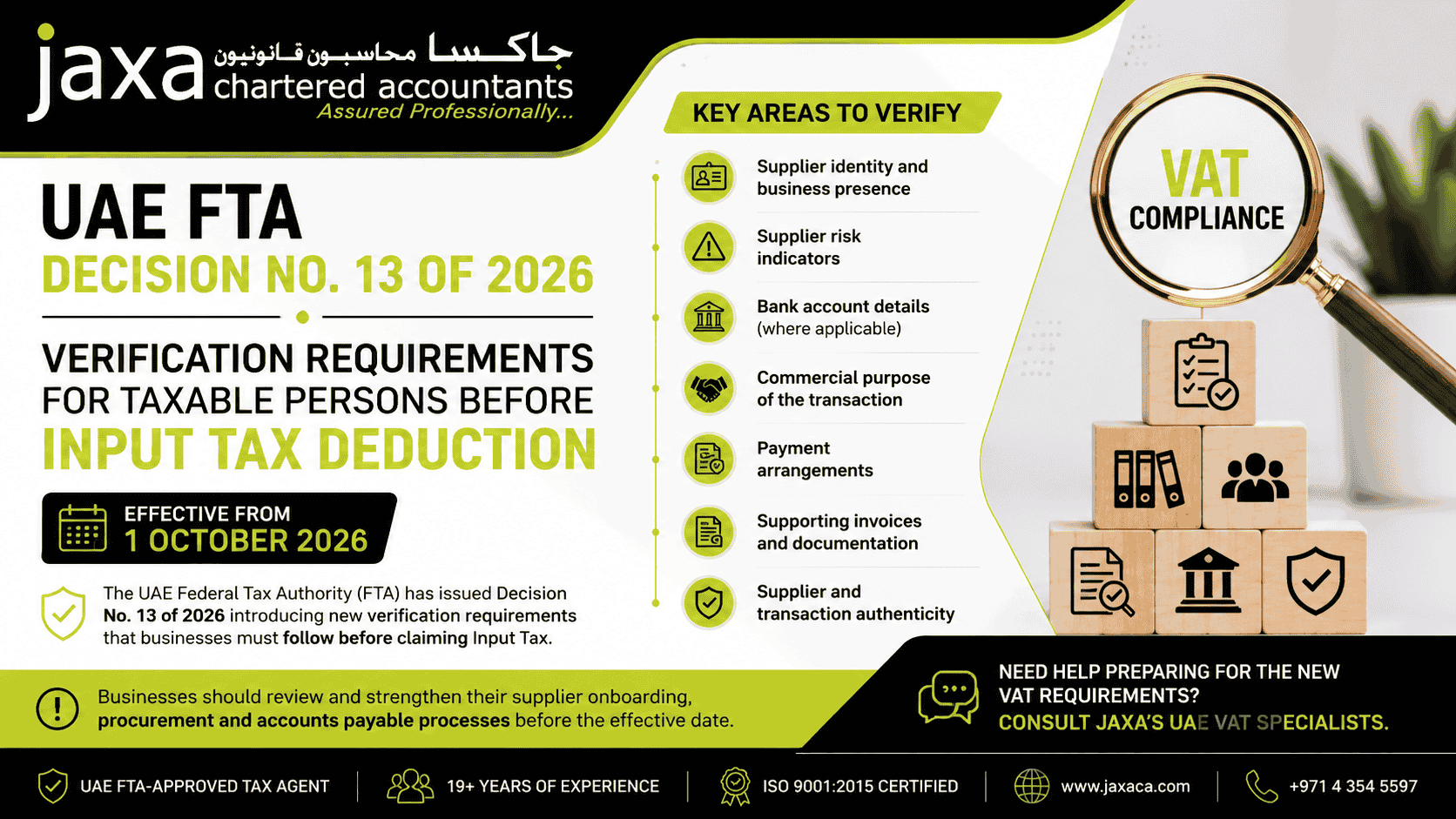

Under UAE FTA Decision No.13 of 2026, issued on 22 July 2026 and published on the Federal Tax Authority’s website on August 20, 2026, specific verification requirements have been introduced for Taxable Persons. The Decision requires taxable persons to verify the validity and integrity of supplies received before claiming input VAT deductions.
This Decision will come into force on October 1, 2026, and forms part of the UAE’s ongoing efforts to strengthen VAT compliance and Input Tax controls. It requires a taxable person to undertake appropriate verification procedures before claiming an Input Tax deduction, with the aim of ensuring that such deductions are supported by genuine, commercially valid, and properly documented business transactions.
Understanding UAE FTA Decision No. 13 of 2026. Key UAE’s New Input Tax Verification Requirements
The UAE FTA introduced additional verification requirements for businesses claiming Input tax deductions, with the new requirements coming into effect on October 1, 2026.
FTA Decision No. 13 of 2026 establishes the measures, procedures, and conditions that a taxable person must follow to verify the validity and integrity of supplies before claiming an Input Tax Deduction.
The main purpose of this Decision, as per the UAE VAT framework, is to reduce the risk of tax evasion and improper input tax recovery.
The Decision requires taxable Persons to implement appropriate verification measures to establish the validity and integrity of supplies and ensure that Input tax deductions are adequately supported by relevant records and documentation.
The Decision broadly covers:
- Supplier identity verification, including verification of the supplier’s legal status and authorized representatives
- Verification of the supplier’s business address and place of business
- Assessment of supplier risk indicators, including frequent changes in addresses or key personnel and unusual transaction activity.
- Bank account verification and review of publicly available information where supplies from a supplier exceed, or are expected to exceed, AED 375,000 over a 12-month period
- Assessment of the commercial purpose and circumstances of the supply
- Verification of payment methods and payment conditions, including certain third-party, overseas bank accounts, and cash payment arrangements.
- Assessment of pricing and profit margin against market conditions
- Verification of the nature, authenticity, origin and ownership of goods, where applicable
- Verification of the commercial role of intermediaries, where a supplier acts as an intermediary
- Documentation and retention of verification steps and supporting records
- Maintenance of a documented internal policy identifying the person responsible for implementing, reviewing, and supervising the verification procedures.
These requirements indicate that businesses should strengthen their supplier due diligence, procurement controls, payment procedures, and VAT documentation before the Decision takes effect on October 1, 2026.
When does the New UAE VAT Verification Requirement Apply?
UAE FTA Decision No.13 of 2026 will come into effect on October 1, 2026. The Decision introduces specific requirements for taxable persons to verify the validity and integrity of supplies before deducting Input Tax.
Businesses should review their existing VAT compliance procedures, supplier onboarding processes, procurement controls, and Input VAT documentation before the effective date.
Key Input Tax Verification Requirements under UAE FTA Decision No. 13 of 2026
- Verify the Supplier’s Identity before deducting Input VAT: A taxable person must verify the supplier for the first time or when dealing with a supplier again where the supplier has not been verified within the previous 12 months.
Where the supplier is a Natural Person
The taxable person must:
- Obtain a copy of a valid identification, such as an Emirates ID or Passport
- Meet the supplier either physically or virtually before the supply.
Where the supplier is a Legal person
The Taxable Person must:
- Verify the supplier’s incorporation through official databases or obtain its certificate of incorporation
- Ensure that the incorporation details correspond with the supplier’s name, address, employees, and other relevant information.
- Verify the identity of the director, agent, or employee authorized to represent the supplier
- Obtain valid identification, such as an Emirates ID or passport, for the authorized representative.
Jaxa viewpoint: New supplier onboarding should include a defined VAT compliance checklist before the first invoice is processed and Input Tax is deducted, ensuring the required supplier verification procedures are completed and documented.
-
Verify the supplier’s address and Place of business
Supplier verification does not end with checking registration documents. Taxable Persons must also establish that the supplier has a genuine place of business.
This requires the Taxable Person to:
- Verify the existence of an actual business location using appropriate electronic methods or through a field visit
- Verify that the location is appropriate for the nature and scope of the supplier’s business activities.
- The location and nature of the supplier’s business premises should correspond with the activities it conducts.
This requirement strengthens supplier due diligence and helps businesses identify arrangements involving suppliers whose physical presence or business activities may not be consistent with the transactions.
-
Assess the Supplier’s Risk Indicator
The UAE FTA Decision No. 13 of 2026 introduces specific supplier risk indicators that a taxable person should consider.
A supplier may require further review where:
- Its address has changed more than twice during the previous 12 months
- Its key employees or managers have changed more than twice during the previous 12 months
- It has entered into transactions that are disproportionate or unexpected in terms of volume, value, or nature, considering the size and business history of the supplier.
The identification of a risk indicator does not mean that the supplier is involved in Tax Evasion. However, businesses must document a clear and justified reason for the indicator and be prepared to provide the explanation to the FTA upon request. Such an explanation must not contradict the evidence available to the taxable person.
-
Bank Account and Reputation Checks for Higher- Value Supplier
Additional verification is required where the value of the supplies received from a supplier:
- Exceeded AED 375,000 in the preceding 12 months or
- Is expected to exceed AED 375,000 in the following 12 months
In these conditions, the Taxable Person must:
- Obtain written confirmation from an authorized UAE bank that the supplier holds a bank account.
- Review reliable publicly available reviews and media coverage relating to the supplier
- Assess whether the information reviewed is consistent with the supplier’s business activities, size and operations
- Identify any indicators that may suggest suspected tax evasion.
The bank confirmation does not have to be issued directly to the taxable Person receiving the supply.
For higher-value supplier transactions, businesses should conduct additional Due diligence beyond the documents provided directly by the supplier.
Jaxa Insights: for businesses with active and recurring supplier relationships, the AED 375,000 threshold may be reached over time. A structured and periodic supplier verification process helps businesses to maintain effective UAE VAT compliance.
Before deducting Input Tax, the taxable Person must conduct a general assessment of the circumstances of the supply and verify that the supplier’s involvement in the transaction is based on genuine commercial reasons.
The assessment should establish that the transaction has a legitimate commercial basis and that the circumstances surrounding the supply are consistent with the information and evidence available to the Taxable Person.
-
Review the Payment Methods conditions:
The Taxable Person must assess whether the payment method and conditions are justifiable for commercial reasons.
This assessment should consider:
- Whether the payment method and terms are commercially reasonable
- Whether a third-party is involved in making or receiving the payment.
- Whether the payment is made to the bank account outside the supplier’s country of incorporation.
- Whether there is a reasonable commercial explanation for such payment arrangements, consistent with the evidence available to the taxable person.
The consideration for the supply should be paid electronically. In case of cash payment, the taxable person should ensure that:
- There is a documented commercial reason for the cash payment
- The payment is made within the threshold prescribed under applicable Tax legislation
- The payment is readily verifiable through appropriate supporting records and evidence.
-
7. Verify the Circumstances of the Supply
The Taxable Person must assess the circumstances of each taxable supply and verify the transaction before deducting Input Tax.
This includes assessing the following:
- The price or profit margin is commercially reasonable, and any significant deviation from market conditions is clearly justified.
- The goods or services supplied fall within the supplier’s ordinary or licensed business activities.
- The authenticity and origin of the goods can be verified
- The supplier has ownership of the goods or the right to dispose of them.
- The supplier acts as an intermediary, where its role in the supply has a clear and commercially justifiable basis.
These measures are intended to support the Taxable Person’s verification of the validity and integrity of the supply before claiming related Input Tax.
- Document the Input Tax Verification Process: A taxable Person must document the verification steps performed and retain the supporting documents and records to ensure compliance with the Decision.
These records should provide sufficient evidence of the supplier verification and supply-level checks carried out, including identification and incorporation documents, business address verification, risk assessment, payment records, and relevant transaction records, and allow the UAE FTA to verify that the requirements have been properly implemented.
- Establish an Internal Verification Policy: The taxable Person must maintain a documented policy that clearly sets out who is responsible for implementing, reviewing, and supervising the required verification procedures. The policy should clearly define the powers, role, and responsibilities of the relevant personnel and must be retained at the designated location for maintaining the required records.
This provides a clear internal framework for implementing the supplier and supply verification requirements.
Exception for Supplies Below AED 10,000
A taxable person may disregard the verification measures and conditions under the Decision for a taxable supply where the consideration, excluding VAT, is less than AED 10,000.
However, this exception does not apply where the total value of supplies received from the same supplier:
- Exceeded AED 100,000 in the preceding 12 months, or
- Is expected to exceed AED 100,000 in the following 12 months
Therefore, the AED 10,000 threshold must be considered together with the AED 100,000 supplier-level threshold when applying the exception.
Accordingly, businesses should consider the aggregate value of supplies from each supplier when determining whether the exception applies.
What should UAE Businesses do before October 1, 2026?
With UAE FTA Decision No.13 of 2026 coming into effect on October 1, 2026, businesses in the UAE should take proactive steps to strengthen UAE VAT compliance, supplier verification, and Input Tax deduction procedures.
Key steps for businesses in the UAE:
- Review supplier verification procedures: Review existing supplier onboarding processes to ensure supplier identity, incorporation details, business address, and authorized representatives are appropriately verified.
- Strengthen supplier Due Diligence: Establish procedures to identify relevant supplier risk indicators and document clear explanations where such indicators apply.
- Review Input VAT controls: Ensure the required verification procedures are performed and documented before deducting Input tax on taxable supplies.
- Assess payment arrangements: Review payment methods, third-party payment arrangements to bank accounts outside the supplier’s country of incorporation, and cash payments against the requirements of the Decision.
- Monitor key Supplier Thresholds: Track the AED 10,000, AED 100,000, and AED 375,000 thresholds, where relevant, to determine the applicable verification requirement and exceptions.
- Maintain proper documentation: Record the verification procedures performed and retain the supporting documents and records to demonstrate compliance with the UAE FTA.
- Implement an Internal Verification policy: Clearly identify the person responsible for implementing, reviewing, and supervising the verification procedures, including their powers and responsibilities.
- Train Relevant Team: Ensure personnel involved in procurement, finance, accounts payable, and tax compliance understand the new UAE VAT supplier and supply verification requirements.
Prepare for the New UAE VAT Requirements
Early preparation can help businesses strengthen their UAE VAT compliance framework, improve supplier due diligence, and maintain appropriate documentation for Input Tax Deductions.
Taxable persons should review and update their internal processes well before October 1, 2026, to facilitate a smooth transition to the new requirements.
Jaxa Chartered Accountants, an FTA-approved tax agent in the UAE, helps businesses prepare for the new Input Tax Verification requirement ahead of the timeline.
How can Jaxa Chartered Accountants — the VAT Advisory in the UAE — help?
As a UAE FTA-approved tax agent, Jaxa Chartered Accountants can assist businesses in preparing for the requirements introduced under FTA Decision No. 13 of 2026, effective from October 1, 2026.
With the new verification requirements introducing Input VAT recovery, Jaxa Auditors can support businesses in establishing a practical and sustainable compliance framework.
Our support includes:
- UAE VAT compliance Readiness Review: Evaluate existing supplier onboarding, verification, and payment procedures to identify gaps.
- Supplier Due Diligence: Conduct periodic supplier verification and risk assessment to help maintain accurate and up-to-date vendor records
- Supplier Verification Support: Assist in establishing documented proce
- Verification Policy Development: Develop and implement a documented supplier verification policy.
- Input Tax Risk Assessment: Evaluate potential VAT recovery risks arising from verification gaps.
- UAE VAT Pre-health Check: Conduct periodic reviews to monitor continued compliance.
- VAT Process Integration: Embed verification checks before invoices are processed.
- UAE VAT Registration and return filing support
- Documentation and record-keeping procedures
- Staff guidance on new UAE FTA requirements
With 19+ years of excellence and recognition as a UAE FTA-approved tax agent, Jaxa Auditors helps businesses to navigate the new UAE Input VAT verification requirement ahead of October 1, 2026.
Ready for New UAE VAT Compliance Requirement?
Prepare your business for FTA Decision No. 13 of 2026 with Jaxa Chartered Accountants- an FTA-approved Tax agent with 19+ years of excellence
Speak with Jaxa’s VAT specialist to assess your readiness before the requirements take effect on October 1, 2026.
Find more updates based on UAE FTA regulations.



 Reach us on WhatsApp