
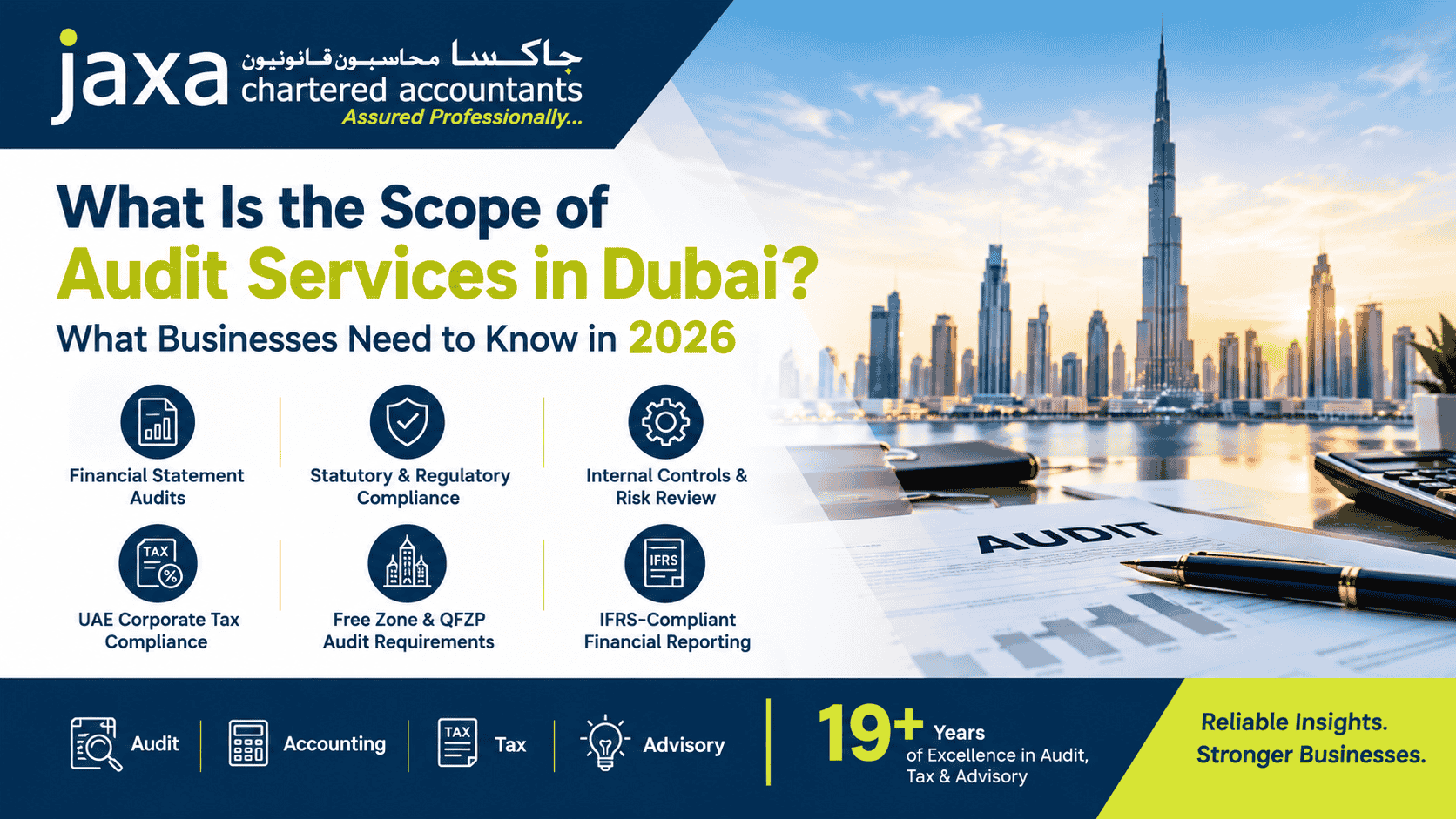

Discover what audit services in Dubai include with Jaxa Chartered Accountants. Learn about financial, statutory, external, and internal audits and the complete audit process.
For companies looking for audit services in Dubai and UAE, understanding what a professional audit involves is essential. Businesses rely on professional auditing to maintain reliable financial records, assess internal controls, review accounting records, and maintaining financial statements to assess whether the company’s financial information is fairly presented. An audit in the UAE provides businesses with greater confidence in the accuracy and reliability of their financial statements.
Working with experienced audit firms in the UAE, or registered auditors in the UAE, can help businesses prepare necessary documentation and address audit queries efficiently.
What do professional Audit Services in Dubai cover?
Professional audit services in the UAE involve much more than simply checking the accuracy of financial figures. An audit in Dubai is a structured review of a company’s financial information and supporting evidence. It goes beyond checking accounting figures and can involve an examination of transactions, financial statements, internal controls, assets, liabilities, and other relevant records.
For businesses seeking auditing services in Dubai, the scope of work depends on the type of audit engagement and the company’s specific requirements.
Financial audits, external audits, or statutory audits in the UAE may involve different procedures, but each requires the auditor to obtain appropriate evidence before reaching a conclusion.
Key areas of audit are:
- Reviewing financial records and statements to assess the accuracy
- Verifying the completeness of reported financial information
- Examining supporting documents, including invoices, contracts, bank statements, and other relevant records
- Assessing internal control and accounting processes to identify potential weaknesses and financial reporting risks
- Verifying assets, liabilities, and financial balances through appropriate audit procedures and supporting evidence
- Assessing financial statement presentation and disclosure in accordance with the applicable accounting and reporting framework
- Issuing an independent audit report in the UAE that presents the auditor’s professional opinion on the financial statements.
The role of a qualified audit firm in the UAE extends beyond reviewing financial figures. It plays an important role in strengthening the reliability and transparency of financial reporting. Through an independent assessment of financial information and relevant supporting evidence, an audit provides stakeholders with greater confidence in the company’s financial position based on the reliable financial information.
What do auditors examine during an audit?
The areas covered by an audit are determined by the nature of the business, the purpose of the engagement, and the financial complexity, audit objectives, and applicable reporting standards. As part of auditing services in the UAE, auditors examine several key areas to obtain sufficient evidence and support the reliability of the financial statements.
Key areas that professional auditors in the UAE evaluate are as follows:
- Financial statements and Accounting records: One of the primary areas covered by a financial audit in the UAE is the review of financial statements alongside the accounting records from which they are prepared.
Auditors may review:
- Balance sheet and income statement
- Cash flow statement
- Trial balance and general ledger
- Accounts receivable and payable records
- Supporting schedules and reconciliations
- Key journal entries and adjustments
- Financial statements disclosure
- Supporting documentation for major balances
These procedures help auditors in the UAE to evaluate if financial records are accurately recorded, properly supported, and presented as per IFRS and the UAE accounting reporting framework.
2. Examine Revenue and Expenditure: As a part of an external audit in the UAE, auditors examine revenue and expenditure to determine whether they are accurately recorded, appropriately classified, and supported by reliable financial documentation. This review helps strengthen the accuracy and credibility of a company’s financial statements.
The auditor’s review may include:
- Sales and revenue transactions
- Purchase and operating expenses
- Payroll and employee cost
- High-value or unusual transactions
- Transaction testing
- Check whether income and expenses are recorded in the appropriate accounting period.
- Verify underlying documentation such as invoices, agreements, Purchase orders etc.
Jaxa Auditors provides professional audit services in the UAE, helping companies maintain reliable financial records and meet applicable reporting requirements.
3. Review of Assets, liabilities, and bank statements: During a company audit in the UAE, auditors review key balance sheet items to assess whether the company’s financial position is accurately presented.
The registered auditors in the UAE, such as Jaxa Auditors, cover bank reconciliations, accounts receivable and payable, fixed assets, loans, liabilities, and supporting financial schedules.
The objective is to determine whether these balances are properly recorded and supported by appropriate evidence.
- Tax records and supporting documentation: As part of the audit engagement, auditors in the UAE may examine tax records and supporting financial documentation, including UAE VAT returns, tax invoices, reconciliations and related schedules. At Jaxa Auditors, the best audit firm in the UAE, the scope of each audit engagement is tailored to the company’s requirements, applicable UAE regulations and relevant financial reporting framework.
The auditors may review:
- Transaction approvals: checking whether financial transactions are properly finalized
- Accounting procedures: Reviewing internal controls that are in place to record and maintain financial information
- Bank and account reconciliations: reviewing reconciliations to identify discrepancies
- Financial documentation: checking whether transactions are supported by appropriate records
- Internal control weakness: identify gaps that could potentially increase financial reporting or operational risks.
4 . Financial reporting disclosure and compliance: As part of a financial audit in the UAE, the auditors review:
- Accounting policies and significant estimates
- Notes and supporting disclosures
- Related-party disclosure
- Contingencies and commitments
- Compliance with UAE applicable reporting standards
These procedures help ensure that financial statements are accurate, transparent, and reliable for stakeholders.
Key stages of the audit process in the UAE
- Audit Planning and Scope Definition: The auditor in the UAE reviews the company’s business activities, financial records, accounting system, and reporting requirements to determine the scope of the audit. The initial audit assessment help identify potential risks and establish the procedures and timelines for an effective audit.
- Business operation and Risk Analysis: The auditor evaluates key financial and operational risks by evaluating internal controls and business operations to identify potential risks and support an effective audit in the UAE.
- Financial data verification in the UAE: The auditor examines financial statements, invoices, bank records, ledger, and supporting documents to assess the accuracy and reliability of the company’s financial statements.
- Checking financial records and account balances: The auditor verifies key financial transactions and account balances against invoices, bank statements, contracts, and other supporting documents. This helps ensure the accuracy, completeness, and reliability of financial records during the audit procedure in the UAE.
- Review of audit observation: The qualified auditor in the UAE identifies discrepancies, internal control weaknesses, and financial risks to determine their significance and potential impact on financial statements.
- Financial audit review and reporting in the UAE: Once the audit procedures are completed, the audit team evaluates the final findings and prepares the audit report in the UAE.
What do Audit firms in Dubai Examine?
The audit in the UAE goes beyond checking for accounting errors. The audit procedure in the UAE involves a detailed review of financial records, accounting practices, internal controls, and supporting documents to identify potential risks and reporting issues.
Key areas audit firms in the UAE examine
- Financial record accuracy
- Accounting documentation
- Internal control effectiveness
- Account balance verification
- Unusual, high-value, or complex transactions
- Unsupported balances
- Financial reporting Compliance
- Tax and regulatory compliance
- Compliance with Accounting Statements
Choose the right audit firm in Dubai
Working with an experienced audit firm in Dubai can help businesses manage the audit process efficiently and address complex financial and regulatory requirements. An experienced and knowledgeable audit team oversees the audit process, coordinates the required documentation, conducts necessary procedures, and supports timely completion.
While choosing an auditing firm in Dubai, businesses should consider:
- Professional Qualification and Experience: Look for qualified professionals with relevant audit experience and a track record of handling similar industries.
- UAE regulatory and compliance expertise: Strong awareness of UAE accounting, auditing, tax, and financial reporting requirements relevant to businesses operating in the UAE.
- Clear client communication: Maintaining transparent communication and providing timely responses throughout the audit process in the UAE.
- Confidentiality and data protection: Ensuring financial details and business records are handled securely and confidentially.
- Sector-specific audit knowledge: Understanding the accounting practices, financial risks, and regulatory processes relevant to the client’s industry.
- Efficient audit completion: Managing the audit engagement effectively to complete audit procedures and reporting within agreed timelines.
- Post-audit guidance: Providing the business with clear insights into UAE audit findings, internal control gaps, and areas for improvement can help strengthen financial processes and support audit and compliance requirements in the UAE.
Benefits of professional audit services in Dubai
A professional audit firm in Dubai offers businesses valuable insights into their financial position, accounting processes, and internal controls while supporting compliance with UAE financial reporting requirements.
Key benefits include:
- Independent financial review: Provides an objective assessment of the company’s financial records and statements
- Improved financial transparency: Helps ensure financial statements are accurate, reliable and properly supported.
- Early identification of financial risk: Highlights accounting errors, inconsistencies, and potential reporting risks.
- Strengthen internal control: Identifies internal control gaps and opportunities to improve financial processes.
- Build stakeholder confidence: Reliable audited financial statements boost stakeholder confidence.
- Support for UAE compliance requirements: Assist businesses in complying with applicable UAE audit, tax, and financial reporting requirements.
- Better financial decision-making: Audited financial statements provide management with greater clarification on financial performance, potential risks, and opportunities, and support informed business planning and strategic decisions.
With the issuance of Ministerial Decision No. 84 of 2025, certain entities may be required to maintain audited financial statements as per UAE corporate tax regulations. Applicable to the tax period beginning on or after January 1, 2025, the decision makes it important for businesses to assess key audit and financial reporting obligations.
Jaxa Chartered Accountants, a leading audit firm in the UAE and corporate tax advisory in UAE assist business in understanding applicable UAE audit requirements.
UAE Audit Preparation: a key audit checklist
Being well-prepared financial statements can help businesses minimize delays and facilitate a smoother audit in the UAE. This helps businesses to reduce delays and ensure financial statements are readily available for review.
- Compile financial statements for review
- Reconcile bank, cash, and other accounts and clear outstanding differences.
- Organize audit evidence
- Verify accounts receivable and payables
- Prepare UAE VAT returns, tax calculations, reconciliation, and supporting documents for the audit
- Resolve accounting differences
- Designate a responsible auditor in the UAE to manage requests, provide documentation, and coordinate responses throughout the audit engagement.
Get help from the Best audit firm in the UAE
Jaxa Chartered Accountants, a leading auditing firm in the UAE, provides comprehensive audit, accounting, tax, and advisory services in the UAE. Jaxa Auditor, a certified UAE FTA tax agent, helps businesses with practical guidance designed to address their audit, tax and financial reporting requirements.
For businesses looking for auditing and assurance services in the UAE or across Dubai, Jaxa Auditors offers valuable and professional support throughout the audit and financial reporting process.
Our audit services include:
At Jaxa Auditors, our audit services in the UAE are designed to address different business, financial reporting and regulatory requirements. Our services include:
- Statutory audit services
- Internal audit services
- External audit services
- Financial statement audit
- Due diligence services
- Corporate tax in the UAE
- VAT return in the UAE
- Accounting and Bookkeeping services in the UAE
With more than decades of professional experience and expertise as a UAE FTA tax agent, Jaxa supports businesses with practical, professionally guided audit and assurance solutions across the UAE.
If you need any help with audit services in the UAE, please contact Jaxa for expert audit support.



 Reach us on WhatsApp