
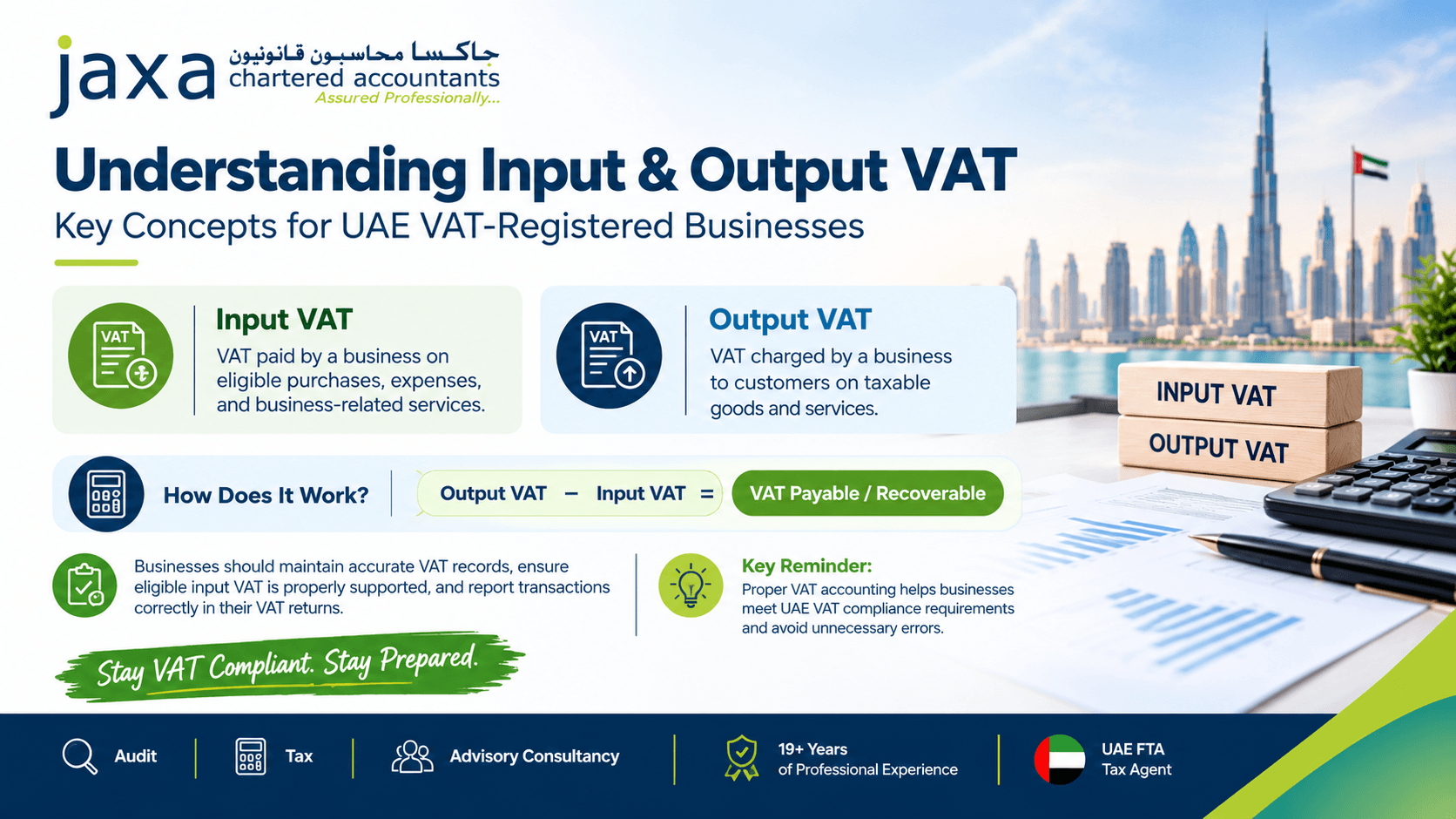

The UAE implemented Value Added Tax (VAT) on January 1, 2018, with a standard VAT rate of 5% for most taxable supplies of goods and services. Understanding VAT in the UAE is essential as it influences pricing decisions, cash flow management, expense accounting, and tax compliance. Two fundamental parts of the UAE VAT system, Input VAT and Output VAT, play a central role in determining how much VAT a business needs to pay or recover.
In simple terms, output VAT is the VAT a business charges its customers on taxable sales, while Input VAT is the VAT paid on eligible business purchases and expenses. The difference between these amounts determines the net VAT liability or recoverable amount payable to the FTA, subject to UAE VAT rules.
Understanding how input and Output VAT work together can help businesses maintain accurate records, recover eligible VAT, and ensure effective VAT compliance in the UAE.
UAE VAT: Overview
Value Added Tax (VAT) is an indirect tax imposed on taxable goods and services supplied in the UAE. The standard VAT rate in the UAE is 5%. VAT is collected through different stages of the supply chain, with VAT-registered businesses accounting for the tax on their taxable sales and eligible purchases.
At each relevant stage of the supply chain, VAT-registered businesses account for VAT on their taxable supplies.
What do you mean by Output VAT?
Output VAT is the Value-Added Tax that a VAT-registered business in the UAE charges on taxable goods and services supplied to its customers. It represents the VAT collected on the business’s taxable sales and forms part of its VAT reporting obligations. It must be appropriately recorded and reported in the business’s VAT return.
The Output VAT collected is taken into account when determining the business’s net VAT position for the relevant tax period. After considering eligible input VAT, the business may have a VAT amount payable to the UAE Federal Tax Authority, or, where applicable, a recoverable VAT balance, subject to the relevant UAE VAT regulations.
Who needs to charge Output VAT?
Businesses that are registered for VAT in the UAE are required to charge Output VAT on taxable supplies of goods and services. The applicable VAT amount should be clearly stated on the tax invoice issued to the customer. Proper invoicing helps businesses maintain accurate VAT records and meet the compliance requirements of the UAE FTA.
How to calculate Output VAT?
Output VAT is calculated by applying the applicable VAT rate to the value of a taxable supply.
Formula:
Output VAT= taxable sales value * applicable VAT rate
Example:
- Value of taxable sales: AED 1000
- VAT rate: 5%
- Output VAT: AED 50
- Total invoice amount: AED 1,050
In such an instance, the AED 50 is the Output VAT collected from the customer. The business must report this amount in its VAT return and account for the applicable VAT payable to the FTA, after considering eligible Input VAT.
Key Considerations while charging Output VAT
Once a business is VAT-registered in the UAE, it must apply the appropriate VAT treatment to its taxable supplies. Accurate VAT charging requires businesses to determine:
- Whether a sale or service is subject to VAT
- The applicable VAT rate
- At which time VAT becomes due
- How VAT should be presented on the tax invoices
- How VAT transactions should be recorded and reported
Applying the wrong VAT treatment can result in underpayment or overpayment of VAT, incorrect invoices, compliance risk, and potential penalties.
Role of UAE VAT invoices in UAE tax compliance.
A properly prepared VAT invoice is necessary for UAE VAT compliance. It is essential for accurate tax records and should include the information required under UAE VAT regulations. A VAT invoice should:
- Supplier details including the business name and address
- Customer details, where applicable
- Tax Registration Number (TRN) of the supplier and customer, as applicable
- Unique invoice number for proper record-keeping
- Invoice date and relevant tax point details
- Description of goods or service supplied
- Tax amount before VAT
- Applicable VAT rate
- VAT amount charged
- Total invoice amount, including VAT
Maintaining accurate VAT invoices helps businesses support their Output VAT reporting, maintain proper tax records, and provide customers with the documentation needed to substantiate eligible Input VAT claims.
How Output VAT affects Business Cash Flow
Output VAT directly affects a business’s cash position because VAT collected from customers must ultimately be accounted for with the UAE Federal Tax Authority.
- VAT collected is a Tax Liability: The VAT charged on taxable sales is collected from customers but represents a liability that the business must account for in its VAT return.
- Difference between Output and Input VAT: Businesses calculate their net VAT liability by comparing Output VAT collected on sales with recoverable Input VAT paid on eligible business expenses. When Output VAT is higher, the difference is paid to the FTA.
- Effective cash flow management: Maintaining accurate VAT records and setting aside the VAT collected can help businesses avoid using tax funds for operational expenses and ensure sufficient cash is available when the VAT payment becomes due.
What is Input VAT in the UAE?
Input VAT is the Value Added Tax a VAT-registered business pays on goods and services purchased for business purposes. In the UAE, businesses may be able to recover eligible Input VAT through their VAT returns, subject to conditions and requirements set by the UAE FTA.
Input VAT commonly arises on business expenses such as:
- Raw materials and Inventory: VAT paid on goods purchased for manufacturing, production, or resale.
- Utilities and Operational Expenses: VAT incurred on electricity, water, telephone, internet, and other business-related utilities.
- Office equipment and supplies: VAT paid on computers, furniture, stationery, and other equipment used for business activities.
- Professional services: VAT charged on accounting, auditing, legal, consultancy, and other professional services.’
- Imported goods: VAT incurred on goods imported into the UAE, including those subject to the applicable reverse charge mechanism.
Accurately recording input VAT and maintaining the required supporting documents can help determine their recoverable Input VAT and calculate their correct VAT liability while filing VAT returns in the UAE.
Input VAT recovery in the UAE: How does it work?
Input VAT recovery in the UAE allows eligible VAT-registered businesses to recover the VAT paid on business-related purchases, subject to the conditions prescribed under UAE VAT regulations. While filing a VAT return in the UAE, recoverable input VAT is generally offset against the Output VAT charged on taxable supplies.
Formula:
Net VAT Payable/refundable = Output VAT- Recoverable Input VAT
The result determines whether your business has VAT payable to the FTA or may be entitled to a VAT refund in the UAE.
- If Output VAT is higher than Input VAT: The difference becomes the VAT payable to the UAE Federal Tax Authority.
- If recoverable input VAT is higher than Output VAT: The business may have an excess VAT credit. Subject to the applicable UAE VAT rules, this amount may be claimed as a VAT refund from the FTA or carried forward to offset future VAT liabilities.
Example of Input VAT Recovery
Suppose your business purchased office equipment for AED 2000 with 5% VAT, resulting in AED 100 of Input VAT.
If the AED 100 meets the requirements of Input VAT recovery, it can be included as recoverable Input VAT when you file your VAT return with the FTA. This amount can then be offset against the Output VAT charged on your taxable sales.
Accurately maintaining VAT records, valid tax invoices, and supporting documents is essential for claiming VAT recovery in the UAE and ensuring accurate UAE VAT return filing.
Businesses must satisfy certain requirements to claim Input VAT in the UAE. Before including input VAT in a VAT return, ensure that the following conditions are met:
- Valid VAT documentation: A valid tax invoice or other required supporting document should be available to substantiate the VAT claim.
- Business-related expenses: The goods or services must be acquired for business activities. VAT incurred on personal or private expenses is generally not recoverable.
- VAT Registration: The business must be registered for VAT with the UAE FTA to recover eligible Input VAT.
- Eligible business activities: The purchase should relate to activities that permit input VAT recovery under UAE VAT regulations. VAT associated with exempt or non-business activities may not be recoverable.
- Supporting records: Businesses should retain the relevant invoices and accounting records to support the input VAT claims during VAT return filing.
Eligibility for Input VAT recovery in the UAE
A business may be able to claim input VAT in the UAE when the expenses are incurred for its taxable business activities and meets the applicable UAE VAT requirements. The business must also maintain sufficient documentation to support the input VAT claim.
Key requirements generally include:
- Business Purpose: The goods or services must be used for eligible business activities rather than personal purposes.
- Taxable activities: The expenses should be related to activities that allow input VAT recovery under applicable UAE VAT regulations.
- Valid Tax Invoice. A valid VAT invoice should be obtained from the supplier where required.
- Import documentation: For imported goods, relevant customs and import records should be maintained to support input VAT claims.
- Proper records: Businesses should retain invoices, accounting records, and other supporting documents for their VAT return filing and potential UAE FTA review.
For example, if a company purchases business software and receives a valid tax invoice showing VAT, the VAT amount may be recoverable input VAT provided all applicable recovery conditions are satisfied.
Maintaining accurate VAT records helps businesses support their Input VAT claims and correctly determine the VAT amount payable or refundable when filing a VAT return in the UAE.
Understanding Input and Output VAT after UAE VAT registration
Once the business completes VAT registration in the UAE, it must establish proper accounting and record-keeping processes to track VAT on its business transactions. This includes recording both input VAT paid on purchases and Output VAT charged on taxable sales.
For example, a newly VAT-registered business may purchase inventory for AED 10,000 with 5% VAT before making significant sales. If the purchase meets the applicable Input VAT recovery requirements, the AED 500 may be claimed as recoverable Input VAT.
When a business makes taxable sales, it collects Output VAT from its customers and records the amount against its sales transactions. As part of VAT return filing in the UAE, the business calculates its VAT liability by setting eligible input VAT against Output VAT collected.
Maintaining well-organized VAT records, including purchase invoices, sales invoices, and supporting documents, helps businesses substantiate their input VAT claims, report accurate figures, and remain compliant with UAE VAT regulations.
UAE VAT Bookkeeping: set up your records from Day one
Businesses should begin VAT bookkeeping in the UAE as soon as they become VAT registered rather than waiting until the first VAT return is due.
An effective system should include:
- Setting up appropriate VAT codes in accounting software
- Separating taxable, exempt and non-taxable transactions
- Maintaining valid sales and purchase invoices
- Recording input and output VAT accurately
- Reconciling VAT accounts regularly before filing VAT return
Early and accurate VAT record-keeping helps businesses reduce errors and maintain ongoing UAE VAT compliance.
Monitor the UAE VAT Registration threshold
Businesses should regularly monitor their taxable turnover to determine whether they are approaching the UAE VAT registration threshold.
- Mandatory VAT threshold: Registration is generally required when taxable supplies and imports exceed AED 375,000 over the relevant period.
- Voluntary VAT Registration: Businesses may apply for voluntary registration when taxable supplies, imports, or relevant taxable expenses meet the AED 187,500 threshold.
Tracking turnover in advance allows businesses to identify their VAT registration obligations on time and complete the registration process without unnecessary delays.
How to report Input VAT and Output VAT in UAE VAT Return filing
VAT-registered businesses must report their taxable transactions and VAT position through VAT returns in the UAE based on their assigned tax period.
The net VAT amount is generally calculated by comparing Output VAT collected on taxable sales with recoverable input VAT paid on eligible business purchases
Net VAT = Output VAT – Recoverable Input VAT
- Output VAT exceeds Input VAT: the difference is generally payable to the UAE FTA.
- Input VAT exceeds Output VAT: The business may have a VAT credit or refundable position, subject to applicable UAE FTA requirements.
Example
If a business reports AED 25,000 in Output VAT and AED 16,000 in recoverable input VAT:
AED 25,000 – AED 16,000= AED 9000
The business would generally have AED 9000 in net VAT payable for the period, subject to the complete VAT return calculation.
VAT Documentation in the UAE
Keeping proper VAT documentation in the UAE helps businesses support their input and output VAT calculations and meet FTA record-keeping requirements.
Key documents may include:
- Tax invoices and purchase invoices
- Sales invoices and credit/debit notes
- Import and customs documents
- Accounting and transaction records
- Relevant payment documents
Organized records make UAE VAT return filing more efficient and help businesses substantiate their figures if the FTA requests supporting documents.
UAE VAT compliance: Common errors and how to avoid them
Effective management of Input and Output VAT in the UAE helps businesses maintain accurate VAT records, claim eligible input VAT, and file their VAT returns properly. Regular reviews can help identify and prevent common VAT compliance errors.
- Inaccurate VAT invoices: accurate tax invoices are essential for proper VAT compliance in the UAE. Businesses should ensure that invoices contain required information and correct VAT treatment is applied to each taxable transaction.
- Claiming ineligible input VAT without checking eligibility: businesses cannot recover input VAT on every expense. Each purchase should be reviewed to confirm that the Input VAT is recoverable under UAE VAT regulations before it is included in the UAE VAT return filings.
- Including personal expenses in VAT claims: Personal expenses should be kept separate from business-related purchases when calculating recoverable Input VAT. Maintaining separate records helps ensure accurate VAT records and compliant UAE VAT return filings
- Inaccurate VAT reporting: Incorrect VAT calculation or transaction classification can result in errors when filing VAT returns in the UAE. Businesses should verify input and output VAT figures and reconcile them with their accounting record before submission.
- Delaying VAT record-keeping: Delaying VAT bookkeeping until the filing deadline can result in missing documents, incorrect transaction classification, and reporting errors. Maintaining VAT records regularly helps businesses prepare UAE VAT return filings efficiently.
Choose the right VAT consultant in the UAE
VAT registration in the UAE marks the beginning of a business’s ongoing tax compliance responsibilities. Businesses must accurately record VAT transactions, maintain supporting documents, issue valid tax invoices, claim input VAT, and submit VAT returns within the required deadline.
Engaging a qualified VAT consultant in the UAE can help businesses manage these requirements and reduce the risk of reporting errors. Professional VAT services in the UAE may include:
- VAT registration in the UAE
- VAT compliance in the UAE
- Input VAT recovery reviews
- VAT return preparation and filings
- VAT bookkeeping and record-keeping
- UAE FTA correspondence and support
- VAT audit preparation
Choose Jaxa Auditors, a UAE FTA-registered tax agent
Businesses dealing with complex transactions, imports, cross- border supplies, or input VAT restrictions may benefit from professional VAT guidance. Engaging with the best VAT consultant in the UAE, as well as a UAE FTA-registered tax agent, may provide structured support for VAT compliance and help businesses address their tax obligations efficiently.
Our tax agent in the UAE provides professional VAT services in the UAE, including VAT health checks, VAT compliance and advisory, and VAT return filing and UAE FTA assistance. We are certified UAE FTA tax agents with 19+ years of experience in managing UAE VAT compliance with practical and reliable tax support.
If you need support with UAE VAT registration, VAT return filing, Input VAT recovery, or ongoing UAE VAT compliance, Jaxa Auditors can assist.
Contact Jaxa Auditors today to discuss your VAT requirements and stay on top of your UAE VAT obligations.

 Reach us on WhatsApp