
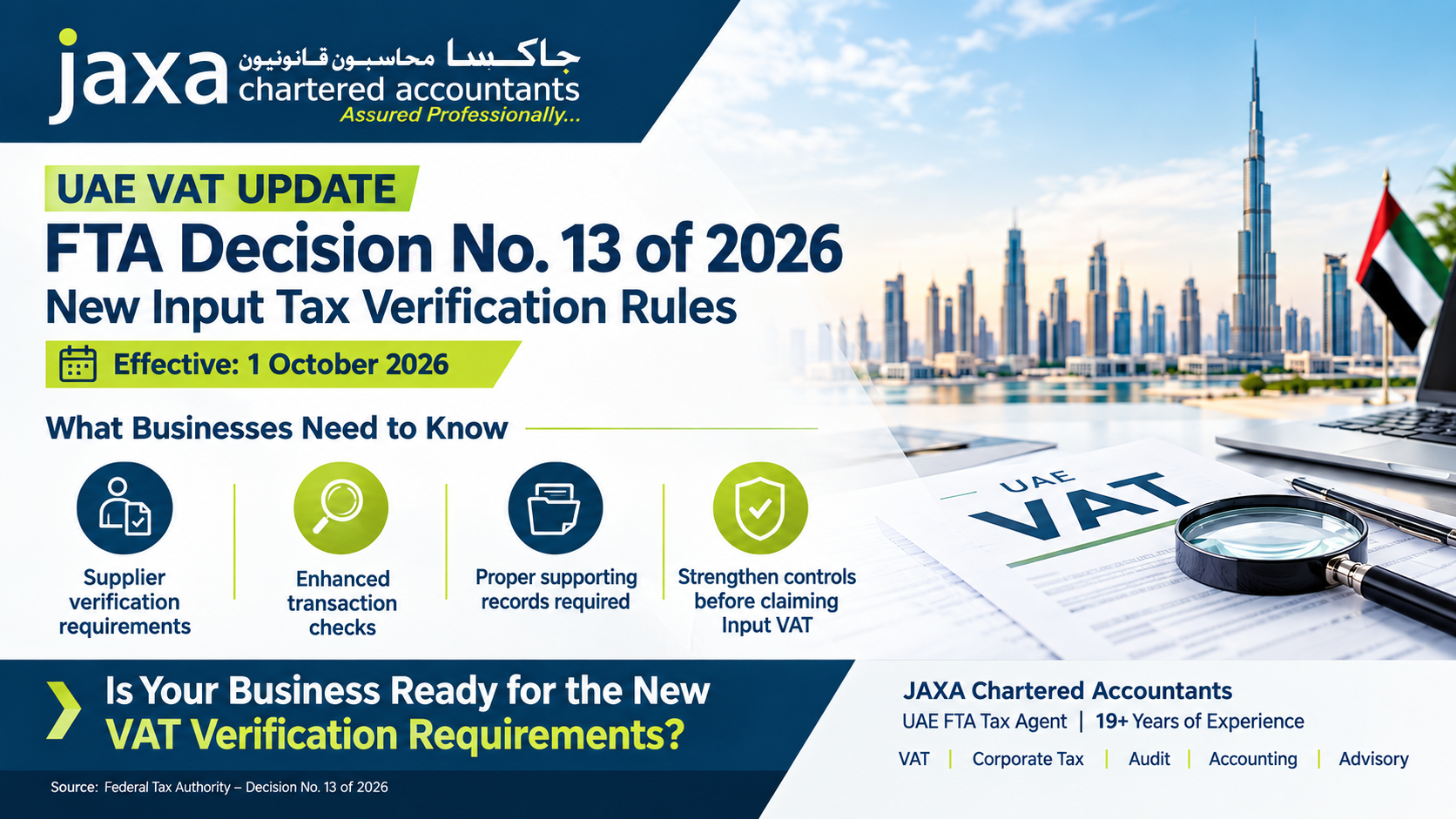

In a significant UAE VAT compliance update, the UAE Federal Tax Authority (FTA) has issued Decision No 13 of 2026, introducing new Measures, procedures, and conditions required for a Taxable Person to verify the validity and integrity of suppliers before claiming Input Tax. The new measure will apply from October 1, 2026 and is expected to strengthen VAT compliance and documentation practices.
This decision is issued pursuant to Article 54(bis) of Federal Decree-Law No. 8 of 2017 on Value Added Tax.
In practice, businesses seeking input tax recovery may be required to maintain evidence of the necessary checks performed on the supplier and the transactions, subject to the exceptions provided under the Decision.
This guide outlines the new requirements, identifies the business affected, and highlights the key steps to take before October 1, 2026.
Understanding UAE FTA Decision No. 13 of 2026. Key UAE’s New Input Tax Verification Requirements
FTA Decision No.13 of 2026 introduces new requirements under Article 54 bis of the UAE VAT framework for businesses claiming input VAT recovery. This decision requires VAT-registered businesses to carry out specific verification checks on their supplier and the underlying transactions before recovering input VAT.
The purpose of this Decision, as per the UAE VAT framework, is to strengthen measures against tax evasion and prevent input VAT recovery on transactions linked to VAT fraud. The Decision introduces specific verification requirements that taxable persons must consider when determining their entitlement to deduct input tax.
Failure to meet the applicable requirements may affect the business’s ability to substantiate input tax deductions, particularly where the conditions under the UAE VAT legislation relating to the validity and integrity of suppliers are relevant.
All VAT-registered businesses in the UAE are covered by these requirements. The level of supplier and transaction checks required may vary based on the value of supply, with higher-value transactions subject to greater scrutiny.
The UAE FTA introduced additional verification requirements for businesses claiming Input tax deductions, with the new requirements coming into effect on October 1, 2026.
Which UAE Businesses comply with new UAE VAT Verification Requirements- FTA Decision No. 13 of 2026?
The new requirements under UAE FTA Decision No.13 of 2026 are particularly significant for businesses with high purchasing volumes, deal with multiple suppliers, or have significant claims for input VAT recovery. The new UAE VAT requirements are likely to have a greater impact on:
- Business with large purchasing volumes
- Companies with cross-border supply chains
- Marketplace operators and digital platform businesses
- Growing businesses that onboard new or multiple supplier
- Trading businesses handling high-value transactions
- Businesses with substantial or frequent input VAT claims
The new UAE VAT verification requirements are not limited to large businesses. From October 1, 2026, small and medium-sized businesses must also have a written verification policy in place. Businesses should review their existing VAT procedures, strengthen supplier and transaction checks, and retain proper documentation of these supplier and transaction checks.
What are the supplier and supply verification requirements under FTA Decision No. 13 of 2026?
UAE FTA Decision No. 13 of 2026 introduces specific UAE VAT verification requirements that a taxable person must consider before deducting input tax. The new framework requires businesses to verify both the supplier and the taxable supply received or accepted
The ultimate purpose of these measures is to strengthen input VAT compliance, improve due diligence across supply chains, and help businesses establish the validity and integrity of their transactions
- Supplier Verification Requirements: Businesses are required to carry out prescribed supplier verification checks when dealing with a supplier for the first time. Businesses should verify new suppliers and carry out a further verification where no verification has been completed within the previous 12 months. The checks may include:
- Supplier identity, incorporation and registration
- Director or authorized representative details
- Physical business location
- Changes in business details
- Unusual transaction patterns
- Additional information required under the applicable verification procedures
Businesses should maintain clear records of the verification performed to demonstrate that appropriate supplier due diligence has been completed.
- Enhanced Supplier Verification: AED 375,000 threshold
When the value of supplies received from a single supplier exceeds, or is expected to exceed, AED 375000 over a 12-month period, enhanced verification requirements apply.
The business should take the following steps:
- Monitor supplier purchases: Track the total value of supplies received from each supplier over the relevant 12-month period.
- Obtain bank confirmation: Obtain written confirmation from a UAE bank that the supplier maintains a bank account with the bank.
- Review public information: Consider relevant publicly available information about the supplier as part of the enhanced verification process.
- Maintain documentation: Keep evidence of the verification checks and supporting documents for VAT compliance purposes.
Key Threshold: AED 375,000
When supplies from a single supplier exceed or are expected to exceed AED 375,000 over 12 months, businesses should apply the enhanced supplier verification requirements.
Why it matters
Businesses should monitor total purchases from each supplier, rather than looking at individual invoices alone, to determine when the AED 375,000 threshold may be reached.
- Supplier Verification requirement
Before deducting input VAT, businesses must also verify the taxable supply before claiming input VAT.
Key UAE VAT verification checks include:
- Commercial purpose of the transactions and supplier
- Payment method and payment flow
- Reasonableness of the transaction value compared with market conditions
- Whether the goods or services match the supplier’s licensed business activities
- Ownership and origin of goods, where applicable
- Commercial justification for any intermediary in the supply chain
Periodically documenting these supplier and transaction verification checks in the UAE helps businesses strengthen UAE VAT compliance and support input VAT recovery claims.
- Payment Verification and Cash Transactions:
As part of the new UAE VAT input tax verification requirements, businesses should review the payment method and check whether the payment flow for relevant transactions is commercially appropriate and properly documented. If the transaction is settled in cash, businesses should document the commercial reason, supported by proper documentation and records.
- AED 10,000 Small-supply Exception: Under the new UAE VAT verification requirement, certain taxable supplies below AED 10,000 excluding VAT may qualify for a exception from verification. However, exceptions may not apply where the total value of supplies received from the same supplier exceeded AED 100,000 in the previous or expected to exceed in next 12 months.
Businesses should monitor total purchases from each supplier, rather than assessing individual invoices alone.
- Documentation and Record Keeping for UAE VAT compliance: Proper documentation and record-keeping are a key part of the new UAE VAT verification requirements. Businesses must document the verification procedures carried out on suppliers and taxable supplies and retain the relevant supporting records/
Under FTA Decision No.13 of 2026, businesses must also maintain a documented internal verification policy covering:
- Supplier and supply verification procedures
- Persons responsible for implementing, reviewing and supervising the checks
- Relevant powers and responsibilities
- Supporting documents and records demonstrating that the required verification was performed
Businesses should review their supplier onboarding, procurement, accounts payable, and input VAT recovery processes before October 1, 2026, to help maintain UAE VAT compliance and support input VAT claims.
Risk of Non-compliance with the New Input VAT Verification in the UAE (FTA Decision No.13 of 2026)
Non-compliance with the new UAE VAT verification requirement could affect a business’s input VAT recovery and overall UAE VAT compliance.
Some potential consequences include:
- Input VAT deduction may be denied where the applicable verification requirements are not met
- Business may face additional VAT liabilities if input tax deductions are disallowed
- Inaccurate VAT records may result in administrative penalties
- Inadequate supplier and transaction documentation can make it more difficult to support input VAT claims during an FTA audit or review.
Businesses should ensure that their supplier verification, transaction checks, and VAT records are properly documented before FTA Decision No 13 of 2026 takes effect on October 1, 2026. This may help minimize compliance risk and provide stronger support for input VAT recovery.
How to prepare for FTA Decision No. 13 of 2026 before October 1, 2026
Businesses should start preparing UAE VAT verification procedures well before the new verification takes effect. Let’s look into the following steps which can help ensure readiness:
- Implement a Written Verification policy: Businesses should establish a written verification policy covering the supplier and supply checks required under FTA Decision No.13 of 2026. This policy includes the procedure to be followed and individuals responsible for carrying out and reviewing the checks.
- Review and verify existing suppliers: Review your current supplier database before October 1, 2026, and identify:
- Suppliers that have not been verified
- Suppliers whose verification is more than 12 months old
- Supplier when purchases exceed or are expected to exceed AED 375,000
- Suppliers that may require enhanced verification checks
This review will help businesses identify verification gaps and ensure their supplier due diligence and UAE VAT compliance procedures are ready for new requirements.
- Prepare for enhanced supplier verification: Identify suppliers that exceed or are expected to exceed the AED 375,000 threshold and ensure the applicable enhanced verification checks, including bank confirmation, are completed and correctly documented.
- Update VAT and accounting procedures: Integrate the new supplier verification and supply verification requirements into your procurement, accounts payable, and input VAT recovery process. Ensure all relevant checks are properly documented and aligned with UAE VAT compliance and FTA requirements
Businesses should review their existing VAT compliance procedures and accounting controls with professional VAT advisory and tax consultants in the UAE, such as Jaxa Auditors, also a UAE FTA tax agent, to ensure they are prepared for the new requirements.
- Strengthen staff Awareness: Ensure employees responsible for supplier invoice processing, accounting, and VAT return preparation are familiar with the recent UAE FTA Input tax requirements. This helps businesses to integrate these verification checks with routine accounting procedures while ensuring UAE VAT compliance and accurate FTA records.
How will UAE FTA Decision No 13 of 2026 affect Input VAT Verification?
With the new requirement taking effect from October 1, 2026, businesses will need to strengthen their procedures for Input VAT recovery and UAE VAT compliance. Key areas to focus on include:
- Verifying suppliers and taxable supplies as required
- Maintaining proper VAT documentation and supporting records
- Ensuring input VAT claims are backed by appropriate verification
- Reviewing supplier and transaction checks before filing UAE VAT returns
- Aligning internal processes with UAE FTA compliance requirements
Following a consistent verification process can help businesses support input VAT claims, maintain accurate VAT records, and minimize compliance risk during an FTA review or tax audit. Ensure you seek a professional tax agent in the UAE, such as Jaxa Auditors, a UAE FTA tax agent, to strengthen UAE VAT compliance and prepare for new UAE FTA Decision 13 of 2026 with confidence.
Prepare your business for New UAE VAT requirements with a Dubai VAT consultant
Businesses should start preparing early to strengthen UAE VAT compliance, improve supplier due diligence, and ensure proper documentation for input VAT recovery. Taxable persons should review and update their internal processes well before October 1, 2026, to ensure a smooth transition to the new input tax verification requirements.
Jaxa Chartered Accountants, a leading UAE FTA tax agent and VAT advisory firm in Dubai, helps businesses understand and implement the requirements of UAE FTA Decision No. 13 of 2026. Our Dubai VAT consultants can support businesses with supplier verifications, VAT compliance reviews, documentation, and processes designed to support input VAT claims and UAE FTA compliance.
How can Jaxa Auditors, a top VAT consultant in the UAE, help?
As a UAE FTA-approved tax agent, Jaxa Chartered Accountants provides professional VAT advisory and compliance services in Dubai and across the UAE. With extensive experience in UAE taxation, our team assists businesses in understanding and preparing for the requirements introduced under FTA Decision No. 13 of 2026, effective from October 1, 2026.
With the new verification requirements introducing Input VAT recovery, Jaxa Auditors can support businesses in establishing a practical and sustainable compliance framework.
Our UAE VAT compliance support includes:
- UAE VAT compliance Readiness Review: Evaluate existing supplier onboarding, verification, and payment procedures to identify gaps.
- Verification Policy Development: Develop and implement a documented supplier verification policy.
- Input Tax Risk Assessment: Evaluate potential VAT recovery risks arising from verification gaps.
- UAE VAT Pre-health Check: Conduct periodic reviews to monitor continued compliance.
- VAT Process Integration: Embed verification checks before invoices are processed.
- UAE VAT Registration and VAT return filing support
- Review of VAT Documentation and record-keeping procedures
- Staff guidance on new UAE FTA requirements
With 19+ years of professional experience across UAE tax, VAT, accounting, audit and advisory services, Jaxa Auditors combines practical knowledge of UAE VAT, corporate tax, audit, accounting, and compliance to help businesses navigate evolving UAE FTA requirements. As a UAE FTA-approved tax agent and VAT advisory firm in Dubai, Jaxa Auditors helps businesses to prepare for the new UAE Input VAT verification requirement ahead of October 1, 2026.
Is your business ready for the new Input Tax Verification requirement?
With the October 1, 2026 deadline approaching, now is the right time to review your supplier verification, VAT controls, and documentation processes.
Speak with Jaxa’s UAE VAT specialist today and take the next step towards stronger UAE VAT compliance.
FAQ
-
What is FTA Decision No. 13 of 2026?
FTA Decision No. 13 of 2026 introduces new UAE VAT verification requirements for businesses claiming input tax deductions. Businesses will need to carry out certain checks on their suppliers and taxable supplies before claiming input VAT. The Decision is aimed at improving UAE VAT compliance, strengthening supplier due diligence and reducing the risk of input VAT claims linked to tax evasion.
2. When does FTA Decision No. 13 of 2026 take effect?
FTA Decision No. 13 of 2026 will come into effect on 1 October 2026. Businesses should prepare their VAT and input tax processes before this date.
3. How can businesses prepare for the new UAE input VAT verification requirements?
Businesses should create a clear VAT verification policy, review their suppliers, check applicable thresholds, update procurement and accounting processes, maintain proper VAT documentation and records, and train staff. A UAE FTA Tax Agent or VAT consultant in Dubai can also help businesses prepare and improve their UAE VAT compliance.
4. How can JAXA Chartered Accountants help with the new UAE VAT requirements?
JAXA Chartered Accountants, a UAE FTA Tax Agent and VAT advisory firm in Dubai, helps businesses manage UAE VAT compliance, supplier verification, input VAT risks, and VAT documentation. JAXA can also help businesses update their internal processes and prepare for the requirements under FTA Decision No. 13 of 2026.





 Reach us on WhatsApp