
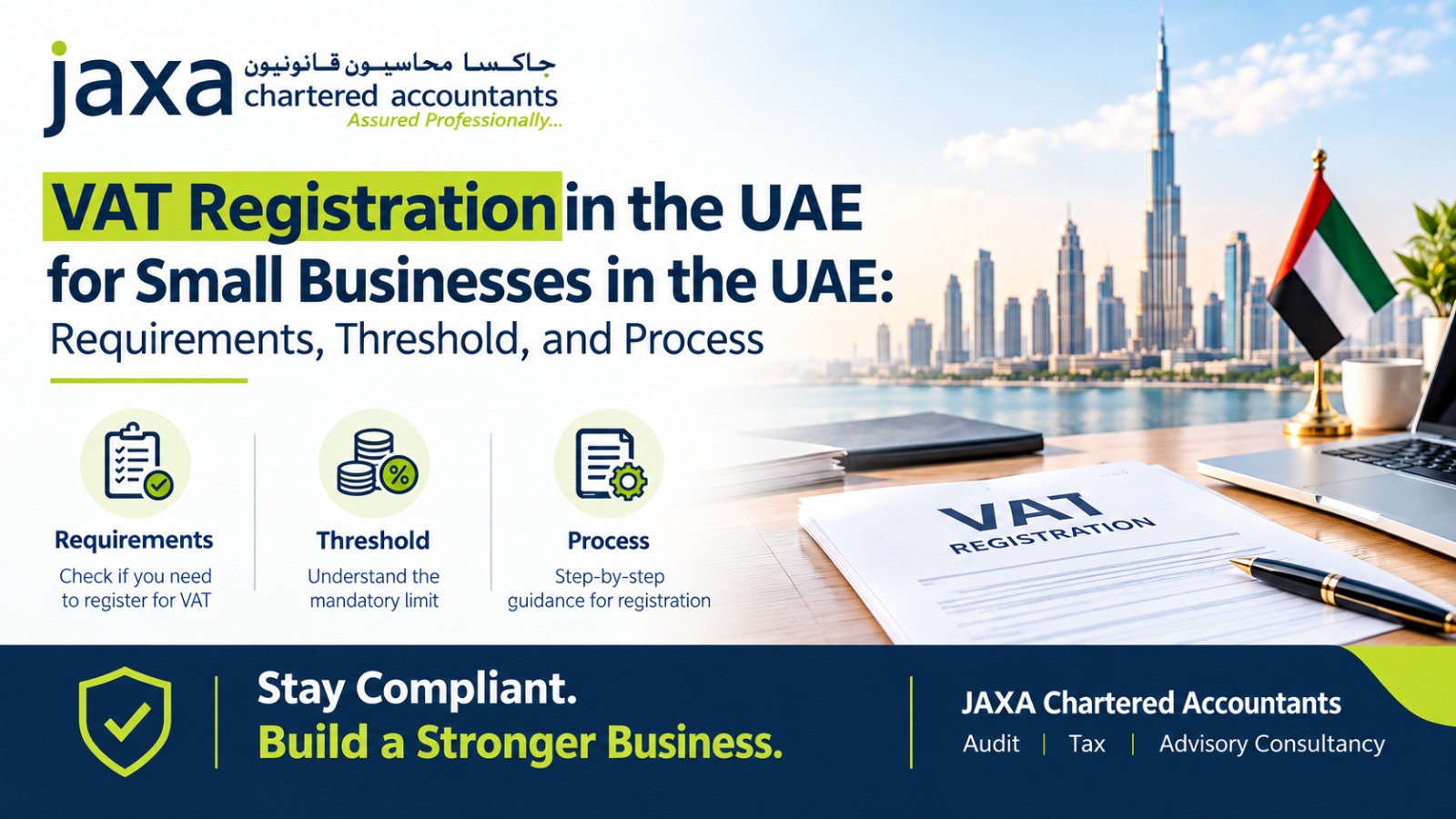

VAT registration in the UAE is an Important tax compliance requirement for eligible small businesses. Since the implementation of VAT in the UAE in 2018, it has become an integral part of the country’s tax framework and economic diversification strategy. Understanding the VAT registration threshold, eligibility requirements, and registration process in the UAE can help businesses meet their FTA obligations and, where applicable, recover eligible input VAT, subject to the applicable UAE VAT regulations.
For small businesses, regularly monitoring taxable turnover, maintaining accurate accounting records, and registering for VAT in the UAE within the applicable timeframe are essential for effective VAT compliance in the UAE. Taking these steps can help businesses manage their VAT obligations efficiently and reduce the risk of avoidable compliance issues.
With support from Jaxa Chartered Accountants, a leading VAT consultant in the UAE, businesses can navigate the VAT registration process efficiently and ensure they meet the applicable requirements.
Key Takeaways
The UAE VAT framework has developed consistently since VAT was first introduced in 2018. The following timeline highlights some of the major milestones.
- The UAE introduced Value Added Tax (VAT) at 5% on January 1, 2018.
- The UAE VAT has undergone several amendments to strengthen and clarify the VAT framework.
- The VAT Executive Regulations were updated in 2024, introducing important changes for businesses.
- The UAE introduced E-invoicing in phases, with mandatory implementation beginning in 2027 for specific businesses.
- The deadline for eligible businesses subject to the initial E-invoicing phase to appoint an Accredited Service Provider (ASP) was extended to October 30, 2026.
- Businesses with AED 50 million or more in revenue are scheduled to go live with E-invoicing from January 1, 2027.
- Businesses should monitor their VAT and E-invoicing obligations and seek professional guidance when required.
Understanding VAT in the UAE
UAE Value Added Tax (VAT) is an indirect tax imposed on the supply of most goods and services in the UAE at the standard rate of 5%. It is a consumption-based tax levied on the supply of goods and services in the UAE. The standard VAT rate is 5%, and VAT-registered businesses generally charge VAT on taxable supplies, collect it from their customers, and account for it to the UAE Federal Tax Authority through their VAT returns.
For small businesses, understanding VAT registration in the UAE is crucial. Knowing the applicable registration threshold, compliance requirements, and filing obligations can help businesses meet their tax responsibilities and reduce the risk of penalties. Professional guidance from a VAT consultant in the UAE can help businesses manage their VAT obligations effectively.
VAT Registration Requirements in the UAE
Businesses operating in the UAE must assess whether they are required to register for VAT based on their taxable supplies and imports. VAT registration becomes mandatory when the value of taxable supplies and imports exceeds the mandatory threshold of AED 375,000 over the applicable period. Businesses that are required to register should submit their application to the UAE FTA within the prescribed timeframe to avoid compliance issues and potential penalties,
Who needs to register for VAT in the UAE?
VAT registration requirements in the UAE depend on the value of a business’s taxable supplies and imports. Businesses should monitor their turnover regularly to determine whether VAT registration is mandatory or voluntary.
- Mandatory VAT Registration: A business is required to register for VAT in UAE when the value of its taxable supplies and imports exceeds AED 375,000 over the relevant period. Businesses expecting to exceed the mandatory threshold within the applicable period should also assess their registration obligations in advance.
- Voluntary VAT Registration: Businesses that do not meet the mandatory threshold may choose to register voluntarily when the value of their taxable supplies, imports, or qualifying expenses meets the AED 187,500 threshold, subject to the applicable UAE VAT regulations.
Voluntary registration can be particularly useful for eligible small businesses that incur VAT on business-related expenses and may be able to recover eligible input VAT.
VAT Registration Threshold at a Glance
| Registration Type | Threshold | Requirements |
| Mandatory Registration | AED 375,000 | Registration is mandatory when the applicable threshold is exceeded |
| Voluntary Registration | AED 187,500 | Registration is optional for eligible businesses |
Businesses should assess their VAT position and seek a professional VAT consultant in the UAE where necessary to determine when registration is required.
How to register for VAT in the UAE
Businesses that meet the UAE VAT registration requirements can complete their registration electronically through the Federal Tax Authority(FTA). The process involves creating an account, providing business and financial information, submitting supporting documents, and obtaining a Tax Registration Number.
Step 1: Create an FTA account: To complete VAT registration in the UAE, create an account on EmaraTax’s FTA online tax portal. Provide the required business and contact details, and complete the account verification process.
Step 2: Prepare the Required Documents: Before submitting your VAT registration application, prepare the relevant business and financial information. Depending on the nature of your business, this may include:
- Valid UAE trade licence
- Business and ownership details
- Passport and Emirates ID details of the authorized signatory
- Registered business address and contact details
- Description of business activities
- Details of taxable supplies and imports
- Turnover and financial information
- Bank account details, where applicable
- Other supporting documents requested by the FTA
Keeping the required documents ready can make the UAE VAT registration process more efficient.
Step 3: Complete the VAT registration Application: Access the VAT registration service through your FTA account. Enter the required information such as legal structure, business activities, taxable supplies, turnover, ownership details, and other relevant tax information.
Ensure that details entered in the application are accurate and consistent with your supporting documents. Review the application periodically before submitting. This may prevent requests for clarification and unnecessary delays in the VAT registration process in the UAE.
Step 4: Submit the Application to the FTA: Once the application and supporting records have been reviewed, submit the VAT registration application electronically. The FTA may review the application and request additional documentation if necessary.
Step 5: Obtain your Tax Registration Number (TRN): Once the application is approved, the FTA will issue your tax registration number (TRN). The TRN is used for VAT invoices, VAT returns, correspondence with the FTA, and other tax compliance requirements.
Step 6: Comply with ongoing VAT requirements: After completing VAT registration in the UAE, businesses must meet their ongoing VAT obligations. These may include:
- Issuing tax invoices
- Settling VAT liabilities,
- Maintaining appropriate documentation for input VAT recovery
Get Professional Assistance with VAT Registration in the UAE
The VAT registration process can involve several documentation and compliance requirements. Jaxa Chartered Accountants, a trusted VAT consultant in the UAE, can help businesses with VAT registration, application preparation, documentation, VAT compliance and ongoing tax advisory services.
Post-VAT Registration Compliance Requirements in the UAE
Obtaining a VAT registration is just the beginning. Businesses must continue to meet UAE VAT compliance requirements to ensure accurate reporting, VAT return filing, and timely payment of tax dues to the UAE FTA.
- Charge VAT on Taxable supplies: Registered businesses must charge the applicable 5% VAT on taxable goods and services.
- Issue Valid Tax Invoice: Issue a VAT-compliant tax invoice containing the required business details, including supplier and customer information, TRN, invoice dates, description of supplies, and VAT amounts.
- File VAT returns on Time: VAT-registered businesses must submit VAT returns within the filing period specified by the UAE FTA and pay any VAT liability due within the applicable deadline. Eligible Input VAT may be recovered subject to UAE VAT regulations.
- Maintain Proper VAT records: Businesses must maintain accurate sales, purchase, accounting records, and VAT return records for the required retention period. Proper record-keeping helps support VAT reporting and compliance during an FTA review or audit.
Why VAT Registration matters for UAE business
VAT registration is an important part of tax compliance for eligible businesses in the UAE. Beyond meeting regulatory requirements, VAT registration in the UAE helps:
- Recover eligible Input VAT: One of the key benefits of VAT registration in the UAE is the ability to recover eligible input VAT paid on business-related purchases and expenses, subject to the applicable UAE VAT requirements.
- Establish Business credibility: VAT registration provides businesses with a Tax Registration Number (TRN) and establishes their status within the UAE VAT system.
- Supports business growth: VAT registration helps businesses establish proper systems for VAT accounting, invoicing, record-keeping, and financial reporting.
- Improve tax and financial management: Maintaining accurate VAT records and regularly reconciling out VAT and Input VAT can give businesses better visibility over their tax position and support effective financial management.
Get Expert VAT consultancy in the UAE
Managing VAT registration and ongoing VAT compliance in the UAE can be overwhelming without expert professional support. From determining your registration obligation to filing UAE VAT returns and managing input VAT recovery, businesses need accurate and timely tax guidance.
Jaxa Chartered Accountants is a UAE FTA tax agent backed by 19+ years of professional experience in accounting, auditing and taxation. Our team provides comprehensive VAT consultancy services in the UAE, helping businesses manage their VAT obligations efficiently and stay aligned with UAE FTA requirements.
Our VAT services in the UAE include:
- VAT registration and Deregistration
- VAT Consultancy and Advisory
- VAT Return Preparation and filing
- VAT compliance and health Checks
- Input VAT recovery assistance
- VAT refund services
- VAT Audit support
- UAE FTA Tax advisory and Representation
Whether you are a start-up, small business, or established company, our VAT consultant in the UAE can provide practical guidance tailored to your business requirements.
Need assistance with VAT registration or VAT compliance? Contact Jaxa Chartered Accountants today and speak with our experienced VAT consultants in the UAE.
Stay compliant with Expert VAT support.
Explore our VAT services in the UAE on our page now.

 Reach us on WhatsApp