
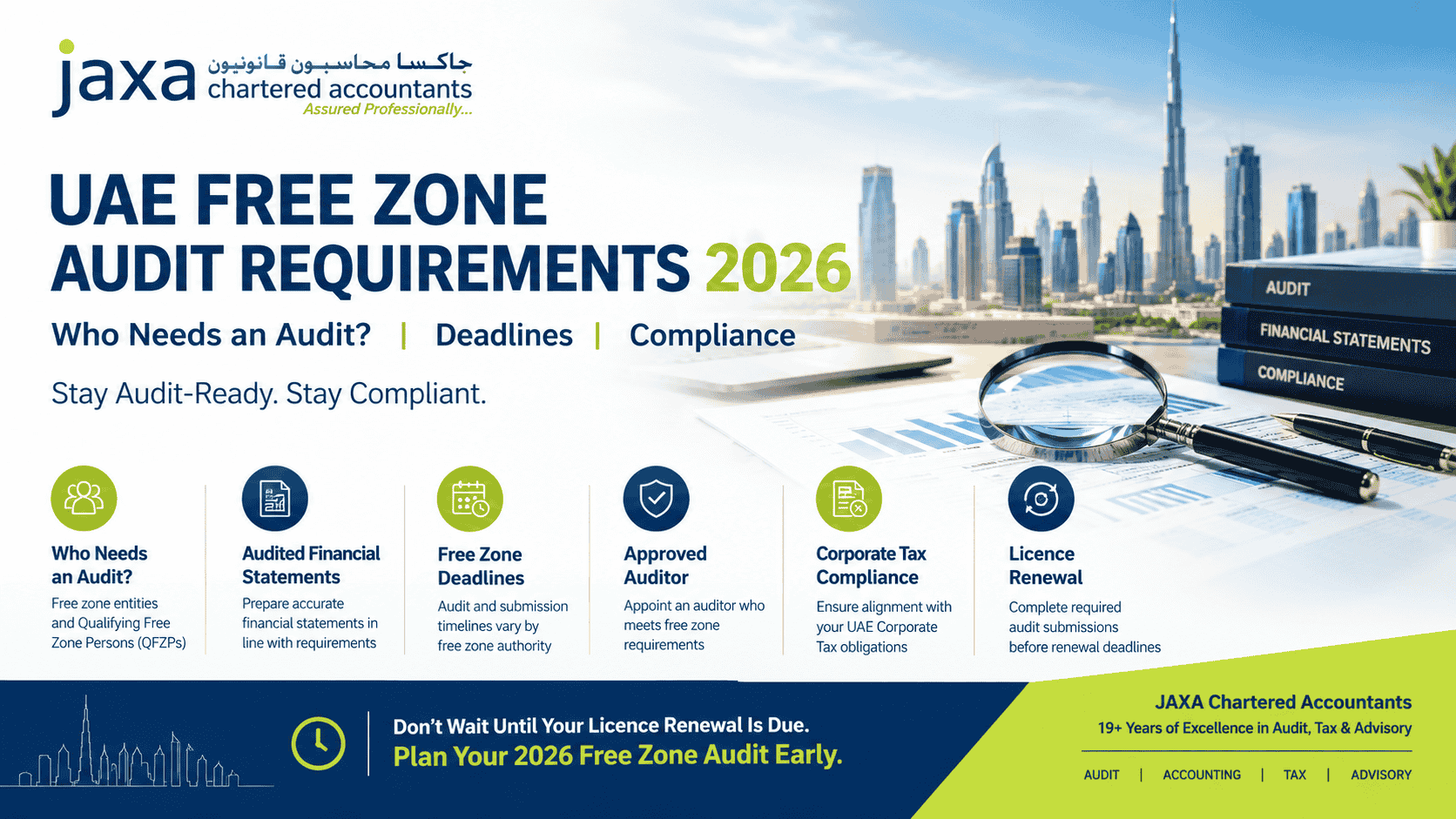

Free zone audit compliance in the UAE is an important part of UAE corporate tax compliance for businesses claiming Qualifying Free Zone Person(QFZP). Under the current UAE corporate tax framework, QFZPs are required to prepare and maintain audited financial statements regardless of whether their revenue is below the AED 50 million threshold or not.
For businesses operating in 2025 and 2026 tax periods, understanding the applicable UAE Free Zone audit requirements, financial reporting obligations, and corporate tax filing deadline is essential.
In this guide, our auditors in Dubai explain the key audit requirements for free zone companies in the UAE in 2026, including who can conduct the audit, what financial records are required, and what records may be required, how the audit process works, and how the audit fits into the UAE Free Zone Audit Requirements 2026: Who Needs an Audit, Deadline and Compliance
Free zone audit compliance in the UAE is no longer just an annual financial exercise. In 2026, businesses need to align their financial statements, corporate tax position, accounting records, and free zone compliance requirements. For businesses operating in UAE free zones, audit compliance is a key part of the 2026 UAE Corporate tax landscape.
Is your UAE free zone company claiming QFZP status? Your financial statements may need to be audited. Qualifying Free Zone Person (QFZPs) are subject to preparing and maintaining audited financial statements for a relevant tax period.
In this guide, our auditors in Dubai explain the key audit requirements for free zone companies in the UAE in 2026, including who can conduct the audit, what financial records are required, and financial reporting obligations, documentation, and compliance deadlines.
Key points to cover
- QFZP should prepare for mandatory audit requirements applicable to the tax periods.
- The previous AED 50 million income threshold should not be relied upon when assessing current QFZP audit obligations
- Audited financial statements must be maintained, where required under the UAE Corporate tax rules for QFZPs
- Businesses completing their 2026 Corporate Tax compliance should review their 2025 financial reporting requirements.
- Early audit planning is essential to organize records, appoint a registered auditor in the Free Zone, and meet the applicable deadlines.
Who Qualifies as a Qualifying Free Zone Person (QFZP)?
Being registered in a UAE free zone does not automatically make a business a Qualifying Free Zone Person (QFZP). To obtain and maintain QFZP status, a free zone person must meet the conditions prescribed under the UAE Corporate Tax framework.
These requirements can cover qualifying income, adequate economic substance in the UAE, transfer pricing compliance, financial reporting, record-keeping, and meeting the applicable UAE Free Zone conditions.
Therefore, businesses should assess their activities and compliance position carefully before relying on the tax treatment available to QFZPs.
Key conditions for QFZP Status
A Free Zone Person must generally:
- Be a judicial person established or registered in a UAE Free Zone
- Maintain adequate economic substance in the UAE
- Derive Qualifying income
- Comply with applicable transfer pricing requirements
- Prepare and maintain audited financial statements, where required under the applicable QFZP rules.
- Meet the relevant de minimis requirements, where applicable
- Comply with other conditions prescribed under the UAE Corporate Tax regulations
Is a Free Zone License Enough to Qualify as a QFZP?
Not necessarily. A company registered in a UAE Free zone does not automatically qualify as a Qualifying Free Zone Person. To benefit from the applicable UAE Corporate Tax treatment for QFZPs, a free zone person must meet the specific conditions prescribed under UAE Corporate tax legislation.
This applies across UAE free zones, including DMCC, JAFZA, DIFC, Abu Dhabi Free Zone, and other free zones. Businesses should evaluate their qualifying activities, qualifying income, transfer pricing compliance, and financial reporting requirements before claiming QFZP status and the 0% corporate tax rate on Qualifying Income.
What to Look for in Audit Services for Free Zone in the UAE
Selecting the right audit firm for a UAE free zone company requires more than comparing professional fees. A qualified and experienced auditor in the UAE can help ensure that financial statements are properly prepared.
- Approval or Registration with the relevant Free zone: Some free zone authorities require companies to appoint an approved or registered auditor from their designated panel. Before engaging an audit firm in Dubai, check the specific requirements of your free zone and confirm that the auditor is eligible to conduct and submit the required audit report.
- Experience with UAE Corporate tax and QFZP requirements: Choose an auditor familiar with UAE corporate tax, QFZP requirements, qualifying income, transfer pricing, and related compliance obligations to ensure your financial statements are properly prepared.
- Timely audit completion: Start the audit process early to align with your financial-year end, free zone filing requirements, license renewal, and corporate tax deadline. This allows sufficient time to resolve any accounting or documentation issues.
- Clear and competitive pricing: Choose an audit firm in Dubai that provides transparent pricing with clearly defined services and deliverables,
- Strong accounting and Bookkeeping Support: Well-maintained accounts make the audit process more efficient. Jaxa Chartered Accountants is one of the leading accounting and bookkeeping firms in the UAE, providing professional bookkeeping, accounting, financial reporting, and audit support to businesses across the UAE.
- Free zone compliance expertise: Choose an audit firm that understands the specific compliance requirements of your free zone authority, including auditor approval, reporting formats, filing procedures, and deadlines. This helps ensure smooth compliance, timely submission, and non-compliance risk.
QFZP Audit requirement: what Businesses need to know
The deadline of the audit requirements is important for UAE free zone businesses. QFZP should ensure that their financial reporting and audit arrangements are aligned with applicable UAE Corporate Tax rules.
Applicable period:
- Tax period beginning on or after June 01, 2023: QFZPs are required to prepare and maintain audited financial statements.
- 2025 financial year: Businesses with a 2025 tax period should ensure that financial statements are audited as part of their 2026 tax compliance
- 2026 and onwards: The audited financial statements requirements continue for QFZP, subject to applicable UAE corporate tax regulations.
Do not wait until the end of the year to think about the audit. Start early, keep your records organized, and have your financial statements and supporting documents audit-ready to make the process simple and avoid last-minute compliance risk.
Connect with Jaxa Auditors, a UAE FTA tax agent now.
QFZP Audit and Tax Compliance Calendar
For QFZPs, staying ahead of the audit and Corporate tax calendar helps avoid last-minute compliance pressure.
| Key Date | Compliance Milestone |
| 31st December 2025 | End of the 2025 Tax Period for businesses with a calendar based financial year |
| September 30, 2026 | Corporate tax return and payment deadline for 2025 tax ending December 31, 2025. |
| December 31, 2026 | End of the 2026 tax period with a calendar based financial year
|
| September 30, 2027 | Corporate tax return and payment deadline for a 2026 tax period ending December 31, 2026 |
Plan Ahead: QFZPs should ensure that their audited financial statements, accounting records, and supporting documentation are prepared and maintained in accordance with the applicable UAE corporate tax requirements before completing their tax compliance process.
Note: For a tax period ending on December 31, the UAE corporate tax return and payment are due by September 30 of the following year. Businesses with different tax periods should calculate their deadline based on the applicable 9-month filing period.
Documents required for a UAE Free Zone Audit
Preparing the rjaxaauditors.com/the-uae-corporate-tax-return-filingight documentation is an important part of a smooth UAE free zone company audits. Auditors review financial records and supporting evidence to assess whether the financial statements are properly prepared and supported by appropriate documentation.
Depending on the business structure, transactions, and applicable requirements, your auditor may request:
- Bank statements
- Sales invoices, receipts, contracts and sales ledger
- Purchase and Expense records
- Payroll records
- Fixed Asset record
- VAT returns filing, tax invoices, input VAT records
- Corporate records
- Year-end records
Prepare Early for a smoother Audit
Keeping your accounting and bookkeeping records accurate and organized may help minimize audit queries and avoid unnecessary delays. Businesses should reconcile bank accounts, receivables, payables, and tax records before the audit begins and ensure that supporting documents are readily available.
For free zone entities in the UAE, it is important to consider additional documentation or reporting requirements prescribed by the relevant free zone authority.
UAE Free Zone Audit process: Step-by-Step Guide for QFZPs
For Qualifying Free Zone Person (QFZP), maintaining audited financial statements is a crucial part of a UAE Corporate tax compliance. The smooth free zone company audit starts with reviewing accounting records, verifying financial transactions, and appointment of a qualified auditor in Dubai to review and finalize the financial statements.
The process includes:
- Step 1: Hire the right auditor: Choose a suitably qualified and licensed audit firm and ensure the auditor is approved by the relevant free zone authority. Jaxa Auditors is a Free Zone Auditors in the UAE with 19+ years of experience helping free zone businesses in preparing financial reporting and compliance requirements.
When choosing an auditor in the UAE, consider:
- Experience with UAE free zone companies
- Knowledge of UAE Corporate tax and QFZP requirements
- Approval or registration requirements of the relevant free zone
- Experience with businesses similar to yours
- Ability to complete the auditing engagement within your required timeline.
Step 2: Prepare accounting records: Ensure your records are complete, reconciled, and supported before the audit begins. Having organized records ready can help reduce audit queries and avoid unnecessary delays
Step 3: Auditor conducts the Audit: The auditor reviews financial records, tests selected transactions and balances, and verifies supporting documents to assess whether the financial statements are fairly presented. The auditor may request additional information or clarification from the management.
Step 4: Finalize the UAE Free Zone financial statements: After completing the audit, the financial statements are finalized in accordance with the applicable financial reporting requirements. The financial statements may include the statement of financial position, Profit or Loss, cash flow, and the independent auditor’s report.
For QFZPs, maintaining audited financial statements is a key part of UAE Corporate tax compliance.
Step 5: Submit your financial statement for corporate tax filings: After finalizing the audit, the business can use the audited financial statements to prepare and submit its UAE Corporate tax return within the applicable deadline through UAE FTA’s Emaratax portal.
Businesses should ensure that
- Audited financial statements are finalized, where an audit is required
- Accounting records and tax adjustments are properly documented
- The corporate tax return is accurately prepared
- The corporate tax return is submitted within the applicable deadline.
UAE Corporate tax filing deadline: The return is generally due within 9 months after the end of the relevant tax period.
For a December year-end:
- 2025 year-end- September 30, 2026
- 2026 year-end- September 30, 2027
Prepare Early: Well-maintained financial records help streamline the audit process, reduce audit delays, and support smooth corporate tax filing.
2026 Free Zone Audit Compliance Checklist
Businesses should follow these steps to meet UAE Free Zone audit requirements 2026 and maintain proper QFZP compliance.
Before the Audit
- Confirm your QFZP status and Free zone audit requirements
- Check your financial year-end and corporate tax filing deadline
- Appoint an experienced free zone company auditor in the UAE
- Organize accounting records and supporting documents
During the Audit
- Reconcile bank accounts and accounting records
- Prepare the trial balance and fixed asset schedule
- Compile invoices, contracts, VAT, and payroll records
- Respond to audit queries and address required adjustments
Before filings
- Finalize the financial statements and audit report, where required.
- Review your UAE corporate tax compliance position
- Check your UAE free zone corporate tax treatment
- Submit the corporate tax return through Emaratax
- Maintain all supporting records
Ongoing Compliance
- Keep accounting records updated
- Monitor QFZP compliance requirements
- Track tax and audit deadlines
- Address recommendations from the audit
- Prepare early for the next UAE Free Zone audit
Get Help from Jaxa Auditors. A UAE FTA tax agent
Effective audit planning is key for UAE Free Zone businesses to meet their 2026 compliance obligations and maintain proper financial reporting and QFZP eligibility with greater confidence. Whether your entity operates in DMCC, IFZA, JAFZA, DAFZA, RAKES, or other UAE Free Zone, timely audit preparation can reduce compliance risks and avoid last-minute compliance risks.
Jaxa Chartered Accountants provides free zone audit services for businesses operating across major UAE Free zone, subject to the applicable auditor approval or registration requirements of each Free Zone authority.
Looking for reliable Free Zone audit services in the UAE? Jaxa Chartered Accountants is a UAE FTA- approved tax agent with 19+ years of excellence in offering professional audit, accounting, VAT, and corporate tax services.
Jaxa Chartered Accountants is an approved Free Zone auditor for major UAE Free Zones, including
- Registered auditor in DMCC
- Registered auditor in Meydan
- Registered auditor in IFZA
- Registered auditor in JAFZA
- Registered auditor in DIFC
- Registered auditor in RAKEZ
- Registered auditor in DAFZA
- Registered auditor in DWC
- Registered auditor in SAIF Zone
Partner with Jaxa Auditors, an experienced Free Zone auditor in the UAE, to manage your financial statement preparation, audit, and corporate tax compliance requirements without hassle.
Get expert assistance to manage your free zone audit requirements, QFZP compliance, and corporate tax obligations accurately and on time.
Stay audit-ready with Jaxa Auditors. Choose Jaxa for Free Zone audit and corporate tax services from a UAE FTA tax agent.

 Reach us on WhatsApp